



Roy's Blog: Customer Service
April 1, 2021
Why goosebumps should tell you the best one to hire

Source: Pexels
Why goosebumps should tell you the best one to hire.
A key element of the business plan that many organizations use to separate themselves from their competition is to create memorable experiences for their customers.
To blow ‘em away and leave them breathless with how they’ve been treated.
The problem is, however, is that these same organizations haven’t figured out precisely how to do it. They’re excellent at declaring the aspiration but fall short when it comes to delivering on their intent.
And as a result their customer service intent is no more than a helium-filled shallow promise with no evidence to back it up and their performance is unaffected.
Typically memorable experiences are created by people, notwithstanding the relatively unsuccessful attempts - in my view - that many organizations make using technology to do it.
Hire the right person
The most important and basic way of achieving this objective is to recruit people who ‘love’ human beings. People that have the instinctive desire to serve their fellow homo-sapiens. To take care of them. To satisfy them regardless of what they want.
Hire the right person into a service position if you want to dazzle the customer or leave them breathless from the service experience they’ve had with you.
I’m not impressed with the quality of some people recruited into customer service positions because many of them are incapable of delivering even a mediocre service experience.
Why? Well, many of them have been placed in the position because of their seniority in the company, or because they are looking for a career move and they want to try customer service.
And as a result, these people find that they really don’t ‘like customers’ with all the complications they bring and they would really rather be doing something that didn’t involve interacting with other humans (and the customer who engages with this person suffers).
How does this happen? How does an individual who would rather be writing code, taking inventory or preparing financial statements ever get a job in customer service?
The decision making process to select people for service jobs is imprecise and severely flawed and in too many instances unqualified and unwilling people are let loose with your most precious asset — your customer.
So how do you fix the problem? How does an organization ensure they are hiring individuals who are not only capable of delivering mind-blowing service, but also look forward to doing it with every fabric of their body?
Can you train someone to like a human?
Many would say that you can train people to do it; certainly that’s what many human resource managers generally believe — why else would they use seniority as a criteria to place people in customer service?
The fact is, however, despite all the good intentions of cross-training, you simply can’t train someone to like someone else.
You can give them ‘how to have a smile in your voice’ training and teach them how to grin at others and use other tools intended to deal with customer better, but you can’t train a person to bring all the honest emotional energy to the table that is required to create a memorable experience for another person.
People who love people are born to do it, and so the challenge is to discover them and embrace them in your organization as they truly are the custodians of the loyalty moment when a customer decides to continue doing business with you (and to tell others how great your organization is) or to leave for another service provider.
So how do you spot these people who naturally care for — ‘love’ — other humans?
You have to start with the usual task of filtering through the profiles of potential candidates, looking for content that relates to serving customers as opposed to merely stressing academic achievements or other hard accomplishments.
Most people avoid what they believe is the soft stuff as it relates to their background, but for the delivery of remarkable service, the soft stuff is absolutely essential.
And check their references to see if others commented on the candidate’s capability to effectively deal with others with care and affection.

Source: Pexels
The interview
But the critical element of the hiring process is the personal interview and I discovered an effective tool to separate the individuals who could really create magical experiences for others from those that talked a good game but who didn’t have the attitude or inclination to do it.
Ask two simple questions
Here’s a rather simple but so effective way of separating the human being lovers from the ‘fish’ who may have been through some type of customer service training program.
▪️ First, ask the prospective employee “Do you love human beings?”.
They will realize that this is a bit of a trick question but will not know where you are going with it. It’s a fun question to ask as the interviewer to say the least.
Most people will say ‘yes’ in varying ways, ranging from the declaration ‘absolutely’ to the positive inference ‘sure’ and the questioning ‘of course’.
However, to satisfy the real intent of the question, you need to dig deeper.
▪️As a follow up question, pose this: “Tell me a story that will show me that you love and care about your fellow humans”.
The responses you get from this question will define two types of candidates: one, ‘The Intellectualizer’’ and two, ‘The People Lover’.
The Intellectualizer has figured out what you are up to with the question and conjures up a story with their mind that leaves you cold.
Their answer draws on logic — what they believe you expect to hear from them — and therefore it’s dispassionate to the point of being superficial and phoney.
Those that don’t have the innate desire to move people emotionally with their answer should be ushered out of the interview.
The natural-born People Lover, on the other hand, thrills you with a story that leaves you warm all over.
Their story paints a vivid picture of someone who cares about other people and who is creative at finding ways to deliver unforgettable memories for them.
This was the question that separated the people who really got what it took to serve others from those who had only a theoretical understanding of what it too to be a caregiver.
Do you feel the goosebumps
Those that were born to serve leave you with goosebumps while they tell their story. Their story is rich with detail and the threads that bind it together were all about the importance of connecting with people on the emotional level. And their authenticity pours out with every word.
These individuals were the real deal. I hired them with minor interest in their other qualifications. And they always did me proud the way they dealt with our customers.
And many eventually found their way into higher level positions in the customer service organization to provide the leadership necessary to sustain this strategy that was extremely effective is gaining and maintaining a competitive advantage for our organization.
So if you really want to achieve a service strategy based on remarkable and memorable experiences, hire the People Lover who will leave you with goosebumps.
Cheers,
Roy
Check out my BE DiFFERENT or be dead Book Series
- Posted 4.1.21 at 04:39 am by Roy Osing
- Permalink
February 5, 2021
3 simple ways to give the most brilliant customer service

Source: Pexels
3 simple ways to give the most brilliant customer service.
If you want your customer service to excel, here are 3 essentials.
Essential #1 - set your strategic context to serve customers rather than ‘service’ them.
To provide brilliant customer service, your business plan must give it the priority.
We ’service’ cars and computers but we serve people. The notion of being ‘serviced’ is quite frankly repugnant to me.
Servicing people focuses on inflicting the rules and processes of the organization on the customer. Some analyst in the organization decides that the most efficient way to fulfill a customer’s request and control cost is to do it a certain way. Whether the customer wants to participate in the process is irrelevant.
Serving, on the other hand, requires that systems, rules and procedures are designed to satisfy the service experience expected by the customer.
It may be more cost efficient to outsource your call centre to some distant place in the world where english is not the mother tongue, but if a conversation with one of these reps infuriates your customer, what have you gained?
Too many organizations take this inside-out view of customer service where the needs of the organization are pushed on people.
What is needed is an outside-in perspective where the customer drives how they are served.
Essential #2 - deliver your core service flawlessly 24X7. Core service is the essence of your business; what people get from you. WiFi that works, good food, clean hotel rooms and planes that take-off and land every time are examples of core service.
If you deliver your core service consistently as promised customers will rate you average because they expect your core service to work as promised. On the other hand, failure to deliver satisfactory core service will earn you a fail and your brand suffers as the stories of your shortcomings spread far and wide.
Essential #3 - create dazzling service experiences around your core service. This is the WOW! that surprises people; giving them what they DON’T expect.
Dazzling experiences drive customer loyalty but only if your core service is delivered flawlessly
How to dazzle?
▪️Recruit people that “love” fellow humans and possess the innate ability to serve them.
▪️Create rules, procedures and systems that enable friendly and user friendly transactions.
▪️Turn OOPS! into WOW! by recovering from mistakes and service blunders in a way that surprises and delights the customer.
Don’t expect results over night; serving people in a stand-out manner is a journey.
But start it. Now!
Cheers,
Roy
Check out my BE DiFFERENT or be dead Book Series
- Posted 2.5.21 at 06:40 am by Roy Osing
- Permalink
January 1, 2021
Why does business survival depend on being irresistible and different?
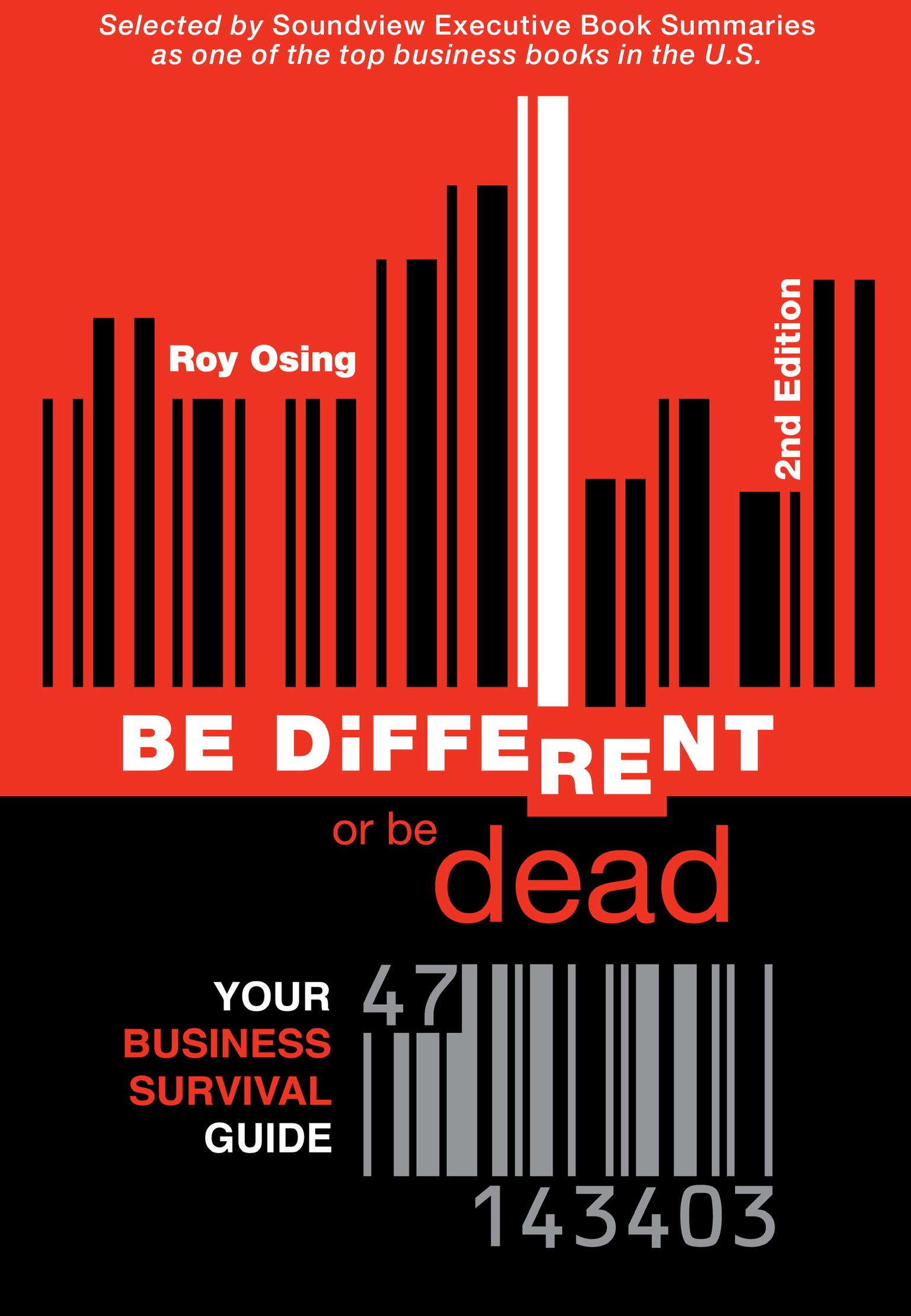
Why does business survival depend on being irresistible and different?
Never has it been more important for your business to be distinctive—to be different—in the marketplace than it is today.
Consumers are spending fewer discretionary dollars. Competition is intense as businesses jockey for the winning formula to attract customers, remain profitable and survive in this challenging environment. Those that don’t face this reality slowly wither and eventually fail.
In BE DiFFERENT or be dead: Your Business Survival Guide, I show you how businesses can navigate the turbulent waters of the contemporary economy.
Drawing on what I learned and successfully implemented over my career as an executive leader, and entrepreneur in the telecommunications industry, and as a business consultant, I give you the real deal: performance enhancement and survival ideas based on solid business principals that work in the real world.
I focus on strategies that I personally developed and executed: things you can do today to immunize your organization against performance decline and business failure tomorrow.
Practical and proven.
For business strategy executives, marketing and sales executives, customer service executives and business owners and entrepreneurs alike, BE DiFFERENT or be dead is an invaluable resource for any leader looking to create a competitive edge for their organization and build long term success.
Key concepts
Here are only a few of the groundbreaking and unheard-of topics in my book you won’t find anywhere else:
— Cut the CRAP.
— Never chase Yummy Incoming.
— Plan on the run.
— Execute first, plan second.
— Get your business plan just about right.
— Customer share: the new marketing measure of success.
— Serving customers: the NEW customer service.
— The customer experience roadmap.
— Service Recovery = Fix the mistake + Surprise the customer with what they don’t expect.
— NEW Sales Mantra: LOSE THE SALE!
— Benchmarking sucks.
— Craft The ONLY statement for competitive differentiation.
— Product flogging is disgusting.
— ME! NOW! marketing is replacing mainstream marketing.
What some of my readers say…
“I had trouble putting this book down. In these challenging times this is exactly what business leaders need to weather the storm. BE DiFFERENT or be dead by Roy Osing is bang on for sales people, marketing executives, entrepreneurs and owner operators. Learn from Roy…I did!”
— Dr. Peter Legge, OBC, LL.D (HON), CEO/Chairman/Publisher Canada Wide Media Limited
“The business book market is awash in ‘how to’ manuals on a myriad of topics. Some are better than others, most simply a recapitulation of material that is all too familiar. Most make grandiose promises but few deliver. Few are truly different. This book is.”
— Brian Canfield, Director and Chairman of the Board, TELUS Corp
“BE DiFFERENT or be dead is one of the top business books in the U.S.”
—Soundview Executive Book Summaries, Concordville, USA
For business strategy executives, marketing and sales executives, customer service executives and business owners and entrepreneurs alike, BE DiFFERENT or be dead: Your Business Survival Guide is an invaluable resource for any leader looking to create a competitive edge for their organization and build long term success.
BE DiFFERENT or be dead: Your Business Survival Guide is available here.
Cheers,
Roy
For all of my books, check out my BE DiFFERENT or be dead book series
- Posted 1.1.21 at 12:00 pm by Roy Osing
- Permalink
October 24, 2020
Breakthrough customer satisfaction lessons from COVID-19 business leaders
Breakthrough customer satisfaction lessons from COVID-19 business leaders.
Recent studies from Glassdoor and the Journal of the Academy of Marketing Science found in 2019 that there is a strong relationship between reported employee satisfaction and customer happiness. These findings are especially important when taken in the context of the Coronavirus pandemic.
Many companies pivoted to better support their customers in innovative and empathetic ways during this time, and the best also placed an emphasis on employee and community support as well.
By prioritizing their employees and the community, these companies were able to also achieve higher levels of customer satisfaction during a crisis.
Take a look at the visual from Chattermill below to learn about 10 companies that showed their commitment to good during this time.
— Heidi Thiel is a writer and content creator based in New York City. When she isn’t covering customer experience, AI and tech, and leadership articles, you can usually find her with her nose in a book or taking a walk through Central Park.


- Posted 10.24.20 at 05:00 am by Roy Osing
- Permalink