



Roy's Blog: Business Success
November 22, 2021
Why the frontline leader should be more important than the CEO

Source: Unsplash
Why the frontline leader should be more important than the CEO.
Results are delivered by your frontline.
Customer loyalty is controlled by your frontline.
Dazzling customer moments are orchestrated by your frontline.
First impressions are delivered by your frontline.
The imperfections in your business processes are masked by your frontline.
Lasting relationships depend on your frontline.
Frontline job satisfaction depends on the frontline leader not the CEO, not the Operations executive and not the EVP of Human Resources.
Therefore the frontline leader in any organization is of the utmost strategic importance and deserves a disproportionate priority by upper management.
Furthermore, these leader positions should demand a careful and rigorous recruitment process that ensures the most skilled and competent people are awarded custodianship of the frontline.
Does your organization:
▪️have insanely tough credentials for frontline leader positions?
▪️engage frontline employees themselves in team targeted interviews for this position?
▪️actively engage frontline people in selecting people to whom they will report in this position?
▪️have an incredibly detailed recruitment process for frontline leader roles?
▪️recognize this leader as a top notch role that requires support from the rest of the organization?
▪️fill these positions with accomplished servers as opposed to technical experts?
▪️honour a chosen frontline leader with wide-spread internal communication?
▪️include a frontline leader assignment in the career path plan for high potential employees?
▪️have ongoing recognition events to honour the best of these leaders?
Successful organizations recognize the frontline leader as their ‘guardians of strategy execution’ and give them the critical attention they deserve.
Do you?
Cheers,
Roy
Check out my BE DiFFERENT or be dead Book Series
‘Audacious’ is my latest…

- Posted 11.22.21 at 01:00 am by Roy Osing
- Permalink
November 1, 2021
6 effective barriers to prevent your customers from leaving you

Source: Pexels
6 effective barriers to prevent your customers from leaving you.
Why is there so much talk about the competition?
How to build a competitive strategy, tips for analyzing your competition, how to attain a cost leadership position against your competitors and how to out-sell your competitors pervade the thinking of most business people.
The underlying strategic intent is to build barriers to competitive entry; erect a massive wall to prevent the hordes from entering your markets and taking your customers.
You have little real control over what they do. If they want to launch a new product, reduce their prices, introduce a new disruptive technology or enter one of your markets to compete with you, they will. And (unless you intend to fight their actions on legal, regulatory or ant-competitive grounds), you will have no choice but to deal with the challenges their actions pose.
All you can do is try to anticipate their actions and go on the offensive, or respond to them defensively when they happen.
Rather than devote copious amounts of resources, time and energy to issues we have little control over, we should focus on what we have SOME degree of control over.
Rather than build barriers to competitive entry, we should be concentrating on building barriers to customer exit.
This you DO have a degree of control over; you stand a better chance of creating the outcome you want than basing your actions on what your competition does.
Spend your time making it extremely difficult for your customers to leave given a choice they might be offered by a competitor.
Barrier to exit profile
What do barriers to customer exit look like?
#1. Relationships
The emphasis is on building relationships and creating personalized experiences for customers as opposed to pushing products and services at them with a one size fits all mentality.
What customers personally need is given priority over what the common needs of the broader mass market appear to be.
In addition, attention shifts to concentrate more on how people feel when they are engaged with the organization and not solely on the right product or service fit.
#2. Chat
Every manager and executive ‘makes the call’—yes, a phone call!—to customers on a frequent basis to ensure they are being served with relevant and compelling solutions.
It’s an opportunity for the organization to get critiqued on their performance as well as receive suggestions for improvement.
The bottom line is the customer feels valued and respected and are less likely to be enamoured and attracted by a competitor’s value proposition.
#3. Deals
Special offers and price promotions are proactively offered to loyal customers; they are not used solely as a tool to attract new customers as is more often the case in most organizations.
The marketing and sales roles are to be proactive with the customer and present these opportunities before that are made available to the broader base.
People are more loyal when they feel that they are special; getting the deal first will go a long way to shutting the ‘bad guys’ out.
#4. Retention
Customer retention outranks new customer acquisition in terms of priority; the key success factor on the organization’s balanced scorecard is the rate of customer attrition.
It’s always incredibly satisfying to attract a new customer especially when it’s the result of a win from a competitor.
Teams love winning a competitive battle; it’s what makes their juices flow.
The issue is, however, that making your organization irresistible so that customers don’t want to leave can’t be done effectively when there is a strong push to get new customers.
The priority must be on retaining the existing customer base and trust that they will refer you and spread your word to others who will come over to your side — your loyal customers will drive new customers to you.
#5. Policies
The policy system of the organization is built to serve customers not control them. Dumb rules are eliminated in favour of those that facilitate customer engagement.
No one is likely to stay loyal to an organization that is difficult to business with; internal rules that put customers through hoops and policies that make no sense other than to control what customers do as opposed to enable them to get their needs and wants satisfied.
Every employee in an organization has a critical role to be an advocate for the customer and find and fix the internal roadblocks—rules and policies—that annoy customers and make the engagement experience negative for the customer.
And given the inertia that presides in most organizations, to make meaningful change that favours the customer, everyone must take on an advocate role to fight their internal bureaucracy and stand up for the rights of the customer.
#6. Screwups
A HUGE barrier—ironically—to customers leaving is what you do when a mistake has been made and the customer has been screwed over.
Most organizations spend all their time on how to prevent mistakes from occurring (and that’s ok) but few if any have a strategy in place to deal with the situation when prevention goes awry and a colossal blunder happens (and it will).
The fact of the matter is that service blunders that are handled right actually enhance customer loyalty because of the ’impress’ factor.
If an organization responds to a service OOPS! in a way that surprises the customer and dazzles them, they WILL be impressed and they WILL think of the organization in a more positive way (compared to the blunder never happening in the first place).
Impress = Fix the blunder fast + surprise the customer with what they DON’T expect.
Build a barrier to customers leaving by admitting you’ll commit a blunder from time to time and have a plan to recover in an astonishing way when you do.
Going to war with the competition and focusing relentlessly on them may get the adrenalin flowing, but it does so at the expense of your loyalists who have been committed to you in the past and who need you to continue to give them good reasons to stay.
Cheers,
Roy
Check out my BE DiFFERENT or be dead Book Series
‘Audacious’ is my latest…
- Posted 11.1.21 at 03:25 am by Roy Osing
- Permalink
October 18, 2021
Why a business plan for ‘cults’ can be an amazing success

Source: Pexels
Why a business plan for ‘cults’ can be an amazing success.
There are a plethora of opinions on how to build a business plan, and I have written numerous pieces on my unheard-of Strategic Game Plan process which is unique and cannot be found elsewhere.
In fact I’ve dedicated one of my books to the topic and explained why a planning methodology geared to execution is critical for any organization to consistently achieve a high level of performance.
A practical element of my business planning process is to carefully choose the customer segments you decide to target and serve.
The fascinating criteria I advocate is quite simple: choose those customer segments that have the latent potential to deliver your growth goal.
The choice you make is absolutely critical to the plan’s success.
If the wrong customer segment is chosen, the organization’s resources are wasted and its growth goals are not realized.
And if a mass market is the choice, the same end result happens.
In fact in this scenario, the organization’s marketing message and resources are spread thinly across the entire market hoping for enough ‘hits’ to justify the investments made.
Flogging a value proposition to everyone is not likely to be very successful as the range of appeal is too broad to generate sufficient market momentum to deliver required sales.
So what’s the solution? How does an organization choose the right customers to serve?
One approach that should be given much more attention involves exploring the opportunities presented by polarization: examining clusters of people who are clustered at the extreme right end of the bell curve around a particular value set.
For example, if the value set to be explored were ‘concern for the environment’, a polarized view might be the belief that carbon dioxide emissions will destroy the earth’s atmosphere in 24 months.
Polarized groups—cult movements—are not only unique and distinct from the crowd in some way, their differences are quantum and order of magnitude in nature rather than incrementally distinct.
They are groups of individuals who have an obsession with, fixation on, mania for, passion for, idolization of, and reverence for an idea, thing or cause, for example, such as:
— the environment
— black lives matter
— LGBTQ
— #MeToo
— anti- globalization
— feminism
— veganism
— indigenous rights
People in these segments choose to express themselves in a way that others don’t.
I’m not referring to extremist right wing religious cults, but rather groups of people who share a passionately held view around a particular cause or movement and who express their opinions within acceptable societal and legal limits.
These polarized clusters of people represent relatively narrow slices—slivers—in the market that can have demand characteristics worthy of study.
They may represent a significant source of economic opportunity for the business because their beliefs are precise, well defined and the cluster is growing in number as an expression of society’s changing views.
And, if the business can use ideologies and beliefs to attract cult interest and cult member passion to engage them, perhaps relationships can be established and sales made.
We should start thinking about finding ‘cults’—who have excessive admiration for a particular thing—that express desires and cravings at the poles of the demand curve.
ME! segments are different from the mass crowd; cults are REALLY different.
The challenge, of course, is to find a cult or two whose members represent good potential for you to chase.
Here are five steps you can take to see if a cult has a future in your business plan.
#1. Keep your eyes open for trends
Cults typically follow social trends, so stay alert to the issues of the day because they could lead to the formation of a cult.
For example, there are many climate change cults—The Extinction Rebellion is one—that have been formed over the past few years which could represent a growth opportunity for some businesses because, for example, the cult is growing in membership and you have a solution that would easily allow them to collaborate among themselves very easily.
As a way of getting traction on this activity, assign someone to a cult follower role to identify, track and evaluate them as they are discovered and evolve.
#2. Talk to existing cult leaders
This is a good way to not only get a better understanding of cult values, but also to get insights on what the profile of the cult member looks like.
Even if a particular cult isn’t on your radar, it’s worthwhile engaging with a leader to deepen your understanding of cult dynamics which will provide ideas on how to engage with its members and form relationships with them.
#3. Check traditional and social media
Media headlines are a good source to explore which movements are currently attracting the most attention and therefore might be an attractive target for your organization.
And check out the nature of the conversation on social media to get a feel for the main themes of the conversation—the ‘triggers’—which would provide a window on not only what’s important to the cult members, but also whether your organization would even want to be associated with their cause.
This information is critical in terms of what it might take to successfully market your products, services and solutions to them.
#4. Pick a cult that seems to be a fit for you and give it a try
First of all, you’ll never know if a cult target will work for you until you give it a go.
I don’t think many (if any) organizations actually study cults to determine if they possess any potential so you would be breaking new ground here.
If trailblazing appeals to you, experimenting around the cult phenom is for you.
There are, however, a few considerations that you might use in selecting a high potential cult to chase:
— what does your current business plan say in terms of the customers you’re looking for? Is there some similarity between your current marketing efforts and the potential cult you could target?
— do a bit of back-of-the-envelope calculating in terms of the sales potential. Is there a good growth prospect if things work out for this cult?
— what are the possibilities of partnering with the cult to explore longer term mutual benefits?
— how divergent are the cult’s values from any element of yours? Although improbable, it might just be possible to find a hint of commonality with what the cult stands for and what your organization values. Any common denominator could help to define a workable marketing platform.
#5. Use experience and results to attract another
If your experiment works out, you may want to use it to attract the interest of other cults; you might be The ONLY organization that looks to social movements for joint opportunities.
So, track the results of your ’cult try’ in detail so you can use them in negotiating other arrangements if and when the time comes.
Social movements house untapped opportunities to grow your business and gain a competitive advantage as others are unlikely to pursue a similar strategy.
Exploiting customer groups at the edges of the demand curve—beyond ME!—can be risky, but can also be rewarding.
BE DiFFERENT.
You’ll never know until you give it a try.
Cheers,
Roy
Check out my BE DiFFERENT or be dead Book Series
‘Audacious’ is my latest…
- Posted 10.18.21 at 05:17 am by Roy Osing
- Permalink
September 27, 2021
20 really simple human traits of an amazing leader

Source: Pexels
20 really simple human traits of an amazing leader.
A brilliant leader is made of simple stuff really; here are some of the things they do to make them unmatchable among others.
They:
1. Create discontinuity in their organization to expose opportunities for competitive advantage and growth.
2. Make getting employee input their #1 priority everyday.
3. Are intolerant of being the same as others in the marketplace.
4. Are at ease with uncertainty; they see it as a major source of innovation.
5. Inspire people to get out of their comfort zone and make mistakes.
6. Learn voraciously and contunuously.
7. Practice the art of ‘constructive emulation’ — building on someone else’s idea to make it even better.
8. Are not incremental thinkers; they are always looking for breakthrough change.
9. Are rarely charismatic; their appeal to others comes from their honesty and integrity.
10. Are customer addicts and model this behavior to the rest of the organization.
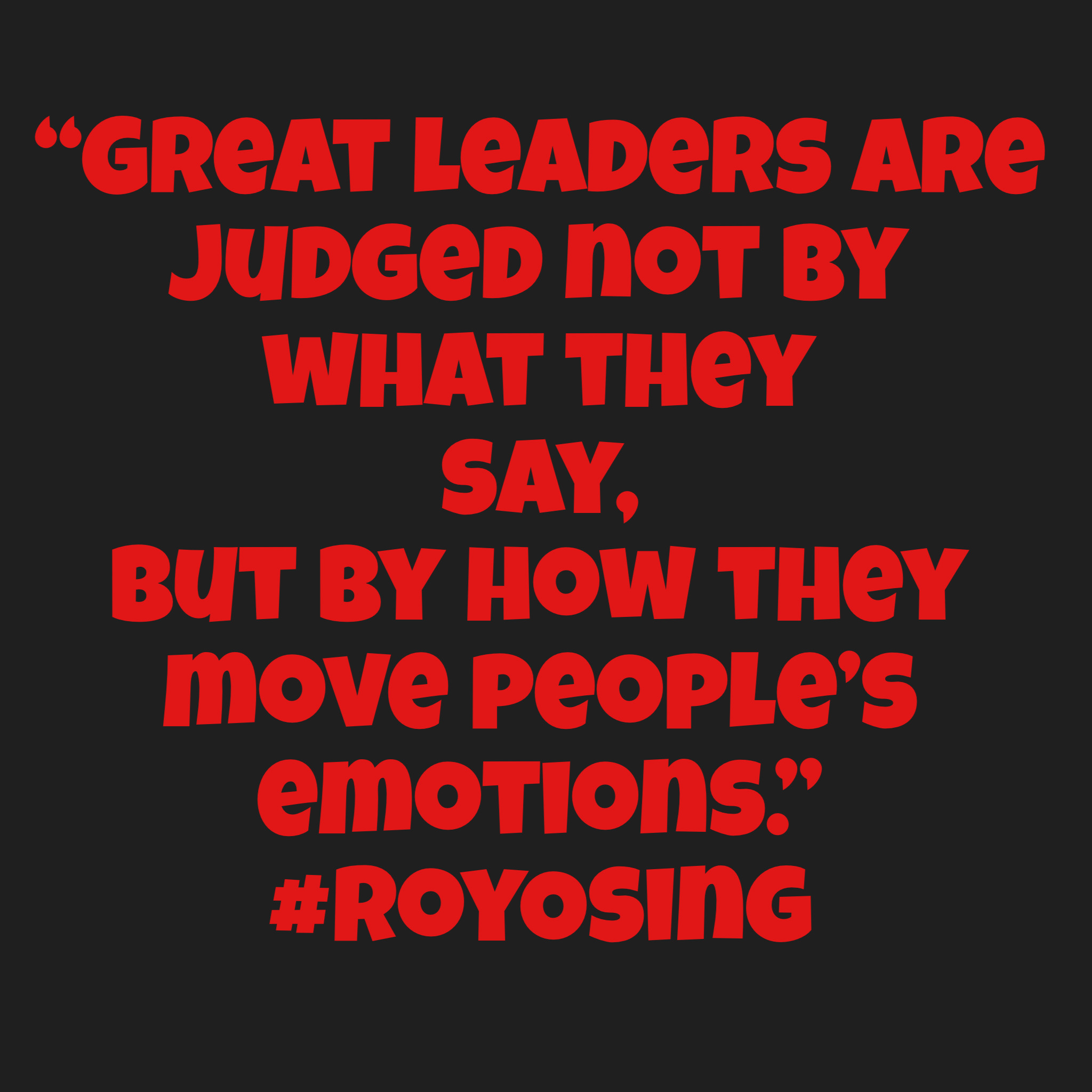
11. Serve people not command them to action.
12. Are consummate story-tellers, breathing life into the organization’s strategy by providing examples of successful execution.
13. ‘Bash barriers’ and remove obstacles to progress on the inside to make it easier for people to get their job done.
14. Constantly and passionately communicate the organization’s vision and strategy to capture the hearts as well as the minds of people.
15. Ask “How can I help?” rather than order people to ‘do this’!
16. Give hope to people in times of chaotic change.
17. Are obsessed with making tries as the route to innovation and creativity.
18. Are mindless about executing the business plan of the organization.
19. Make decisions with incomplete and imperfect information.
20. Are good at anticipating future trends and events, but are great at responding to the random and the unexpected.
If you can check-off all twenty, consider yourself an amazingly brilliant stand-out leader.
If you can honestly say that you exhibit half of these leadership dimensions you are well ahead of 99% of other leaders in business.
Well done and now focus your work on the remaining 50%.
Cheers,
Roy
Check out my BE DiFFERENT or be dead Book Series
- Posted 9.27.21 at 06:15 am by Roy Osing
- Permalink