


Roy's Blog: Entrepreneurs
January 1, 2021
Why does business survival depend on being irresistible and different?
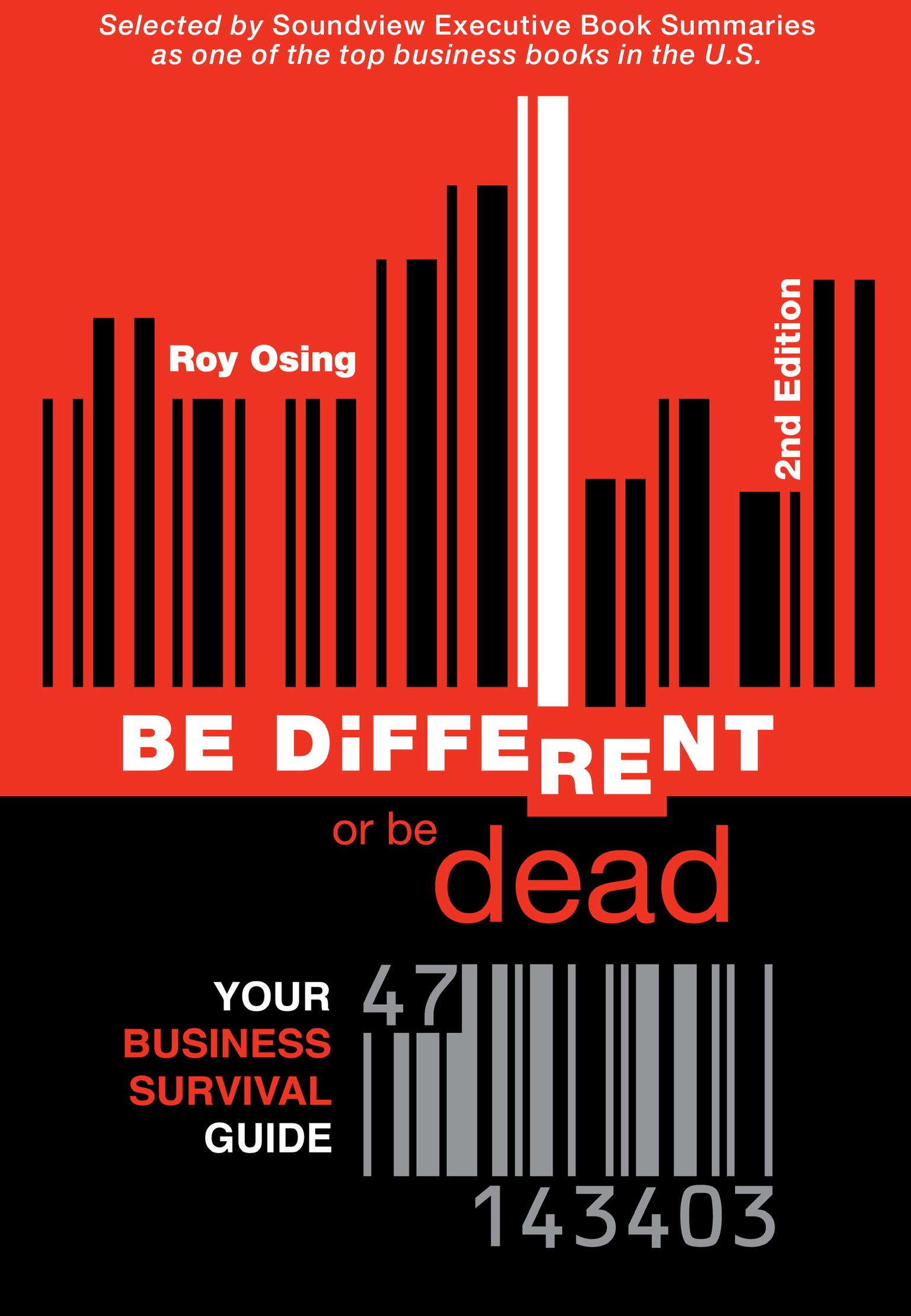
Why does business survival depend on being irresistible and different?
Never has it been more important for your business to be distinctive—to be different—in the marketplace than it is today.
Consumers are spending fewer discretionary dollars. Competition is intense as businesses jockey for the winning formula to attract customers, remain profitable and survive in this challenging environment. Those that don’t face this reality slowly wither and eventually fail.
In BE DiFFERENT or be dead: Your Business Survival Guide, I show you how businesses can navigate the turbulent waters of the contemporary economy.
Drawing on what I learned and successfully implemented over my career as an executive leader, and entrepreneur in the telecommunications industry, and as a business consultant, I give you the real deal: performance enhancement and survival ideas based on solid business principals that work in the real world.
I focus on strategies that I personally developed and executed: things you can do today to immunize your organization against performance decline and business failure tomorrow.
Practical and proven.
For business strategy executives, marketing and sales executives, customer service executives and business owners and entrepreneurs alike, BE DiFFERENT or be dead is an invaluable resource for any leader looking to create a competitive edge for their organization and build long term success.
Key concepts
Here are only a few of the groundbreaking and unheard-of topics in my book you won’t find anywhere else:
— Cut the CRAP.
— Never chase Yummy Incoming.
— Plan on the run.
— Execute first, plan second.
— Get your business plan just about right.
— Customer share: the new marketing measure of success.
— Serving customers: the NEW customer service.
— The customer experience roadmap.
— Service Recovery = Fix the mistake + Surprise the customer with what they don’t expect.
— NEW Sales Mantra: LOSE THE SALE!
— Benchmarking sucks.
— Craft The ONLY statement for competitive differentiation.
— Product flogging is disgusting.
— ME! NOW! marketing is replacing mainstream marketing.
What some of my readers say…
“I had trouble putting this book down. In these challenging times this is exactly what business leaders need to weather the storm. BE DiFFERENT or be dead by Roy Osing is bang on for sales people, marketing executives, entrepreneurs and owner operators. Learn from Roy…I did!”
— Dr. Peter Legge, OBC, LL.D (HON), CEO/Chairman/Publisher Canada Wide Media Limited
“The business book market is awash in ‘how to’ manuals on a myriad of topics. Some are better than others, most simply a recapitulation of material that is all too familiar. Most make grandiose promises but few deliver. Few are truly different. This book is.”
— Brian Canfield, Director and Chairman of the Board, TELUS Corp
“BE DiFFERENT or be dead is one of the top business books in the U.S.”
—Soundview Executive Book Summaries, Concordville, USA
For business strategy executives, marketing and sales executives, customer service executives and business owners and entrepreneurs alike, BE DiFFERENT or be dead: Your Business Survival Guide is an invaluable resource for any leader looking to create a competitive edge for their organization and build long term success.
BE DiFFERENT or be dead: Your Business Survival Guide is available here.
Cheers,
Roy
For all of my books, check out my BE DiFFERENT or be dead book series
- Posted 1.1.21 at 12:00 pm by Roy Osing
- Permalink
January 1, 2021
Great leaders spend their week doing these simple but important things
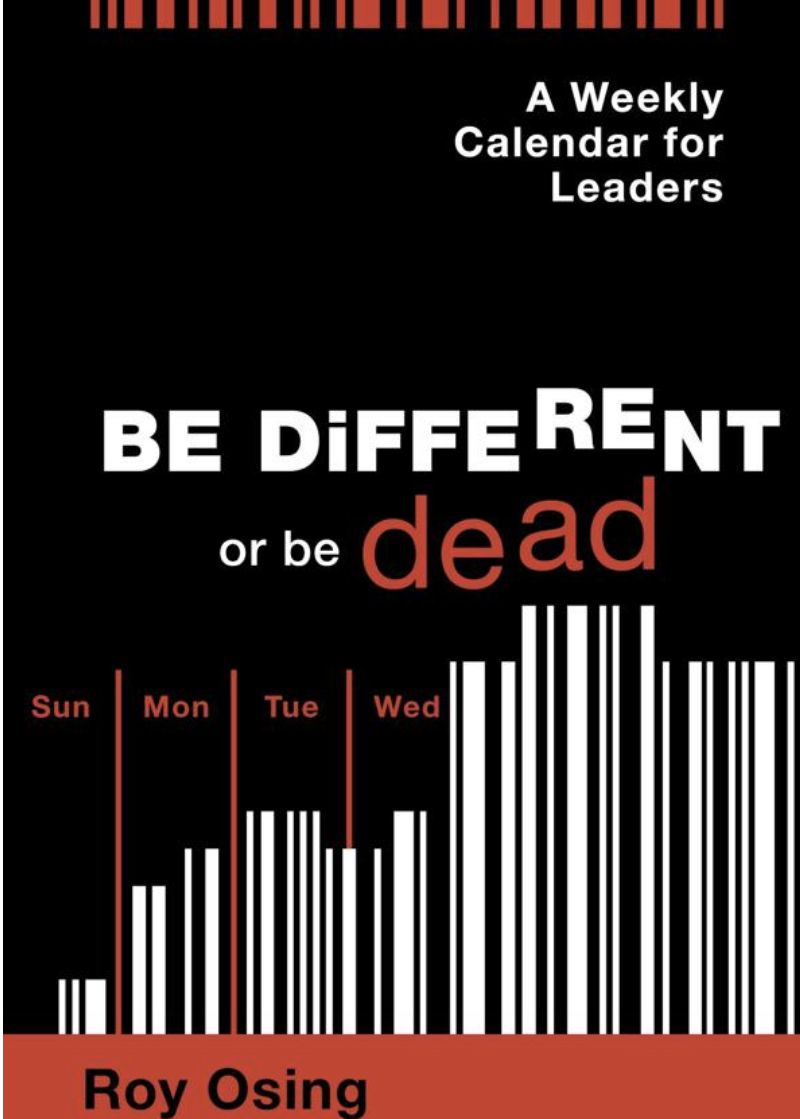
Great leaders spend their week doing these simple but important things.
Leaders require context for what they do and how they spend their time. A philosophy that guides their behavior and the things they treat as a priority.
Without context, leaders tend not to lead.
They flit.
They spend their time on the crisis of the day and chasing what their boss wants them to do.
The appropriate leadership context for today’s rapidly changing and unpredictable world should be all about serving people ‘on the inside’— employees—and people ‘on the outside’—customers.
You can’t plan your activities for the week without getting your thinking straight on which philosophy YOU believe in as a leader.
Do you want to control and direct people or do you want to serve and take care of them, believing that happy engages employees will deliver amazing results?
For some, subordinating oneself to another person is completely out of their comfort zone.
The issue is: which leadership philosophy better serves an organizational strategy today in a world where long term success and survival depends on the ability to stand out from the competitive herd?
Where execution separates the winners from the losers; where employee engagement determines if your game plan rocks or goes down in flames.
My money’s on serving.
If you decide to serve rather than control people, this unprecedented book is for you.
I will give you some simple, practical things you can do every day of the week to promulgate serving both within your organization where your warriors live, and on the outside where customers live.
Key concepts
Here are only a few of the powerful weekly tasks I share with you in my book:
— Get into a customer’s face constantly.
— Practice Leadership by Serving Around.
— Exercise your role as the organization’s strategy hawk.
— For God sakes, micromanage!
— Be nosy.
— Live with the frontline.
— Have regular bear pit sessions.
— Practise your speech style.
— Copy weird people.
— Treat unexpected events as emergencies.
— How to engage your people.
— DON’T be a great leader.
— Make sure employees understand their role in executing the organization’s business plan.
— Hire people when they give you goosebumps in an interview.
— Tell stories—lots of them—that describe success.
— Focus on DONE, not doing.
— Surprise others; don’t be predictable.
— Eat your own dog food.
— Nudge your strategy to success.
What some of my readers say…
“Leadership isn’t about titles, rules of thumb, processes and control. Rather, leadership is about being available – to listen, to guide, to create memorable experiences at every touch point. Be different – or be dead. Be ourselves – or not be ourselves. If we aren’t different, well, we might as well be gone. Thank you so much for writing this piece – a valuable guide for years to come.”—Elena Iacono, Communications Professional, Toronto Canada
“It’s crisp and easy to follow. Just 5 days of following this advice will make a whale of a DIFFERENCE! Well done!”—Nerio Vakil, President Total Business Solutions, Mumbai India
“Roy Osing is a leader focused on execution; this book will help you execute five key elements to make your company DiFFERENT. You will lead your team through helping them understand strategy and by removing obstacles. By executing Roy’s plan, you will have a challenging yet productive and insightful week ahead of you ”—Chris Hache, Host, Voices of Canadian Leadership Podcast, Halifax, Canada
“Love your “to the point” writing style; really sticks. And the key points are so valid particularly for younger leaders who think they have to control everything.”—Gerry Spitzner, Retail Pharmacy Expert, Vancouver Canada
“If you want to enhance your personal leadership style to transform your organization in a way that differentiates you in the marketplace, then I
would highly recommend you check out Roy Osing’s arsenal of leadership tools, and business enablement strategies. In his Weekly Calendar for
Leaders Roy outlines a week’s worth of simple, yet effective steps, and strategies that will help you create your own unique, servant leadership
style, and build a personalized, leadership blueprint for success.”—Gina Campbell, Senior Communications Manager, Soupcan Marketing, Vancouver Canada
A Weekly Calendar for Leaders is available at these retailers.
Cheers,
Roy
For all of my books, check out my BE DiFFERENT or be dead book series
- Posted 1.1.21 at 11:00 am by Roy Osing
- Permalink
January 1, 2021
How marketing can improve and survive in an unpredictable world
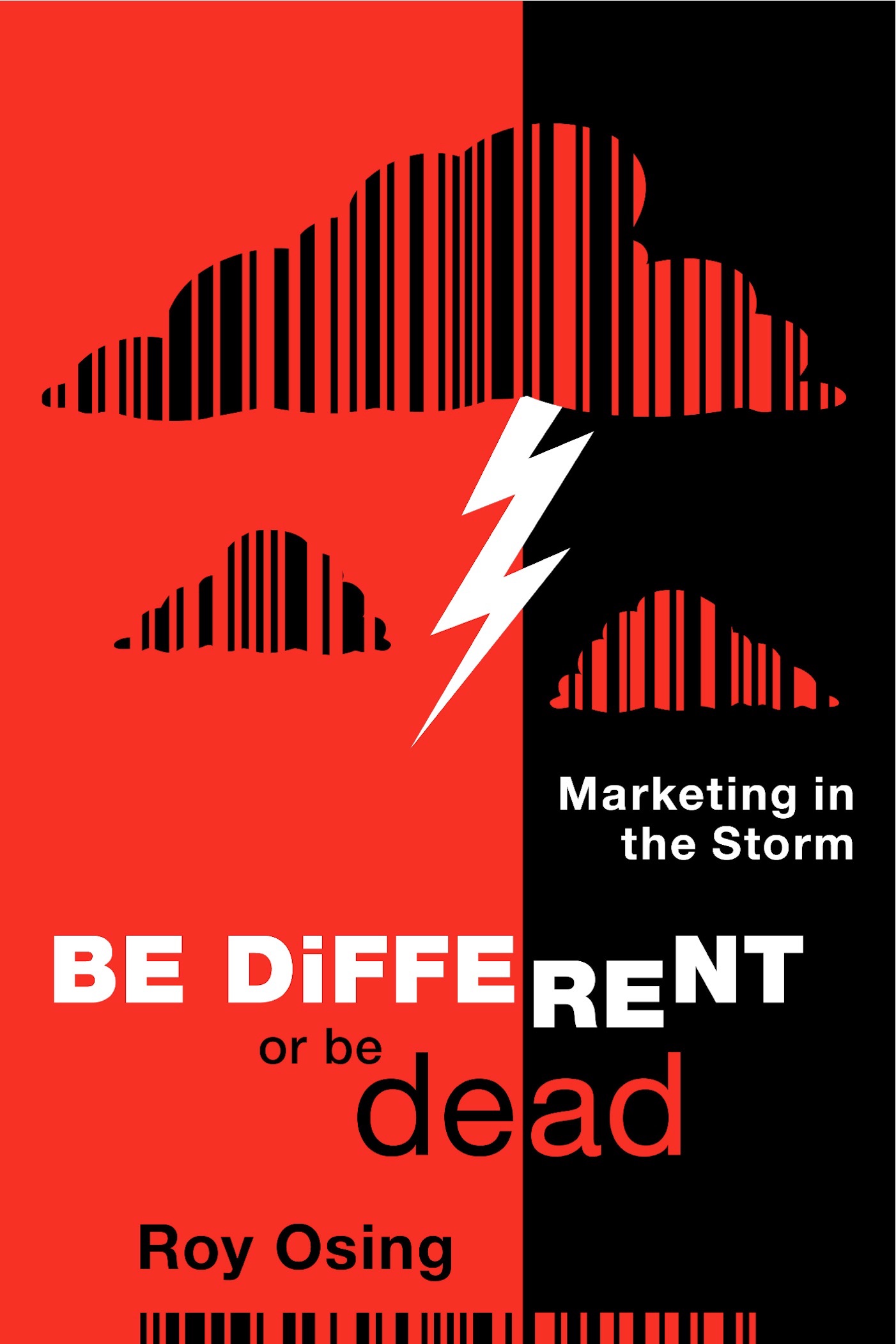
How marketing can improve and survive in an unpredictable world.
How can your marketing strategy survive the storm in today’s world? Marketing is in serious trouble! Its effectiveness is extremely limited.
If you are practising traditional text book marketing, this book is your wake-up call. You are subjecting your organization to enormous risk.
Why? The playground for organizations today is not what it used to be.
Today’s environment is NOT relatively stable, predictable, and slow changing, where a handful of competitors tussle for business.
It is NOT a marketplace where customers dutifully accept what organizations produce with little recourse if they object and are dissatisfied.
It’s anything but.
The Storm is today’s world: turbulent, chaotic, powerful, violent and life-threatening. Where a plethora of hungry and aggressive competitors fight to live or die; where people are connected, well informed and engaging.
Storm consumers wield their power and punish companies who don’t live up to their expectations; they change their minds in a heartbeat and move to greater value and a better deal.
The Storm denies traditional marketing which is risky in current market dynamics. Doing more of the same-old, same-old marketing practices in destroys value and kills businesses.
Companies need a completely fresh and different approach. One that is completely in synch with new world realities.
One that is a shocking change from where we are in marketing today as opposed to a more lethargic shift in thinking which really doesn’t result in much change at all.
Storm marketing throws out the old and creates the new. It asks “What does marketing have to look like to thrive on and survive The Storm”? not “How can present marketing practices be modified and adapted to changes in our operating environment?”
The Storm demands disruptive and audacious thinking.
In this book, discover a new platform for Storm marketing; the essential marketing competencies organizations must take on and consistently demonstrate if they are to weather the maelstrom.
Key concepts
Here are only a few unbelievable concepts in the book you won’t find elsewhere:
— Serve people; stop flogging products and services at them. Respond to their agenda not yours.
— Learn about individual people; stop studying mass markets because they don’t exist.
— Dig for what people crave; merely satisfying their needs won’t give you a differential competitive advantage.
— Create customer experiences to build customer loyalty.
— Be the ONLY organization that does what you do; better and best don’t describe a long term winner.
— Be a premium priced in the markets you serve. Add extra value to your offerings and charge premium prices. Competing on price is insane marketing.
— Shed the strategy of being a fast follower; you’ll still be a copycat.
— Build barriers to customer exit; don’t fuss with competitive entry.
— Target to earn 100% of each customer’s business. Corollary: measure share of customer more than share of market.
— Shun benchmarking; it is a the tool of sameness. Copying lowers the bar it doesn’t raise it. Corollary: benchmarking has no strategic value.
— Focus on your loyal customers to grow your business; leave new customer acquisition to the second rate players.
— Stop product bundling. It’s price discounting in disguise.
— Build a customer learning competency to be able to shift with customer change.
— Grow revenue fast-and-easy during chaos.
— if you say you’re customer focused, choose your words very carefully.
What some of my readers say…
“Roy nails it again! Marketing in the Storm discusses the unusual disturbance of the once normal conditions of the business atmosphere, manifesting itself by winds of unusual force or direction. Today’s business is often accompanied by a rebellious climate of uncertainty, new rules, procurement, trust and lack of client know how. He’s scary correct with his insights. Read it and maybe survive.”—Frank Palmer, CEO DDB Canada
“Osing shouts out a convincing argument for smart marketers to heed: Take the time to respect your customers’ uniqueness, or get tuned out.”—Lori Leavitt Evans, Serial Entrepreneur and President, Lori Leavitt Evans Consulting
“I just love Roy’s books. Short, crisp, relevant, focussed and hard-hitting. Marketing in the Storm is 45 pages of dynamite to help marketeers understand what is important for today’s customers and what keeps them coming for more. He is right….it is about “experiences”, not “products”.
This book is highly recommended not just for new marketeers but also seasoned ones who still play by yesterday’s rules. The quote from Nelson Jackson, ” I do not think you can do today’s job using yesterday’s methods and be in business tomorrow” is the essence of Roy’s book. Loved reading it.”—Nerio Vakil, President Total Business Solutions, Mumbai India
Check out Marketing in the Storm at retailers here.
Cheers,
Roy
For all of my books, check out my BE DiFFERENT or be dead book series
- Posted 1.1.21 at 08:00 am by Roy Osing
- Permalink
December 24, 2020
Why ‘ME’ marketing is now the best way to grow sales

Source: Unsplash
Why ‘ME’ marketing is now the best way to grow sales.
‘ME’ marketing will destroy traditional marketing; it’s all about the individual not the crowd.
Brilliant marketers get that ‘ME’ segments generate higher returns than market segments produced by traditional marketing.
The four bases of commonly prescribed market segmentation are demographics, psychographics, behavior and location (‘geographics’) and the marketing process is to develop programs targeted at potential customers with similar traits within a particular segment.
Segmentation studies are based on observations of population behavior; the characteristics of the masses (represented by the ‘average’ person in the population) determine the conclusions of the study.
Why are these four segments used as the prescription for marketing segmentation? Because this type of data on people is readily available to the marketer.
Census data provides demographic and location information, billing and web visitor tracking systems produce product usage information and standard market research studies ask for lifestyle preferences which people are generally ok with providing.
For a marketing program, individuals are ‘mapped’ into each of these segments and are assumed to be like everyone else in their segment in terms of their likelihood to be attracted to a particular marketing program targeted to the segment.
The marketer’s assumption is that each person in the segment ‘looks the same’ in terms of the segmentation variable chosen and because of this similarity will all exhibit the same buying propensity.

Source: Unsplash
I’ve always found this assumption to be a non-starter. Just because I’m a skier does not in any way suggest that other skiers would be interested in buying the same products as I do.
And just because I’m in the boomer demographic with a specific income in no way is a good predictor of what others with similar characteristics will be interested in buying.
In this approach, an ‘average’ target for a service might be ‘a male boomer with an annual income of between $60 - $100K who lives in Vancouver and who has an annual ski pass at Whistler’.
And the flaw is that there may actually be some people who do have the targets attributes and who would be interested in what is being offered, but there will also be many with these attributes who won’t be interested and who will not be interested in the offer.
Traditional segmentation produces hits and misses and the marketer hopes there are more of the former. But you can’t count on it.
There are two serious issues with traditional segmentation methodology; its underlying assumptions are flawed.
First, having segmentation variables prescribed with the simplifying assumption that people tend to make purchase decisions on the basis of their demographics and so on, is fallacious; people express their differences with their own buying triggers which can’t be prescribed up front.
And second, assuming that people who exhibit the same segment characteristics will make similar buying decisions is simply not true; there are many sub-clusters within any given segment that have their own buying motivations quite apart from those in the overall segment.
‘ME segmentation’ is different from the commonly-used methodology, and should be adopted by a marketing organization that wants to stand out and perform above their peers.
ME segmentation poses the research question to an individual person not the population.
ME segmentation is strategic
It is considered as a strategic exercise which asks the question “How should the market be segmented to expose as many opportunities as I can?” not how do I assign my customer base into the prescribed segments.
The prescribed segmentation variables such as demographics, location, usage and lifestyle are not automatically used; they are given mild attention only: the focus is on determining the appropriate variable that will unlock the growth key for the organization.
The objective is not to place people in the prescribed segments, but to discover the appropriate segmentation elements that will produce the best sales result.
For example, if a specific web application best appeals to a Gen-Z individual with an IOS device, lives in Tsawwassen BC, is a member of a family of 4, and has a household provider who is female, then this is the appropriate segmentation to use.

Source: Unsplash
It’s focus is on differences
Traditional segmentation seeks to define small numbers of customer groups that share similar characteristics, and these characteristics are broad and general in nature.
People who are over 65 years old who have right-of-centre political beliefs, women who live on the west coast who are pro abortion are examples of the segments that are produced by the traditional approach.
ME segmentation, on the other hand, is a process driven by the intent to find differences in customer clusters in order to expose as many customer clusters as possible.
Opportunities come from the differences between people NOT similarities among them.
And greater the number of segments that are defined, the more intelligence you have on each person in the cluster AND the better the ability to match a product, service or experience to their specific individual need.
It’s end game is on ‘the many’
As stated above, ME segmentation tries to define as many different customer clusters as possible in order to get closer to the individual with the belief that if you have a tight fit with an individual person, you have a better chance of selling them something than if the person’s desires are watered down by a larger group.
The probability of making a sale increases due to the fact that you are better able to match your offering with the more precise needs. wants and desires of the individuals in each cluster.
Person-research will yield many conclusions; one for each person you talk to.
And each conclusion will be valid unlike conclusions from population research which will be valid for some individuals (who just happen to be exactly identical to the population profile) and invalid for others (whose special unique characteristics don’t match the population profile.)
Better to have 100 different conclusions from 100 individual people rather than 1 conclusion based on the “average” person in a population of 100.
It’s never-ending
ME segmentation is a continuous process of going deeper and deeper into a cluster of customers. Obtaining more and more information on the individuals in the cluster.
The marketer needs to keep looking for differences until they are nose-to-nose with an individual because that’s when total understanding of people’s desires is achieved.
If there were one million customers, the result of the ME process would be one million segments of 1.
What are the implications of a million clusters of 1?
▪️you would be different as few undertake the journey.
▪️you would have more rich and deep knowledge on your customers than your competitors have.
▪️your sales potential would increase exponentially.
▪️you would build both share of market and customer share.
▪️customer loyalty would increase because you are better able to match your solutions to their needs and wants.
▪️you would be better able to survive unpredictable ’body blows’ you might suffer in an ever changing world because you are so tight with your customers.
All because you choose to put in place a marketing philosophy to treat segmentation as a continuous strategic learning down to the individual.
Keep segmenting your market until you are nose-to-nose with a person.

Source: Unsplash
The role of the ME marketer
Within the ‘ME’ context of segmenting markets down to ‘the nose’ of an individual and examining their needs and wants rather than treating markets as homogeneous groups, the ME marketer’s role is different than what marketers have done in the past.
The ME marketer:
— Is driven by individual people have to say, not by what is implied by large markets or populations, and puts the individual before the average needs of the crowd.
— Is ok with the possibility of creating a unique marketing plan and product or service solution for an individual.
— Drives IT to ‘mass-personalized’ serving systems capable of uniqueness delivered to thousands of customers.
— Reserves Customer Appreciation Day events for specific customers who have demonstrated their loyalty to the company for many years.
— Looks to the power of new technology to define the needs of individuals and to use the secrets discovered to create personalized solutions and not to flog their current product portfolio.
— Uses every tactic available to build long term relationships with people rather than flog products at them with a focus on making short term sales. They see AI as a way to create new experiences for people and not a productivity tool.
— Is a strong advocate for the customer inside their organization, ‘doing battle’ for them to protect their interests in their own bureaucracy.
— Does whatever it takes to try and eliminate any dumb rules in their organization that infuriate customers and threaten their loyalty.
Mass marketers are the dying breed of the profession, and it starts with the practice of segmentation.
Segmenting down to ‘the nose of a person’ enables a deep understanding of what people want and desire, and exposes opportunities to not only enhance marketing productivity but also to create sustaining long term value for the organization.
ME markets are superior to crowds.
Cheers,
Roy
Check out my BE DiFFERENT or be dead Book Series
- Posted 12.24.20 at 06:26 am by Roy Osing
- Permalink