




Roy's Blog: Leadership
September 23, 2021
How great leaders ‘nudge’ their organization to stay on course

Source: Pexels
How great leaders ‘nudge’ their organization to stay on course.
A one-liner that resonated with me from the movie ‘Waiting for the Barbarians’ was in answer to a question posed to The Magistrate on how he managed to keep his frontier outpost safe and ‘orderly’:
With a ‘nudge’ here and a nudge there I kept the world on its course.
My leadership belief exactly.
Effective and sensational leaders are really good ‘nudgers’; they are relentless and unyielding at moving their organizations forward—‘slightly west’—with constant prodding to keep it from slipping off the chosen path.
Nudgers understand that it’s not reality to have a business plan that is developed, dropped on the organization and left alone to ‘live its life’ successfully without help.
A misinformed leader announces their grand plan and expects everyone to understand and execute it precisely — it never happens.
The 5 key roles of the Nudger:
1. Key functions
Identify and prioritize the functions of the organization that deliver the key strategic imperatives of the business plan.
Not every department will have equal weight when it comes to their contribution to strategic goals; it’s important to identify and rank the prime contributors and pay an inordinate amount of attention to them and leave the balance alone.
This is a critical piece of work because it demands that Nudger knows the strategy at the most detailed and granular level in terms of what behaviour specifically is required to deliver the output that will allow the organization to achieve the intent of the business plan.
“Who are the key players and what do they have to consistently deliver”? is the question the Nudger answers.
The Nudger’s formula: if (this behaviour); then (this successful outcome).
2. Key processes
Since meaningful results are rarely produced by a single functional team in an organization, it is essential to identify and prioritize the key processes that are summoned to create strategic value.
These are processes that work across the organization and involve several separate functions. It could be the product fulfillment process, for example, involving the call center, inventory management, logistics and billing.
If one link in the chain breaks, the customer is certainly unhappy and might just leave for another supplier. The process must work every time it’s used to deliver.
Meaningful strategic results are produced by teams working together across—not down—the organization.
The Nudger typically looks more intently at the critical processes in the strategic value chain.
2. Influencers
It’s critical to identify the people in the organization who control the key functions and processes. These are the leaders without whom control and adherence to the organization’s strategy and direction will not happen.
These people need to be convinced of the new plan and be prepared to put their heart and soul into it.
They must be the ’warriors’ who will determine success or failure so the Nudger spends a copious amount of time getting them on board and securing their commitment.
3. Serving
Nudgers know that the high performance expected of the functional and process leaders can’t be achieved by a one-of meeting.
The Nudger must be in constant contact—serve around—with each leader, monitoring their progress and assessing whether or not they’re achieving the expected results.
And asking “How can I help?”. Nudgers ‘bash barriers’ getting in the way of people doing their job; if the inside grunge isn’t cleared, little progress is achieved and organizational dysfunction occurs.
4. Nudging ‘on the run’
A single nudge doesn’t do it; it won’t achieve miraculous success by putting the organization back on the right path when it deviates from its original game plan because of events encountered that were not envisioned when the plan was assembled.
In view of this constant barrage of unforseen body blows, successive nudges from dauntless leaders are required ‘on the run’ in order to mitigate the downside of these events and maintain a high performance course.
The Nudger is always online with strategy execution, aware of the progress being made and of the issues being confronted by employees, and taking corrective action ‘in the moment’.
Execution runs through the veins of the Nudger
5. Performance moments
Consistently high levels of performance need reinforcement of the behaviours that caused it, and this is where the Nudger adds stunning value.
The Nudger is always alert to catching someone in the act of committing a superlative deed, providing them the recognition they deserve and communicating it to everyone else in the organization. In addition, the Nudger used these moments as an opportunity to coach and mentor as appropriate.
The Nudger lives with employees who are critical in achieving the strategic intent of the organization. They are ambassadors and advocates of the frontline, and will do anything to support their needs.
‘Nudging’ is not a role that is discussed in leadership doctrine but in my experience it is a fundamental trait of outstanding and spectacular leaders.
How much nudging time do you spend as a leader?
Cheers,
Roy
Check out my BE DiFFERENT or be dead Book Series
‘Audacious’ is my latest…
- Posted 9.23.21 at 06:35 am by Roy Osing
- Permalink
August 30, 2021
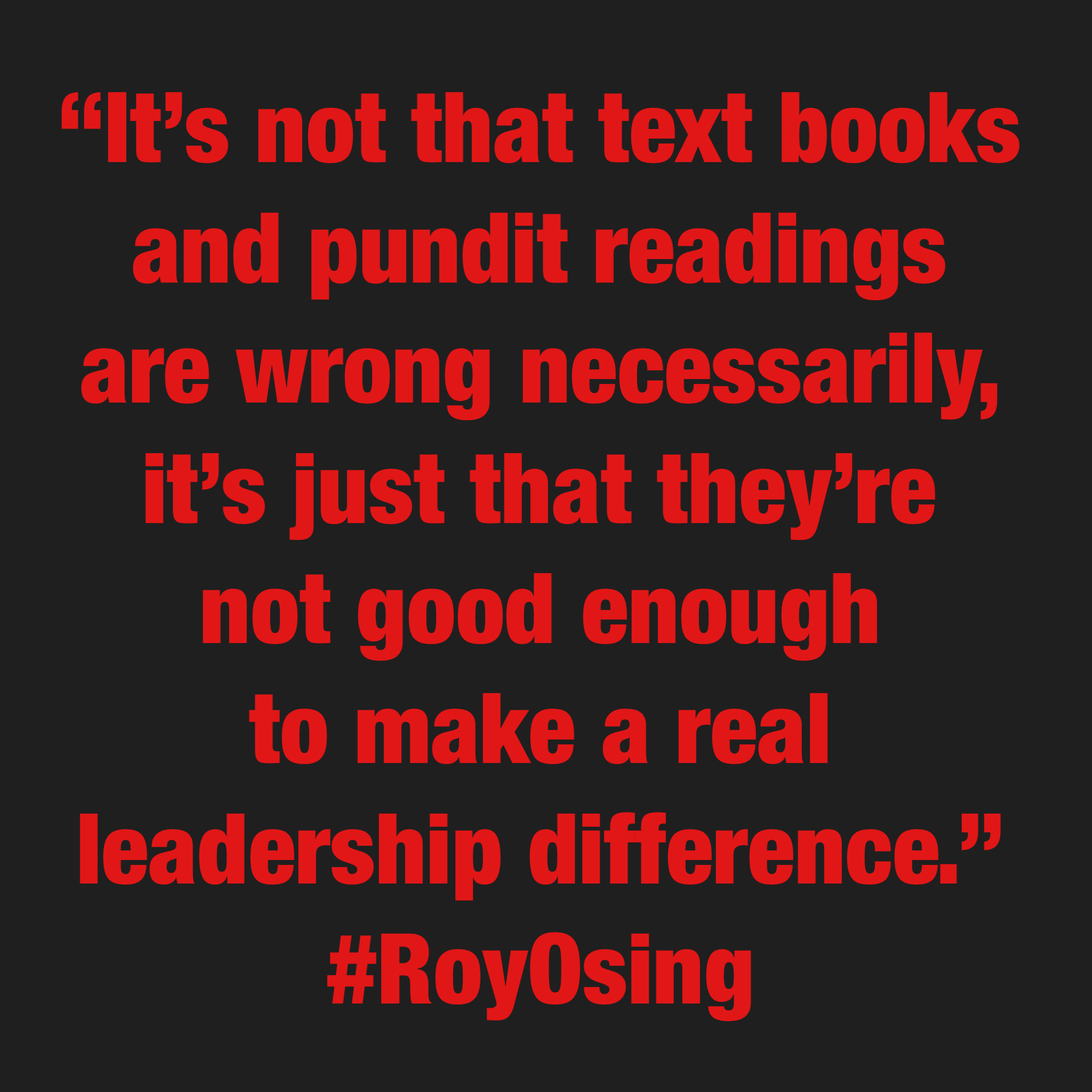
Do textbooks on leadership really do a good enough job?
Cheers,
Roy
Check out my BE DiFFERENT or be dead Book Series
‘Audacious’ is my latest…
- Posted 8.30.21 at 04:22 am by Roy Osing
- Permalink
August 16, 2021
How can a leader build a strong resilient organization able to survive?

Source: Unsplash
How can a leader build a strong resilient organization able to survive?
If there’s a single subject that’s dominated media conversations over the past while, it’s how individuals are dealing with COVID-19, and specifically the mental health challenges they are facing.
COVID continues to challenge people to be resilient and to successfully navigate through the pandemic; to develop the coping mechanisms that will allow them to survive and thrive the formidable forces they’re facing.
Organizations face the same resilience challenges as individuals do; if they aren’t able to get through the bad times, so many people are affected: investors, employees and customers.
Organizations - large and small - need to be resilient in times of stress. They need good coping skills.
Their leaders must be able to manage through the impossible challenges they never asked for and likely (hopefully) will never see again.
What can leaders do to develop a tough skin for their organizations needed to withstand unexpected body blows?
1. Take a breath and pause.
Rather than reacting in the moment, take a bit — but not too long — of time to reflect on the circumstances you find yourself in.
It’s important that you have all of your faculties on full alert and at their best in order to accurately assess the incoming threat and develop feasible options.
It’s better to take extra time and get your plan almost right than knee-jerk under pressure and bolt forward with one that doesn’t stand much of a chance of success.
2. Make a customer call
It’s always a good idea to call a customer and get their input on what actions they think you should take in response to the unexpected event.
Pick someone who has been loyal and who has always expressed their point of view on critical aspects of your business like customer service and product quality; their perspective just might be the difference between life and death.
3. Rely on your core
Success and survival are directed related to your core strengths; those assets you possess that make you strong and from which you can leverage to build more competencies.
What makes you successful in the face of fickle customers and hungry competitors? What is the single thing that makes you special and separates you from everyone else?
Your core competencies contain the secrets to the coping skills that will keep you alive when disaster strikes, so make sure you know what they are in copious detail.
The intimate understanding of who you are makes possible the pivot you may have to make to stay viable.
4. Get warm blankets
In times of cataclysmic change, organizations are forced to shed cost and this usually means laying employees off.
When this happens, leaders must pay attention to the survivors who need to be comforted. They must ’throw warm blankets’ around the employees remaining to help them through the difficult times because they will be wondering if they are the next casualties of the chaos thy find themselves in.
Survivors can’t be an effective instrument of keeping the organization alive if they are spooked, wondering when they’ll be the next job victims.
5. Train proactively
Leaders must learn from catastrophes because they just might show up again in the same or different form.
A critical element of survival is the ability to use employees for different purposes and if people have been trained to be multifunctional, the pandemonium can be handled better than if a specialized workforce has been the essence of your business plan.
And from an employee perspective, in calm times it is always a good idea as part of your career plan to look for opportunities to get out of the specialist straight jacket and develop skills and experience in many areas of the organization.
6. Start changing your culture
The great lesson COVID should have taught leaders of all types of organizations is that long term survival depends on the ability successfully to react to the unexpected, and that cultures need to be created with this attribute hardwired in their DNA.
It’s one thing to be good at developing a business plan in stable markets, but it’s what you do when the business plan is rendered useless because an unforeseen blow strikes.
Those that can pivot in chaos stand a chance of surviving; those that can’t, die
So in periods of relative calm, leaders must start the long, often arduous process of changing the culture of their organization to be able to react to unexpected change. This starts with vision and ends with hiring the right people who live and are rewarded for showing reactive values day-in and day-out.
7. Blow a bubble
Great leaders know that organizational resilience is built by building a protective layer around it; an impermeable membrane that prevents unwanted forces from entering.
Disastrous circumstances find it more difficult to destroy an organization with a bubble that looks like this:
— regular customers are proactively contacted.
— their loyalty is rewarded with special deals.
— they are asked for help.
— surviving employees are revered; they actively participate in the survival strategy for the business.
— every day is about earning business and transacting with customers efficiently with future business is the goal.
— extended business hours to ensure every customer is served.
— every employee is exploited in terms of hours spent on the job. It robs families of time together but it’s necessary for survival.
— leadership focus is to keep people from leaving.
Great leaders make resilient organizations that earn the right to show up everyday and serve customers regardless of the unexpected hardships thrown their way.
Cheers,
Roy
Check out my BE DiFFERENT or be dead Book Series
‘Audacious’ is my latest…
- Posted 8.16.21 at 07:16 am by Roy Osing
- Permalink
August 2, 2021
5 simple ways to ‘bond’ with a person and why it’s better than employee engagement

Source: Unsplash
5 simple ways to ‘bond’ with a person and why it’s better than employee engagement.
First of all a leader can’t bond with a crowd. You can influence the crowd and you can get them collecting leaning your way as supporters.
But it’s virtually impossible to bond with individuals who are in a crowd; they share a common denominator which is exercised along with everyone around them.
This is why I have difficulty with company employee engagement programs created by human resource professionals.
These programs generally are designed to address the employee population at large with little regard for the unique engagement needs of specific individuals.
Analysts conclude what the ‘average employee’ (no such thing though) needs to be thoroughly engaged around the organization’s goals and strategies; they build a program around their conclusions and lay it on the masses.
These general programs do positively impact some people, but miss the mark with others.
Employee engagement nirvana is much more than simply engaging people; it’s more about bonding with them in a way that not only gets their support for corporate goals, it does so by arousing their passion.
Rather than more passive support, the bonded employee looks for ways to implement the organization’s strategy and, with “fire in their belly”, advocates the same level of commitment to other employees.
Personal bonding is employee engagement on steroids.
My experience shows that bonding is a personal act that takes place between two people one-on-one. It’s the only way to unleash the passion and emotional energy in people.
I learned these 5 ways to do it.
1. Find influencers in the workplace
You need to be strategic in how you launch your bonding effort. Wandering into the workplace and randomly starting the process with anyone you bump in to has its limitations in terms of the final result; it means you will most likely have to touch each person in order to make a difference.
The process that worked for me was to begin by targeting the influencers in specific teams; people who were listened to and viewed as thought leaders by their peers.
Influencers are respected and followed by others when they support a new cause, and if you can bond with them, they will likely be able to convince their colleagues to join them in your journey.
2. Be with them where they work
Bonding doesn’t happen when you beckon people to come to you for a conversation; you must show up where they do their thing everyday.
The leader’s presence has a number of benefits: it shows they care enough to learn what is going on throughout the organization, it provides the opportunity for them to listen to what needs to be improved, and it empowers employees to voice their views.
The old mantra was ‘managing by wandering around’; the new school is leading by ’serving around’ where the key question leaders ask is “How can I help?”. A one-on-one conversation on what can be done to make someone’s job easier and more rewarding is the magic bonding agent.
3. Explain in detail their role in implementing the organization’s strategy
Bonding isn’t about making a BFF. The leader’s job is to engage employees to fulfill their organization’s destiny.
And the only way it can happen is if each person clearly understands what they need to do to deliver the declared strategic goals — the things they need to continue to do and the things they need to do differently.
If they don’t have a clear line of sight to the objectives the organization is trying to achieve, typically inconsistency and dysfunction set in (as individuals decide themselves the action that needs to be taken), and little progress is made.
4. Treat them as individuals
It’s a trite expression: no two individuals are the same, but it’s amazing how often company programs are developed with the ‘average’ employee in mind. The most common employee need is used to create a program rather than customizing it to reflect the special wants of the individual.
A good example is employee recognition programs where recognition events and rewards are standardized for everyone. Everyone attends a common event where their efforts are applauded and they are all provided with the standard token of appreciation.
Bonding with a person means that first you have to accept them as unique and special in some way and THEN discover what specific motivation and incentive will influence them to support company goals.
It’s much more difficult to personalize your bonding pitch for each person, but the success rate, compared to a one-size-fits-all approach, is far higher.
5. Provide the tools they need
This is the most basic need of every employee; if they don’t have the tools to do their job, they are constantly fighting an uphill battle to deliver the results expected of them. And yet, many organizations are unwilling to make the investment required to make it easier for people to do their jobs.
“They don’t need a tablet”, “We can’t afford to give everyone that high end calibration tool” are the kind of statements that extract bonding value in an organization.
People see leadership’s desire to increase employee engagement and the unwillingness to help them do their job as conflicting and disingenuous. Don’t micro analyze the payback on investing in your employees basic job needs; provide what they say they need and watch the bonding magic.
Bonding is an emotional connection that produces a incredibly powerful motivation to serve the organization.
Expunge the term ‘employee engagement’ from your lexicon and replace it with ‘personal bonding’ (only if you want folks to follow you to the ends of the earth).
Cheers,
Roy
Check out my BE DiFFERENT or be dead Book Series
‘Audacious’ is my latest…
- Posted 8.2.21 at 01:49 am by Roy Osing
- Permalink




