



Roy's Blog: Leadership
January 21, 2021
Why fantastic leadership skills can be made in ‘the bear pit’

Source: Pexels
Why fantastic leadership skills can be made in ‘the bear pit’.
Survival in The Bear Pit is a critical leadership skill; if you have the jam for it, this should be your happy place.
Amazing leaders have an uncanny ability to know what’s really going on in their organization. And one of the leadership skills they draw on from their toolkit is venturing into and surviving The Pit.
What’s ‘The Pit’?
It’s a people cluster where the leader invites people to provide their honest feedback and opinions on a variety of topics that matter to the leader. The Pit doesn’t have to be face-to-face meeting; it can be virtual and it works just as well.
The Pit consists of a group of individuals in the workplace who have a point of view on how things are going and are very willing to candidly share their feelings to the leader if asked.
The Pit is all about the leader subjecting themselves to the crowd in an effort to learn what will make things better for people. A leader who puts themselves at personal risk are endeared by all, and that’s what makes this skill so key in leadership development.
A bear pit session is managing by wandering around on steroids.
Venturing into The Pit is not for the faint of heart.
The Pit encounter is not a formal event, but a casual meeting between the leader and a group of up to 12 employees (larger meetings generally stifle the flow of conversation and the ability for everyone to be heard.
The leader enters The Pit solo; no accompanying entourage is allowed. He or she stands naked in the cluster to entertain their desire to want better things to do the organization’s business.
It’s a fundamental element of leadership by serving around where the leader seeks feedback on improvements required to increase organizational performance and make things easier for employees.
When the leader ventures into The Pit, it is a free-for-all, no-format session.
The Pit is an opportunity for people to tell it like it is to the leader without their immediate boss being in the room. When I started doing these sessions,
I had pushback from some of my direct reports who quite frankly were threatened by my being in front of their people without them being there as a filter. This spoke volumes about their worth as leaders. If they didn’t want their people to be able to speak freely to me, what did it say about how they were leading their team?
The type of issues I raised in The Pit for reaction, opinion and solutions included:
— What’s generally working in the organization and what’s not. What’s the number one thing people think i as the leader should be worrying about?
— How the business plan of the organization is being executed.
— How effective the leadership of the organization is at helping them do their jobs better.
— The barriers in the organization that prevent them from doing their jobs the way they want to.
— Customer service problems and opportunities to solve them and enhance customer experience.
— Ways to reduce costs without sacrificing service to customers.
— Information on what the competition is up to, and suggestions to counter their moves.
— The dumb rules in the organization that enrage customers and threaten customer loyalty.
I had a Bear Pit session organized every week on my calendar. It mattered to me and after I did a number of them, it mattered to the people in my organization. They came to expect the clusters and they looked forward to putting me on the spot.
They came to believe that their priorities and suggestions for improvement made a difference.
I made it a priority; it mattered.
It was one of the most important drivers of my effectiveness as a leader as long as the issues raised were followed up on and that the improvements people wanted were implemented.
Try it.
If you have honed your Pit leadership skills, you will stand out from others who will watch you with amazement.
The Pit isn’t for everyone, just those who want to pump up their career and leave others in their dust.
Cheers,
Roy
Check out my BE DiFFERENT or be dead Book Series
- Posted 1.21.21 at 06:23 am by Roy Osing
- Permalink
January 18, 2021
Why is ‘line of sight’ a great leadership skill?

Source: Unsplash
Why is ‘line of sight’ a great leadership skill?
Having ‘line of sight’ is the leadership skill that will set you apart from every other leader.
A colleague of mine, Ron Cox, Founder and CEO of Tailwind Consulting in Tampa Florida says that “a staggering 95% of employees in a company are either unaware of or do not understand the strategy”.
No wonder execution fails!
One of the biggest issues in any organization is the lack of congruence between what the strategy says and what people do on a day-to-day basis.
The strategy says one thing and not only do people do another, they do different things out of sync with the strategy.
Massive inconsistency and dysfunction results.
This is a failure of leadership.
Leadership tends to place more focus on direction-setting rather than on determining how the strategy will be executed.
Precision is applied to getting the strategy exactly ‘right’ and less attention is given to how it will be implemented in the trenches where the real work gets done.
The gap between strategic intent and actual results is due to this skewed attention.
If only 20% of leadership’s attention is placed on the details of how the strategy will be implemented, the strategy will likely be hit and miss as employees find it necessary to execute the plan the way they believe it should.
Effective strategy execution occurs when there is clarity between the functional roles that employees play in the organization and its strategy.
It is about translating the strategy into what it means to each function involved in delivering it. What specifically should the call center rep do differently? The product analyst? The sales person? The internal audit manager?
If at the most granular level each employee in the firm doesn’t know how to behave and what results to produce within the context of the new direction change will simply not happen and improved results expected by the new business plan won’t be achieved.
Line of sight
Line of sight to the strategy means what it implies; each employee can ‘see’ the strategy from their position and they understand what they specifically need to do to contribute to the strategy.
If direct line of sight is defined for every role, flawless execution results whereas indirect line of sight results in people having a clouded understanding of what action the strategy demands.
Most leaders absolve themselves of ensuring activity and strategy are aligned. It generally gets delegated to functional heads to sort out by declaring their priorities that they contend are homeomorphic with strategic imperatives.
The problem with this process is that subjectivity is introduced at a very high level in the organization and is magnified again and again as teams are asked to do the same thing through middle and junior management levels.
And the tipping point, of course, is that leadership doesn’t approve detailed functional plans which would at least show whether they were bordering on out-of-alignment or not.
Any inconsistencies between activity and strategy at the highest level in an organization are multiplied by an order of magnitude factor before it reaches the frontline people.
Under these conditions it’s not difficult to see why strategy and organizational activity diverge and not converge.
What can leadership do about this problem?
First, ease the precision around the strategy creation and tighten it up around execution. Get comfortable with getting the plan just about right and applying rigour to implementation and adjusting the plan on the run.
Next, take ownership of aligning organizational activity to strategy.
Alignment Plans
Institutionalize ‘Alignment Plans’ with functional heads; ask for sufficient granularity to the determination of whether or not a team has direct line of sight to the strategy or not. Make them work at it until they get it right and your leadership team approves.
Alignment Plans submitted to the leader should:
▪️ Define the key elements of the strategy that everyone in the organization must align with.
There are many dimensions to any strategy but it is critical to prioritize and focus on the critical ones. Greater alignment success will occur by focusing on a handful of the critical strategic imperatives rather than trying to ‘herd the cats’ around a dozen.
▪️ Define what needs to change in every functional team with an action plan to achieve it.
If the organization is pursuing a new or revised strategic direction, there will most certainly be projects, company values, people skills and technology that will have to be re-vectored to enable the execution of the new plan. Details of everything that needs to change must be defined in detail.
▪️ Identify activities, projects and behaviours that have to be dropped in order to take on new activities required for alignment.
Leadership is just as much about what has to be stopped as it is about what has to be started.
If out-of-alignment activity is not stopped, additional unnecessary resources will be most certainly requested. All non-strategic activity must be isolated and resources removed and redeployed to new challenges that must be undertaken.
Personal initiative
If you’re an employee in an organization that chooses not to impose a process to explicitly align activity to their strategy, take personal initiative to align your own work priorities to what the organization wants to achieve.
Successful careers are built on the backs of the organization’s strategy and those that execute more effectively than others are quicker to reach their personal goals.
These personal actions will propel you forward.
1. Translate for others
Help others translate what the strategy means to them in the organization.
Once you have determined your own line of sight, help others through the same process.
Everyone needs to understand the new things they will have to do and the CRAP they will have to dispose of. Unless this translation for all employees is done, the organization will be frozen in momentum management and no progress in the new direction will be achieved.
Get involved in organizing and leading workshops with various departments in the company and explore a new blueprint for each that represents the new course for them to follow.
The role of translating the new strategy for various employee groups is one that rarely gets performed. It’s a difficult task as it requires an intimate level of understanding of the strategy.
You can’t drill a strategy down into individual action if you don’t truly understand it at a detailed level.
If you’re a leader, you must dedicate much more of your time seeing that people treat this as a priority and hold them accountable.
Wander through the workplace asking people to clarify the top three things they are going to do to help deliver the new strategy and what dozen-or-so things they are going to give up.
And get the expectations hard wired into the performance planning process. It is the difference between an effective one where everyone is working in parallel to support a common purpose, and a dysfunctional one where people are working at odds with one another to deliver some things that are on strategy and other things that are not.
Synchronized outcomes release the power of execution - and competitive advantage; inconsistent outcomes zap the energy of the organization, encumber execution and impair competitive success.
2. Set your calendar
Let the organization’s strategy guide your daily calendar. The ultimate manifestation of direct line of sight is a calendar composed only of activities relating to the outcomes you have deemed necessary for you to deliver the new strategy.
If you can’t strategically relate a particular activity you plan to do on a given day, question why it is occupying your time.
Zero base your calendar and build it through the weeks and months ahead in the image of your strategy.
If you are in a leadership position, ask to see the calendars of those reporting to you. Is each of them doing the things required of the new direction or are they continuing on as custodians of the past?
3. Communicate the strategy personally
Communicate face to face with others in your organization as the most effective way of injecting the emotional component necessary to get people to believe and act.
E-mail blasts to a broad distribution list, employee newsletters and other mass means of communication don’t work as effectively. Use technology like ZOOM if physical distancing is a challenge.
These mass communications vehicles preclude the ability for people to engage in a conversation to enhance their understanding of where the organization is going.
You need to press the flesh even if it’s virtual, and make it matter by showing up in person, explaining the strategy and answering the tough questions.
In non-pandemic times, I used ‘Infonet sessions’ to communicate the company’s strategy to all employees.
They required high levels of energy and were extremely time consuming, but what else could be more important?
People in the organization need to understand where it is going and they have a right to challenge it if they are not convinced it is appropriate. You can’t capture their hearts and minds if you’re a ‘no show’.
4. Use the strategy as the context for solving problems
When confronted by a business problem or issue, always assess it and talk about it with others from the perspective of your strategy.
Create the strategic context for the discussion and then assess your options. What does your strategy suggest is the appropriate action to take?
It’s an effective way to increase understanding and awareness of your strategy and establish you as a leader and the strategy hawk for your organization.
People suddenly forget that they have set a new course in motion for the organization and they look for solutions to problems in the old strategic context.
The opposite is also true; people often don’t relate the visible changes being made in their organization to the new strategic direction that has been put in motion. They don’t get that the cause of the changes they are witnessing is the new strategy.
Assume the role of connecting the dots for people in your organization. Reinforce that the changes that everyone is seeing are the result of your new strategy.
Line of sight leadership is necessary to build teamwork and commitment to the organization’s strategic intent. Take a personal role is making it an essential ingredient in your culture.
Cheers,
Roy
Check out my BE DiFFERENT or be dead book series
- Posted 1.18.21 at 05:58 am by Roy Osing
- Permalink
January 1, 2021
Great leaders spend their week doing these simple but important things
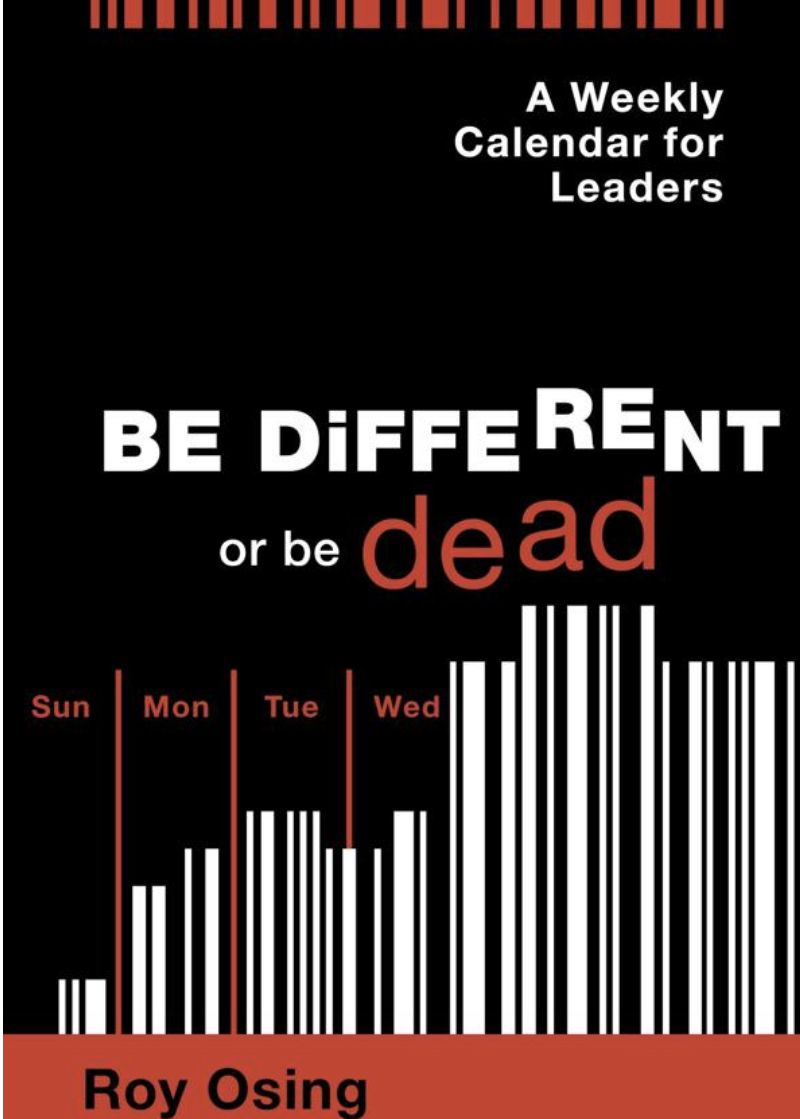
Great leaders spend their week doing these simple but important things.
Leaders require context for what they do and how they spend their time. A philosophy that guides their behavior and the things they treat as a priority.
Without context, leaders tend not to lead.
They flit.
They spend their time on the crisis of the day and chasing what their boss wants them to do.
The appropriate leadership context for today’s rapidly changing and unpredictable world should be all about serving people ‘on the inside’— employees—and people ‘on the outside’—customers.
You can’t plan your activities for the week without getting your thinking straight on which philosophy YOU believe in as a leader.
Do you want to control and direct people or do you want to serve and take care of them, believing that happy engages employees will deliver amazing results?
For some, subordinating oneself to another person is completely out of their comfort zone.
The issue is: which leadership philosophy better serves an organizational strategy today in a world where long term success and survival depends on the ability to stand out from the competitive herd?
Where execution separates the winners from the losers; where employee engagement determines if your game plan rocks or goes down in flames.
My money’s on serving.
If you decide to serve rather than control people, this unprecedented book is for you.
I will give you some simple, practical things you can do every day of the week to promulgate serving both within your organization where your warriors live, and on the outside where customers live.
Key concepts
Here are only a few of the powerful weekly tasks I share with you in my book:
— Get into a customer’s face constantly.
— Practice Leadership by Serving Around.
— Exercise your role as the organization’s strategy hawk.
— For God sakes, micromanage!
— Be nosy.
— Live with the frontline.
— Have regular bear pit sessions.
— Practise your speech style.
— Copy weird people.
— Treat unexpected events as emergencies.
— How to engage your people.
— DON’T be a great leader.
— Make sure employees understand their role in executing the organization’s business plan.
— Hire people when they give you goosebumps in an interview.
— Tell stories—lots of them—that describe success.
— Focus on DONE, not doing.
— Surprise others; don’t be predictable.
— Eat your own dog food.
— Nudge your strategy to success.
What some of my readers say…
“Leadership isn’t about titles, rules of thumb, processes and control. Rather, leadership is about being available – to listen, to guide, to create memorable experiences at every touch point. Be different – or be dead. Be ourselves – or not be ourselves. If we aren’t different, well, we might as well be gone. Thank you so much for writing this piece – a valuable guide for years to come.”—Elena Iacono, Communications Professional, Toronto Canada
“It’s crisp and easy to follow. Just 5 days of following this advice will make a whale of a DIFFERENCE! Well done!”—Nerio Vakil, President Total Business Solutions, Mumbai India
“Roy Osing is a leader focused on execution; this book will help you execute five key elements to make your company DiFFERENT. You will lead your team through helping them understand strategy and by removing obstacles. By executing Roy’s plan, you will have a challenging yet productive and insightful week ahead of you ”—Chris Hache, Host, Voices of Canadian Leadership Podcast, Halifax, Canada
“Love your “to the point” writing style; really sticks. And the key points are so valid particularly for younger leaders who think they have to control everything.”—Gerry Spitzner, Retail Pharmacy Expert, Vancouver Canada
“If you want to enhance your personal leadership style to transform your organization in a way that differentiates you in the marketplace, then I
would highly recommend you check out Roy Osing’s arsenal of leadership tools, and business enablement strategies. In his Weekly Calendar for
Leaders Roy outlines a week’s worth of simple, yet effective steps, and strategies that will help you create your own unique, servant leadership
style, and build a personalized, leadership blueprint for success.”—Gina Campbell, Senior Communications Manager, Soupcan Marketing, Vancouver Canada
A Weekly Calendar for Leaders is available at these retailers.
Cheers,
Roy
For all of my books, check out my BE DiFFERENT or be dead book series
- Posted 1.1.21 at 11:00 am by Roy Osing
- Permalink
January 1, 2021
Six proven ways you can be an amazing leader
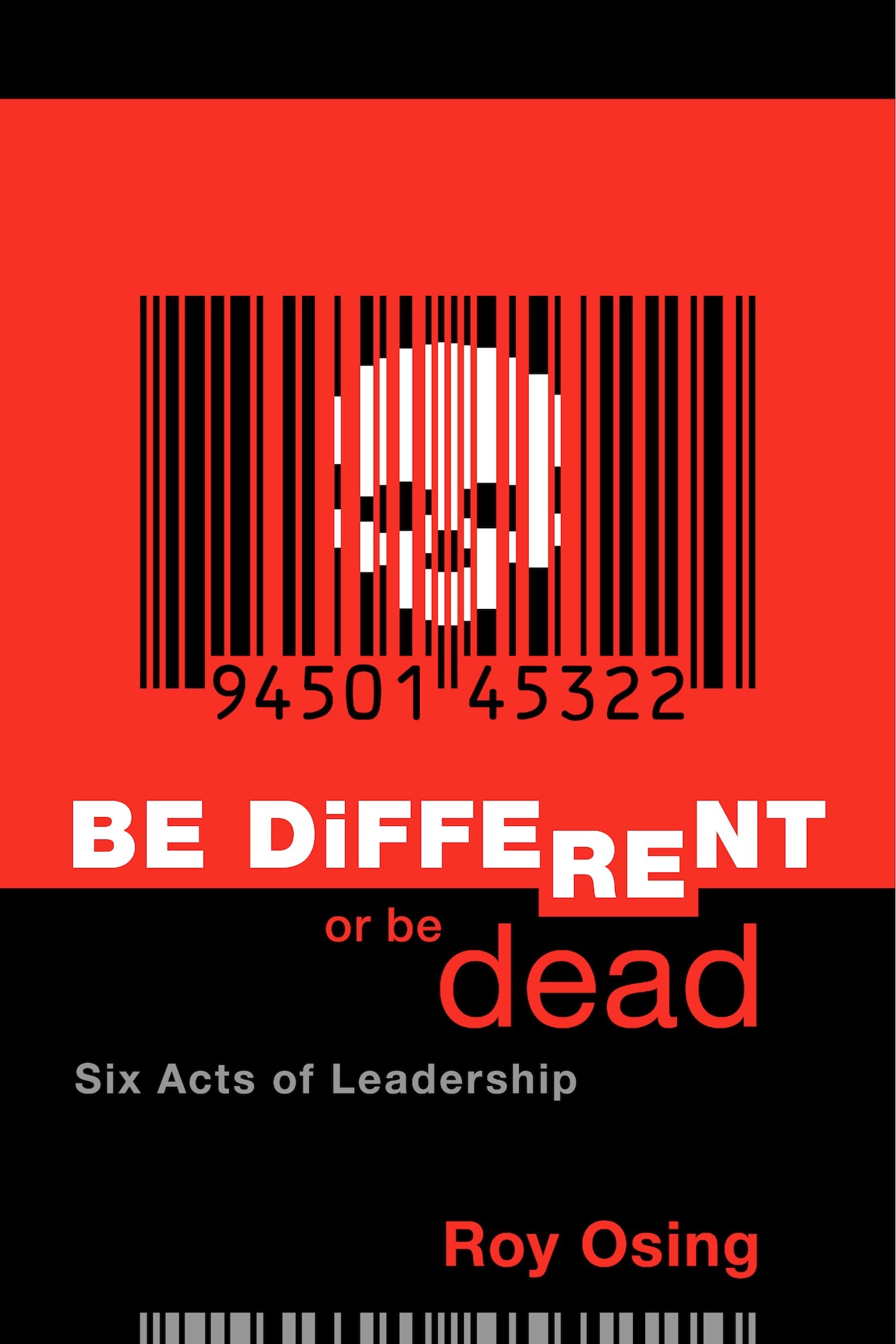
Six proven ways you can be an amazing leader.
The challenge facing a leader in today’s highly volatile economy is formidable.
It is to create an organization to stand out, not fit in; to build a truly unique enterprise that is special in the minds of its customers and feared by its competitors.
Companies that fail to break away from the competitive herd and establish themselves as unique, distinctive and remarkable to their customers fade away and eventually die.
Road kill is everywhere.
Six Acts of Leadership contains my secrets for leaders who want to create sustainable success for their organizations; who want to build something special that will be honored by their customers and loved by their employees.
Six Acts will help mediocre managers become brilliant leaders.
Audacious leaders who focus on how to execute their business plan to achieve amazing results rather than spend their time agonizing over how to make their plan more ‘perfect’ to fit the planning techniques ascribed by the academics.
Brilliant leaders create The ONLY Statement as the competitive claim for their business, that clearly separates themselves from their competitors.
Daring leaders who are hell-bent on creating memorable customer experiences for their customers.
Amazing leaders who serve their employees and make it a priority to make it easy for them to do their jobs.
Key concepts
Here are only a few never-seen-elsewhere concepts from the book:
— Build your business plan with execution in mind.
— Don’t be merely the best at what you do; be the ONLY one who does what you do.
— Shed product thinking; start thinking customer experiences.
— Focus on your existing loyal customers and stay away from deals to attract new ones.
— Satisfying others isn’t good enough; you must dazzle them.
— Pay attention to the little things; if you don’t they will destroy you.
— Get into the workplace and serve around.
— Exercise your strategy hawk role.
— For God sakes, micromanage!
— Be nosy.
— Live with the frontline.
— Have regular bear pit sessions.
— Practise your speech style.
— Copy weird people.
— Treat unexpected events as emergencies.
— How to engage your people.
— Line of sight leadership.
— Hire for goosebumps.
What some of my readers say…
“Roy’s done it again in this concise, quirky, thought-stimulating, cutting-edge and profitable book. Open up your note-taking app and engage!” — Arthur R. Tymos, President & CEO Creation Technologies, Vancouver BC
“It’s a good fast read, power-packed with hard-core advice for today’s service providers. Following your advice, companies will learn to separate themselves from the herd and provide everlasting value by creating unique individualized customer experiences. What I like is that it’s an easy read, short, precise and focused on getting things done. I will be tweeting about it too.” — Nerio Vakil, President, Total Business Solutions, Mumbai, India
“Roy does an incredible job diagnosing one of the major challenges leaders face today -competitive mediocrity. Being different and providing over the top customer service are not easy or inexpensive, but they are your best chance at long term success. Roy’s work is mandatory reading for every FROGBOX Manager” — Doug Burgoyne, CEO, FROGBOX, Vancouver BC
“Roy has put in words something businesses (and governments for that matter) should all aspire to achieve - to dazzle their customers (or us as citizens). His Six Acts of Leadership provide a clear and simple roadmap to achieve a unique strategic path to sustainable success for any organisation, public or private.” — Egon de Haas, Global Director, Government & Public Services, PricewaterhouseCoopers International Limited, Amsterdam, The Netherlands
“Six Acts of Leadership. I liked it. I liked the flow, I liked the nuggets of info condensed.” — Tina Thompson, CEO MUG Solutions, Vancouver BC
Six Acts of Leadership is available at these retailers.
Cheers,
Roy
For all of my books, check out my BE DiFFERENT or be dead book series
- Posted 1.1.21 at 10:00 am by Roy Osing
- Permalink