



Roy's Blog: September 2021
September 6, 2021
8 easy ways to build a successful sales team that CARES about people

Source: Pexels
8 easy ways to build a successful sales team that CARES about people.
Sales organizations are often challenged to be successful.
They craft a strategically brilliant sales plan that would make the pundits proud. It’s replete with industry and competitive analysis, internal strengths, weaknesses and a set of objectives that are time bound with accountabilities assigned.
Then they launch their plan but are disappointed in the results they achieve; they are unable to deliver the results they expect.
And they wonder why they aren’t successful.
But reason is right in front of them.
Success isn’t about the efficacy of the strategy; great plans have been know to fail and mediocre plans have earned amazing success.
The execution competencies of an organization separate those that achieve the results they intend from those that underperform.
The care factor
And those that standout in the ability to consistently execute have one thing in common: they all have a huge ‘care factor’ in their culture. They understand that people caring about people is a critical ingredient to consistently deliver superlative results.
Care about customers and they return the favour by buying what you have to sell. And they do it repetitiously. And they tell others.
Care about your sales warriors and they not only individually produce tremendous results, they also work together across the organization to deliver what customers want when they want it.
Effective organizational processes require seamless handoffs, or ‘touch points’ in order to flawlessly deliver products and services to their customers.
Three are facilitated when people respect and care for the roles and responsibilities of others.
What do sales organizations with a high care factor look like?
▪️they have caring as a critical component of their stated values; “We care about others” in some manner is explicitly stated.
▪️their sales strategy is consistent with caring. Their plan is based on serving customers intimately in order to create memorable experiences for them because they know it will result in sales.
And their sales approach is to discover what their clients care about as opposed to only focusing on what they need.
Caring must be measured
▪️they measure caring outside and inside. Every client and sales employee survey includes questions on caring and the extent to which employees practice the value.
▪️they have a recruitment process that looks for the caring attribute — it goes well beyond whether a person has demonstrated sales skills.
You can’t teach people how to care; they either have the innate drive to do it or they don’t. They are born with the gene to honestly serve. The human resource effort in sales is geared to discover people with this gene.
▪️their sales leaders care and they show it relentlessly. Caring starts from the top; it’s what leaders do to build higher levels of employee engagement.
And they make it visible to everyone.
▪️in addition to specific product sales targets, they include caring in their performance and compensation plan and build in specific objectives to measure it.
The basis of measurement is perception; do customers and employees THINK sales people act in a caring manner; do they think they care?
Sales caregiver stories are told
▪️their employee communication is overwhelming with stories of sales caregivers — when have you EVER heard ‘caregiver’ linked to sales? — and what they’ve done to live the caring values.
What is talked about is what culture is all about. If the airwaves are consumed with caring stories, what conclusion do people reach?
▪️they consider caring to as the essence of their competitive advantage. You can’t build anything if you don’t care, ergo growing a business requires a strong human feeling element exercised particularly through sales, as being a critical customer facing team.
Some might consider caring soft, unnecessary and perhaps a bit weird to consider as a critical element to shape the culture of sales. After all, the prime purpose is to push products and services and make a sale, right?
These folks don’t get it.
They don’t get that mind-blowing sales performance that results in a competitive advantage for the organization is the result of individuals working closely together for a common cause.
And that only happens if there is a caring culture at play.
Cheers,
Roy
Check out my BE DiFFERENT or be dead Book Series
‘Audacious’ is my latest…
- Posted 9.6.21 at 01:06 am by Roy Osing
- Permalink
August 30, 2021
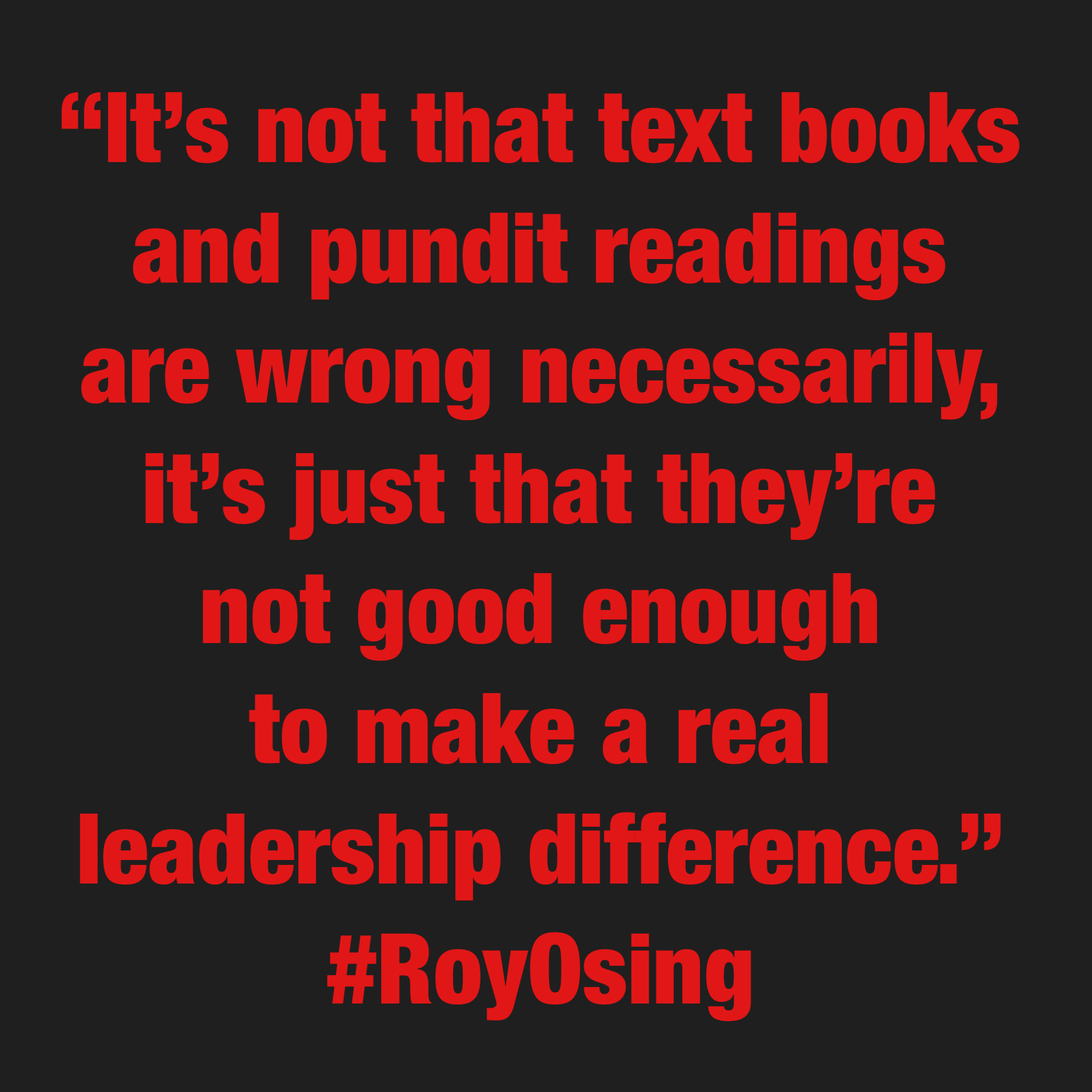
Do textbooks on leadership really do a good enough job?
Cheers,
Roy
Check out my BE DiFFERENT or be dead Book Series
‘Audacious’ is my latest…
- Posted 8.30.21 at 04:22 am by Roy Osing
- Permalink
August 23, 2021
How your competitive advantage can be stated clearly and simply

Source: Unsplash
How your competitive advantage can be stated clearly and simply.
What’s your competitive advantage in the market?
What distinguishes your organization from your competition?
What sustaining differential advantage do you have?
All of these questions try to get at the answer to the question “Why should I do business with your company and not one of your competitors?”
Let’s look at some of the more common expressions used by businesses to explain what they believe to be the advantage they have over everyone else:
— we have the best technology.
— we provide the best customer service.
— we deliver amazing customer experiences.
— we will exceed your expectations.
— we have highly trained staff.
— we offer the lowest prices.
— we are the market leader in providing CRM solutions.
— we’ve been in business since 1950.
— we’re here for you, we’ve got your back.
— we offer customized solutions.
— our products are of the best quality.
— we offer fast, reliable same day service.
These types of competitive claims have limited value to separate one organization from another because most organizations claim the same thing. If you’re in the communications business, for example, most of your competitors claim they have the ‘best’ network, provide the ‘most complete’ product and service portfolio or offer the ‘most enjoyable ‘ customer experience.
Why do most organizations waste their breath and make these types of claims?
For one simple reason: they look at the types of things others are saying AND THEY COPY THEM! Can you imagine benchmarking another company when it comes to declaring competitive advantage? Absurd to say the least but it happens all the time.
Uniqueness, innovation and creativity are MIA in leadership fulfilling this incredibly vital role.
There are 3 reactions I have when I hear these types of statements:
1. What are you saying? — the devil’s in the details.
What exactly is meant by ‘exceeding expectations’ and ‘we’ve got your back’?
Unless someone understands the intent of the statement it’s merely stratospheric clap-trap; a helium-filled aspiration with no substance. It’s worthless.
Now, if a claim with this type of intent said something like “We will always try and say YES! to what you ask of us” I would sit up and take notice.
Or if it said “We will always do more for you than what you ask” I would have pretty good clarity on what behaviour to expect from the organization saying it.
And then break your claim down into even more detail for more clarity for your customers and your employees. When you declare that you will ‘say YES!’, give examples so people will get a picture of what is intended. If you’re in the restaurant business you might be willing to give your customers something they want that is not on your regular menu.
The point is, your competitive claim must be granular as opposed to aspirational if it is to have any real meaning at all.
2. So what and who cares? — the question of relevance.
There are tons of competitive claims that promulgate a benefit that few are looking for (but the company thinks is cool), and there’s nothing as abysmal as claiming you’re great at something your target customers don’t care about.
This is the classic factory supply-push approach used by far too many businesses that simply want to flog their products and services to the masses with no specific individual in mind, emphasizing the features they have and the technologies they use.
These organizations hope that enough people will buy what they’re flogging and that the size of the ‘average’ customer group that goes for their claim is large enough to make their moves profitable.
A radio station in Vancouver declared they are ‘the only ones who provide traffic and weather every ten minutes on the ones’ even though their competitor only provides traffic information. ‘On the ones’ may be true, but it’s irrelevant given the option their customers have.
In addition, most claims address the general market — and the ‘average person’ — so it’s likely that it will resonate with some people and miss the mark with others. Why? Because it’s a supply-based claim and not a demand-driven one.
Learning points: make sure your competitive claim is based on what your target customers crave (link) and not what you supply.
3. Prove it! — the challenge of truth.
This is where the proverbial ‘rubber meets the road’ on your competitive advantage claim: it must pass the burden of truth.
Who owns the truth? If you really have a winner, go ask your target customers whether they actually believe it. Do you consistently ‘say YES!’ when someone orders an item not on your menu? They will tell you!
In addition, take a look at your operational processes, measurement systems and accountabilities. Do you have the ops processes in place to deliver on your competitive claim?
Are measurements being done on the various components to ensure the right hand-offs and deliverables are achieved?
And have accountabilities been established with the key owners in the organization to make the delivery systems a priority? If delivering on your competitive claim isn’t in the performance plans of key executives, it’s unlikely it will be treated as a priority and get done.
The ONLY Statement is the way to solve the deficiencies of the current methods used to differentiate one business from another.
I’ve used it for years and have seen the incredible success businesses have had with it.
‘We are the ONLY business that …’ is the way to communicate specific value to your target customer group in a way that can be measured.
It’s hard work creating The ONLY Statement for your organization but it’s worth it if you really want to separate yourself from the boring herd.
Cheers,
Roy
Check out my BE DiFFERENT or be dead Book Series
‘Audacious’ is my latest…
- Posted 8.23.21 at 04:01 am by Roy Osing
- Permalink
August 16, 2021
How can a leader build a strong resilient organization able to survive?

Source: Unsplash
How can a leader build a strong resilient organization able to survive?
If there’s a single subject that’s dominated media conversations over the past while, it’s how individuals are dealing with COVID-19, and specifically the mental health challenges they are facing.
COVID continues to challenge people to be resilient and to successfully navigate through the pandemic; to develop the coping mechanisms that will allow them to survive and thrive the formidable forces they’re facing.
Organizations face the same resilience challenges as individuals do; if they aren’t able to get through the bad times, so many people are affected: investors, employees and customers.
Organizations - large and small - need to be resilient in times of stress. They need good coping skills.
Their leaders must be able to manage through the impossible challenges they never asked for and likely (hopefully) will never see again.
What can leaders do to develop a tough skin for their organizations needed to withstand unexpected body blows?
1. Take a breath and pause.
Rather than reacting in the moment, take a bit — but not too long — of time to reflect on the circumstances you find yourself in.
It’s important that you have all of your faculties on full alert and at their best in order to accurately assess the incoming threat and develop feasible options.
It’s better to take extra time and get your plan almost right than knee-jerk under pressure and bolt forward with one that doesn’t stand much of a chance of success.
2. Make a customer call
It’s always a good idea to call a customer and get their input on what actions they think you should take in response to the unexpected event.
Pick someone who has been loyal and who has always expressed their point of view on critical aspects of your business like customer service and product quality; their perspective just might be the difference between life and death.
3. Rely on your core
Success and survival are directed related to your core strengths; those assets you possess that make you strong and from which you can leverage to build more competencies.
What makes you successful in the face of fickle customers and hungry competitors? What is the single thing that makes you special and separates you from everyone else?
Your core competencies contain the secrets to the coping skills that will keep you alive when disaster strikes, so make sure you know what they are in copious detail.
The intimate understanding of who you are makes possible the pivot you may have to make to stay viable.
4. Get warm blankets
In times of cataclysmic change, organizations are forced to shed cost and this usually means laying employees off.
When this happens, leaders must pay attention to the survivors who need to be comforted. They must ’throw warm blankets’ around the employees remaining to help them through the difficult times because they will be wondering if they are the next casualties of the chaos thy find themselves in.
Survivors can’t be an effective instrument of keeping the organization alive if they are spooked, wondering when they’ll be the next job victims.
5. Train proactively
Leaders must learn from catastrophes because they just might show up again in the same or different form.
A critical element of survival is the ability to use employees for different purposes and if people have been trained to be multifunctional, the pandemonium can be handled better than if a specialized workforce has been the essence of your business plan.
And from an employee perspective, in calm times it is always a good idea as part of your career plan to look for opportunities to get out of the specialist straight jacket and develop skills and experience in many areas of the organization.
6. Start changing your culture
The great lesson COVID should have taught leaders of all types of organizations is that long term survival depends on the ability successfully to react to the unexpected, and that cultures need to be created with this attribute hardwired in their DNA.
It’s one thing to be good at developing a business plan in stable markets, but it’s what you do when the business plan is rendered useless because an unforeseen blow strikes.
Those that can pivot in chaos stand a chance of surviving; those that can’t, die
So in periods of relative calm, leaders must start the long, often arduous process of changing the culture of their organization to be able to react to unexpected change. This starts with vision and ends with hiring the right people who live and are rewarded for showing reactive values day-in and day-out.
7. Blow a bubble
Great leaders know that organizational resilience is built by building a protective layer around it; an impermeable membrane that prevents unwanted forces from entering.
Disastrous circumstances find it more difficult to destroy an organization with a bubble that looks like this:
— regular customers are proactively contacted.
— their loyalty is rewarded with special deals.
— they are asked for help.
— surviving employees are revered; they actively participate in the survival strategy for the business.
— every day is about earning business and transacting with customers efficiently with future business is the goal.
— extended business hours to ensure every customer is served.
— every employee is exploited in terms of hours spent on the job. It robs families of time together but it’s necessary for survival.
— leadership focus is to keep people from leaving.
Great leaders make resilient organizations that earn the right to show up everyday and serve customers regardless of the unexpected hardships thrown their way.
Cheers,
Roy
Check out my BE DiFFERENT or be dead Book Series
‘Audacious’ is my latest…
- Posted 8.16.21 at 07:16 am by Roy Osing
- Permalink