



Roy's Blog: March 2022
March 14, 2022
How your customer service can be made mistake proof

Source: Unsplash
How your customer service can be made mistake proof.
Successful organizations figure out how to make their customer service OOPS! resistant.
They’re mindlessly focused on how they handle mistakes. It’s all very well to talk about doing it right the first time and providing seamless transactions, but it’s a pipe dream.
The reality is that mistakes will always happen in organizations regardless of the good intentions to ensure they don’t happen. Mistakes cannot be mitigated. The chances of them occurring can be reduced but they can’t be completely eradicated.
Mistakes are a way of life in modern organizations. Humans are not perfect not are they predictable. Technology has its glitches. And systems break down.
So in a marketplace replete with mistake-making, how does an organization gain a competitive advantage over the other mistake-makers?
Do they try and make fewer of them in which case their competitive claim might be ‘Buy from us because we make fewer mistakes than our competitors’?
Or do they go back to the first principles of Quality Management and claim that they are the only ones who deliver what customers expect error-free every time?
No. The only way to gain an advantage in a mistake-riddled world is to pursue two tactics simultaneously:
1. OOPS!-proof the organization as best you can to prevent mistakes from occurring, and
2. Build a recovery strategy to action when #1 doesn’t work and an OOPS! occurs.
OOPS!-proofing
OOPS!-proofing your organization means creating the infrastructure and environment that reduces (not eliminates) the chances of mistakes occurring.
Here’s a checklist:
▪️Examine your rule and policy architecture. Do the rules and policies you have enable easy customer transactions or do they get in the way because customers refuse to follow them (because they think they’re dumb).
▪️Check your culture and values. What comes first: quarterly earnings or amazing experiences? Does your organization put the customer on a pedestal and subordinate everyone in it to creating memorable experiences for them?
Do you have a value that specifically says ‘We exist to provide memories for our customers every time they touch us’?
▪️Ask customers to help design systems, processes and procedures that affect them. An OOPS! is less likely to happen if a customer is doing business with you in a way they helped architect.
▪️Spend more money on training your frontline people. If they know more, they will fail less.
▪️Remove the grunge that gets in the way of employees doing their job. Fighting unnecessary internal resistance gets in the way of focusing on taking care of the customer which causes sh** to happen.
OOPS! reaction
Even if you’ve OOPS!-proofed your organization as best you can to minimize the chances of mistakes happening, they will happen. That’s just the way it is.
So with that reality in mind, the OOPS!-proofer prepares themselves to recover when the mistake is in their face.
Their business plan has a specific strategy to be the best mistake fixer in the market, and there’s good rationale for taking this position.
Brilliant recovery is a customer loyalty builder; customers are more impressed with how the mistake is fixed than being upset about the mistake being made in the first place.
What does brilliant recovery look like? The ‘formula’ for OOPS! recovery is quite simple:
Recovery = Fix the mistake fast and surprise the OOPS! victim with something they don’t expect.
Studies have shown that customer positivity—and loyalty—towards an organization that has screwed them over actually increases after a successful recovery compared to how they felt toward the organization before the OOPS! happened (which is a function of the cumulative experiences they’ve had with the organization to date).
Furthermore, they show that recovery must be achieved within 24 hours of the OOPS! event to have a positive impact. If you haven’t recovered in 24 hours, the opportunity is lost and perhaps the customer with it.
The proper OOPS! recovery is a business loyalty builder and yet few organizations plan for it.
How does one build an OOPS! recovery plan?
Here are a few plan-building steps to consider:
#1.Work on your culture — Most cultures encourage mistake avoidance; mistakes result in added cost because of the rework involved in making things right.
The OOPS!-recovery artist knows that the special sauce is not trying to eliminate mistakes, it’s about having a strategy in place to do the right things for the customer when the blooper happens.
The serious ones have a value statement that goes something like this:
“We will do our best to prevent making a customer OOPS! but when we do, recovery will be our #1 priority.”
#2. Measure your recovery effectiveness — After recovery, ask the customer how you did. You can use all the internal metrics at your disposal, but in the final analysis it’s about how the customer felt about your actions.
Perception is reality, so take action from their feelings regardless if your own tracking says you did an ok job.
#3. Empower people — Speed requires a flat organization structure devoid of the need to escalate action for approval.
OOPS! recovery success is inversely related to bureaucracy: the more bureaucracy involved in making decisions, the longer it takes to take action and the recovery window closes. And you’ve lost the opportunity the screwup presented.
So if you’re serious, you have to empower people to do things to recover without the need to ask anyone for approval (the recovery plan will of course have guidelines to follow but that’s all they are - guidelines).
This is where leaders must step up and declare that they trust that people will do the right thing for both the customer and the organization, and that in recovery mode the organization structure is virtually flat and that an all-out assault on the OOPS! is to be supported by everyone who touches it.
#4. Provide superlative support to the frontline — Frontline people are lynchpins in the OOPS! chain, from when things go bad until recovery is complete.
If frontline people are not supported by authority to command the rest of the organization into action with the tools they need, your recovery plan goes south. Make sure your plan has the investments with the necessary leadership trust to give you a fighting chance to win every OOPS! event.
To make your organization OOPS! resistant, do the best you can to avoid making a blunder (which people expect you to do) but make sure you add the special ingredient—‘recovery sauce’—to recover memorably when you do.
Cheers,
Roy
Check out my BE DiFFERENT or be dead Book Series
‘Audacious’ is my latest…
- Posted 3.14.22 at 06:10 am by Roy Osing
- Permalink
March 5, 2022
Audacious ‘Unheard-of Ways’ is here. NOW! Get your e-copy!
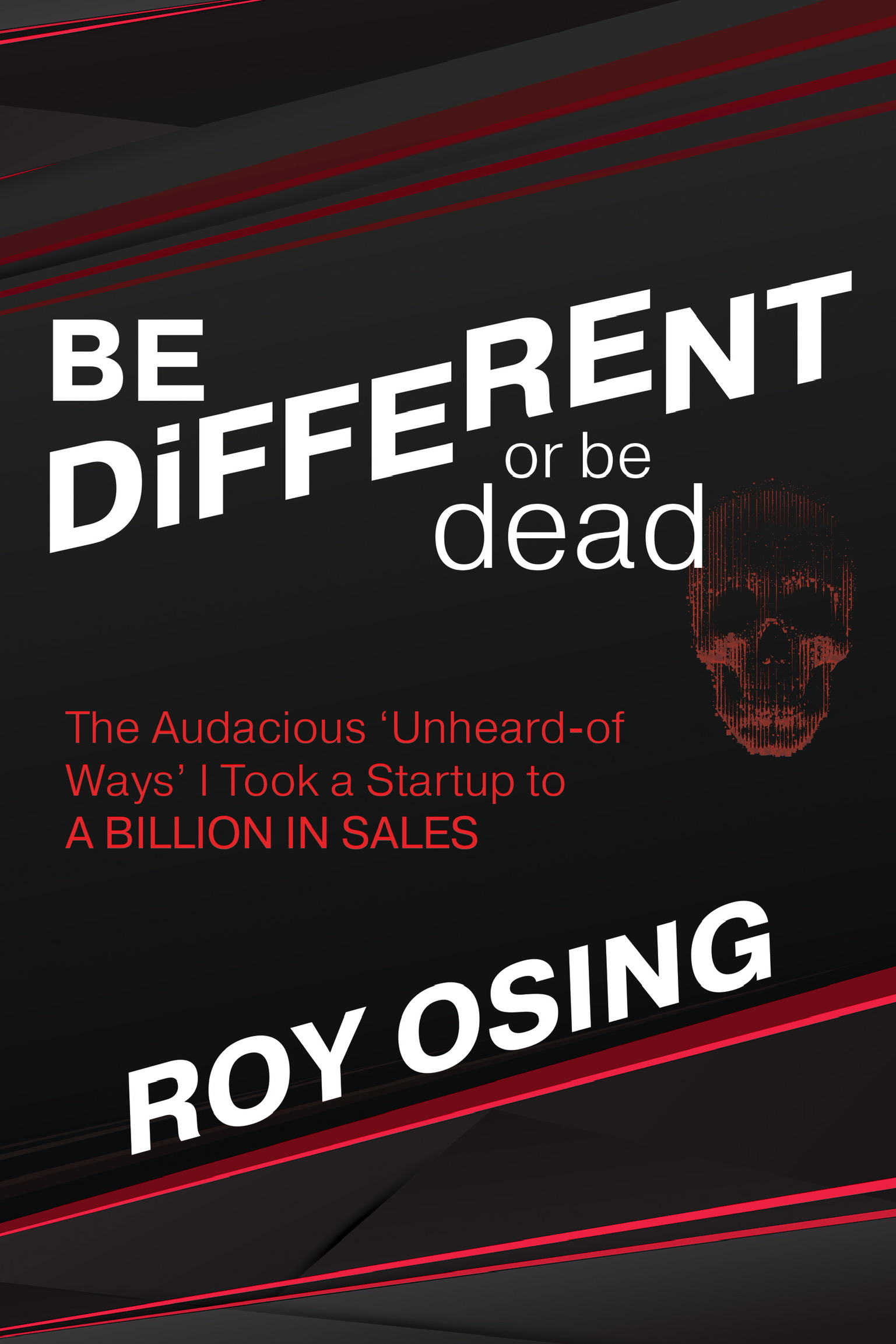
Audacious ‘Unheard-of Ways’ is here NOW. Get your e-copy!
“Whether your business is a start-up, or amongst the Fortune 500, Roy’s audacity and expertise will help you drive innovation, build a customer-centric culture and fuel success within an increasingly competitive and dynamic landscape.” — Darren Entwistle, President and CEO TELUS Corp. Vancouver Canada
The printed version of my new book—Audacious and ‘Unheard-of Ways’ I Took a Startup to A BILLION IN SALES—will be in bookstores everywhere on May 31, 2022.
But you don’t have to wait that long to learn what I did to grow a startup to A BILLION IN SALES.
My e-book—e-Audacious—is available at your favourite e-retailers NOW!
Please grab your download and I would really appreciate your personal review.
Thanks very much.
Cheers,
Roy

Source: Unsplash
Here’s what others are saying about ‘Audacious’…
“Throughout his book, Roy provides pivotal marketing secrets and tips that enabled him to achieve his audacious goals, and to make you hungry to do the same.” — Frank Palmer, Vancouver Canada
“I’m a student of Roy’s work, but ‘Audacious and Unheard-of Ways’ is a superlative piece of ‘how-to’ work that goes beyond the limits of providing useful advice to businesses and career professionals; it surpassed my expectations.” — Bradley Hale, Toronto Canada
“With this book, he turns textbook leadership on its head with creative, out-of-the-box solutions to the biggest problems in business: aligning strategy and execution, motivating employees, and selling in turbulent times.” — Rick Spence, Toronto Canada
“The Audacious ‘Unheard-of Ways’ I Took a Startup to a Billion in Sales is a must-read for anyone looking to advance their career or business.” — Jill Schnarr, Vancouver Canada
“Once in a while the opportunity comes along to experience deep learning from someone who has actually achieved what we are attempting to do. This book is your opportunity.” — Ron Cox, Tampa Florida
“In ‘Audacious Unheard-of Ways’ he shares his advice and guidance which you will not get from anyone else but Roy. An amazing read with so many valuable lessons.” — Egon de Haas, Amsterdam The Netherlands
“Roy tells it like it is. No esoteric prose, just plain, practical advice that can be immediately implemented. You deserve to be a great leader, have a great career, sell as much as you can and Roy lays out the path how to achieve this and more”. — John Golden, PipePacific Palisades California
“Roy does an excellent job relating how customers are treated to growing a business.” — Nerio Vakil, Mumbai India
“If you are a small business owner and you really want to differentiate yourself to achieve better results Roy tells you how.” — Daniel Boisvert, Delta Canada
- Posted 3.5.22 at 06:28 am by Roy Osing
- Permalink
February 28, 2022
10 easy ways you can create an audacious personal brand

Source: Pexels
10 easy ways you can create an audacious personal brand.
Building a personal brand is more than seizing some words that you think tell the story of who you are and what you stand for. Rather, it’s a process of defining and then doing many ‘small things’ that collectively define you.
Personal brand building is a strategic process that asks more than ‘Who am I?’, it also then asks ‘Who do I need to be?’. The latter question is the strategic piece; ‘How do I need to be perceived?’ is answered as if you were creating a business plan with a competitive advantage claim.
Your brand needs to be forever relevant, for if it fades from resonating with the people around you, it’s useless.
To be effective, a brand must continue to resonate with those that experience it; they must see it as a ‘forever’ solution to problems they continue to have or challenges they continue to face.
A brand that doesn’t relate to the issues people care about in the moment is irrelevant and the person propagating the brand goes unnoticed.
Furthermore, a compelling brand is amoebic. It adapts to and changes with the circumstances surrounding the person owning it. It’s like a coronavirus variant that is searching for new ways to stay alive.
A meaningful brand position is forever in a state of flux, anxious to morph itself to survive in a new environment.
So, in no particular order, these are the actions I took to adapt and evolve my brand during my career, starting from an entry level systems analyst position to president and CMO three decades later.
Each action helped me stay relevant during highly changing and turbulent times, but no single one was a ‘silver bullet’ for success.
‘Stay relevant’ brand actions
▪️ Identify the people who you want to ‘talk to’ about who you are and what you do These are the foxes in any organization who tend to make career decisions in your space. It’s important that these people get exposed to the values you represent.
▪️ Have a good understanding of the other players the other players competing for the same brand attributes to understand the brand field you are competing with and their brand claims.
▪️ When presented with a task, ask yourself the question “How can I do this differently?” than others. This is a critical question to get you noticed (if you answer it right). Just having the subject top of mind will lead you in the right direction; use it as the lens to determine what to do and how to do it. Ask yourself this question everyday.
▪️ Purge every aspect of copying from your being.
This is tough because it’s almost second nature for people to ask ‘How did someone else do it?’; to benchmark best in class and apply best practices.
We’ve been conditioned to believe that we are better off when we follow the best in the herd, which is nonsense. All we have done is temporarily change our position in it.
Using a boilerplate that someone else developed robs you of the originality needed to stand out and be remarkable.
Copying what others do keeps you in ‘the common herd’ and prevents you from being noticed. Do whatever it takes to act with attitude and in a way that separates you from the crowd.
▪️ Look at what everyone else is doing then do the opposite. Amazing results are achieved by contrarian acts.
▪️ Learn to focus on the critical few things you need to be successful. It’s so tempting to chase the possibilities that are out there but the problem is that you are busy but ineffective in delivering quality results. Different people are “mindlessly” focused on a few critical things that are not on anyone else’s radar.
▪️ Shed the CRAP that gets in the way of your ability to focus on your key priorities. Holding on to comfy food may satisfy your appetite temporarily, but it won’t enable your quest to stand-out from the herd in the long run.
▪️ Connect with weird and different people. If you’re going to seek stimulation from others, lean in to people who don’t follow the rules and have off-the-wall views.
▪️ Be the first to take on new projects. Covet opportunities to offer standard solutions to radical problems that have not been addressed before. Your solution to a new problem will carry the ‘different’ tag.
▪️ Loosen up on planning; tighten up on execution. Most people think the value is in the cleverness of a plan; of course they’re wrong.
Jump into the messy inelegant world of implementation where results get delivered. Different people get stuff done; they don’t sit around pondering theoretical possibilities.
The do-it brand
▪️ In my experience a winning brand position is to adopt a ‘do-it’ persona. However, never act without a framework that will create a better than average probability of success. Unharnessed action may feel good at the time, but it will likely not produce the outcome you desire.
Build context for action. Action with no context is at best uncontrolled behaviour with no predictable outcome. Context could be your career goals, your personal set of values or the organization’s strategic game plan. Context sets the boundaries inside which acceptable action is defined and outside which inappropriate action resides.
Look for an opportunity to add value to the actions you take. Go beyond what might be expected; surprise the judges observing you by adding extras rather than simply meeting expectations. ‘Action - Plus’ is a way to think about it: act and do more.
Achieve with a twist; leave your fingerprints and personal mark on what you do. Doing something without leaving a trace of YOU is a missed opportunity to leave a lasting impression. If your action blends in with what everyone else does, no one notices and your brand pays the price.
Pause, then act. Be disciplined about taking action. Before moving, take a deep breath to ensure your action is grounded and will have the highest probability of making a positive impact.
Use ‘the pause’ as a necessary element of the acting process. Once you commit to act it’s a chore to shift direction so use the pause wisely.
Prepare for follow up. The results of your action must be determined in order to learn from them. Think through exactly how you intend to track the outcome and the impact it had on people. Develop an improvement plan for any action that didn’t work out the way you had intended.
Memorable action isn’t a knee jerk response; it’s taken with a sense of purpose.
Finally, Try, try and try. While others are seeking the impossible dream of perfection the do-it brand people are achieving results inch-by-inch.
▪️ Ensure that your brand addresses the critical issue of the day for your organization by continually measuring and refreshing your only claim.
And, again, remember that if your brand doesn’t respond to a compelling and relevant need that your business has, it will simply fall on deaf ears and be perceived as merely self serving.
If your brand, however, resonates with people and is consistent with the strategic imperatives of the business, it makes you the currency leader among your peers with the job satisfaction and career growth that goes along with that leadership position.
▪️ Develop the competency to recover brilliantly when you make a mistake (and you will, that’s what do-it professionals do). Fix your mistake (because that’s what people expect) fast, and then add something to the mix that surprises them. You will be remembered for your risk taking and brilliance of recovery; your mistake will quickly be forgotten.
▪️ Develop a communication plan to expose your brand both within your organization and to external audiences.
- Offer to do presentations on your chosen brand topic;
- Get quoted as a subject matter expert in any internal communications media your organization uses;
- Write articles for your organization and for external publications on your brand content; be the thought leader;
- Offer to talk to customers on your brand topic. Help them in any issues they have, and get known on the outside. In my case many of our customers were interested in what we were doing in the area of customer service as well as a ME marketing. I had many speaking engagements to air my brand;
- Talk to the media on your topic. Make it interesting for them. Get them calling you. Your organization’s reputation will overtime be influenced by you.
▪️ Listen to the conversation about you and use your social media presence as the ‘listening post’.
Dedicate time to monitor social media feeds to get real time hands-on feedback from various audiences on your brand.
And engage in any conversation to show that you’re interested in the commentary and to further reinforce your personal tag.
Online dating
▪️ Look to online dating for help. I’m not suggesting that you necessarily get involved in online dating, but I do believe the process can provide valuable insights on how to effectively position one’s brand in a highly contested world.
The crucial element in online dating is the personal profile where the challenge is to describe and ‘paint a picture’ of yourself that leaves no doubt as to who you are and what your specific interests are with the objective of attracting interest from people who are aligned with you — a daunting task given the size of the internet universe.
Bland, general and vague profiles attract few worthwhile hits whereas clear, expressive, and detailed profiles, on the other hand, stand-out to people who are looking for specific characteristics — specifics in the profile do a better job of explaining a brand and hence attract people who are interested in it.
Think of an online personal profile as a granular version of your brand and use it to express what makes you special. Over emphasize your attributes and specifically those that you think make you distinct from everyone else.
And also apply the ‘so what and who cares?’ test intended to catch the vague generalities and a helium-filled claims used by the crowd. If it’s a statement that everyone else uses, delete it and focus on what makes you special.
And don’t expect miracles overnight. You most likely will not come up with a profile that is sufficiently detailed to get the response you want, nor will it likely be crystal clear on how you are different than everyone else.
Doesn’t matter. It’s a start. Work with it and revise it as you experience its impact on your intended audience.
Wrap up
Building an effective personal brand is a journey; it’s not a one-shot exercise. And it’s not built by seizing on a single attribute or trait, but rather by consistently expressing a collection of ‘little things’ that people care about.
Cheers
Roy
Check out my BE DiFFERENT or be dead Book Series
‘Audacious’ is my latest…
- Posted 2.28.22 at 04:33 am by Roy Osing
- Permalink
February 21, 2022
How an unexpected bomb that blows up in your face can be no biggie

Source: Unsplash
How an unexpected bomb that blows up in your face can be no biggie.
▪️A pandemic shuts your business down.
▪️You’ve just been told you’re fired.
▪️An unfiltered remark your friend makes completely blindsides you.
▪️A small business tax increase announced by the government immediately increases your operating costs and reduces your profits.
▪️An aggressive move made by your closest competitor jeopardizes your market position.
▪️you’ve just lost the best player on your team.
Something happens that is completely unexpected, and could never have been predicted.
And it’s not a minor incremental event; it’s a BIG! discontinuity.
How often does this happen in business or your personal life?
It’s normal
It seems that ‘I didn’t see that coming!’ is becoming the new normal in all aspects of our world these days.
In spite of the plethora of sophisticated planning, forecasting and prediction tools available to us, as well as the pumped up awareness we try to exercise in our personal life, stuff we didn’t see coming hits us more often than occurrences we have successfully predicted.
The challenge is to be able to deal with it the best way possible to mitigate any potential downside for us personally.
Here are some ‘deal with it’ actions to take to get through the pain of the unexpected:
#1. Accept it
Understand that the unexpected is now a common element of life and accept it, because if you still believe that your original plan in anything will turn out the way you’ve intended, you’re in trouble. If you don’t have the right frame, you have no chance of turning a surprise into a successful outcome.
You can’t be leaning away from chaotic possibilities; you need to be leaning into it in order to turn a potentially disastrous event into a positive one.
#2. Be wary of predictive tools
Realize the limitations of forecasting tools and don’t put too much reliance on them. Treat the predictive tools as part of your ‘this is what might happen’ thinking; a possibility and no more.
If you give the result produced by the common predictive toolset serious credence, you are vulnerable to the surprise attack.
#3. Develop spider senses
Developing your spider senses to be acutely aware of conditions that might spawn discontinuity is essential if a win is to be extracted from a hit. You need to be prepared for a hit and constantly be uncomfortable in your skin.
If you’re not looking for a possible disruption, you will likely miss it when — not if — it occurs.
If you’re comfortable in these times, you’re not prepared.
#4. Get a rhythm
Try to be more nimble in the face of the unexpected. Can you dance? Can you change your cadence and rhythm to act differently when the unexpected happens?
Generally you don’t have a month to decide what action to take; get used to real time responses that make use of the very best information you have available to you.
Be on your toes, dash, stay on your toes and dash again — the only planning process that will work for a world where constant body blows is the expected.
#5. Have tolerance
Tolerate the blindside as a reality we all face at some point in our lives. There’s no point trying to fight it; it’s a legitimate fact of life over which we have little or no control.
If we can accept the likelihood that a massive shift will likely occur, our openness places us in a good position to create a positive outcome from it.
Intolerance to the blindside and believing that it is unlikely is an unreasonable position to take and it results in being subsumed by it.
#6. Create perspective
Develop a perspective about these happenings. Is the unexpected event a big deal or a no biggie?
You need to be able to assess the importance of the zinger in the total scheme of things in order to decide how much emotional energy you should be expending on responding to it. Pouring your guts into an event with little of no import in your life doesn’t make any sense; it’s draining and counterproductive.
I used the simple 1 — 10 scale to assess whether I should be reacting to a body slam; anything over a ‘7’ got my attention and I was all over treating it serious and responding accordingly. Anything in the ‘5’ to ‘6’ range got mediocre attention; less than ‘5’ got a nod of acknowledgment and nothing more.
#7. Have a backup plan
Always have a contingency plan just in case. If the unpredicted affects a plan you put into action, you should have thought through a contingency in the event that it is thrown off course.
No plan or strategy ever turns out the way we originally thought it would so be prepared with an option that you can throw into place on a moment’s notice.
As part of your strategic planning process, ask ‘what if’ of your critical assumptions. What if your estimated sales fall short by 50%? What if your business is suddenly closed — COVID certainly wasn’t expected, was it?
What if you lose your anchor client for your new product? Assess every cataclysmic event that could impact your plan and have a response ready and waiting to implement.
#8. Take a deep breath
Pause, take a deep breath and think before you act. OMG! knee-jerk responses are dangerous and typically lose the long term perspective; they play out in the here and now and can prejudice the future.
So think about the event that just played out; look for reasons why it occurred; consult the contingencies you’ve developed and then act on the one you believe is appropriate given all things considered.
#9. Stop being naïve
Lose the naivety; bad stuff happens. You’ll only be surprised if you have a pollyanna attitude to believe that continuity of anything is possible.
Being in a state of comfort has its roots founded in the past, where the rate and degree of change — across social norms, technology, politics and markets — was much more modest than it is today.
Today, with its deadly unpredictability must be respected and honored if you are to survive.
Morph your expectations into believing that anything is possible and that how we deal with the unexpected is the most significant determinant of progress.
Be prepared or be done. When the storm comes, it’s critical to be ready with a survival kit and storm shelter to protect you.
‘I didn’t see that coming’ should be part of every school curriculum under survival skills, what you need to know about getting by in a world of unpredictability and change.
And it’s more than developing the ability to cope; it’s about taking the forces you didn’t ask for and using them to your advantage.
Don’t be a victim. Be prepared for incoming.
Cheers,
Roy
Check out my BE DiFFERENT or be dead Book Series
‘Audacious’ is my latest…
- Posted 2.21.22 at 04:18 am by Roy Osing
- Permalink