



Roy's Blog: April 2020
April 18, 2020
How to use the principles of influence in online marketing

Source: Pexels
In 1984, psychologist Robert Cialdini wrote a groundbreaking book called Influence: The Psychology of Persuasion.
It was based on years of studying the sales strategies used in car dealerships, telemarketing firms and fund-raising organizations to identify six key principles that influenced people to make buying decisions.
His work has helped many business over many decades, and the same principles also apply to online businesses.
Let’s take a look at each of the six principles and give you an idea of how they can be used in online marketing:
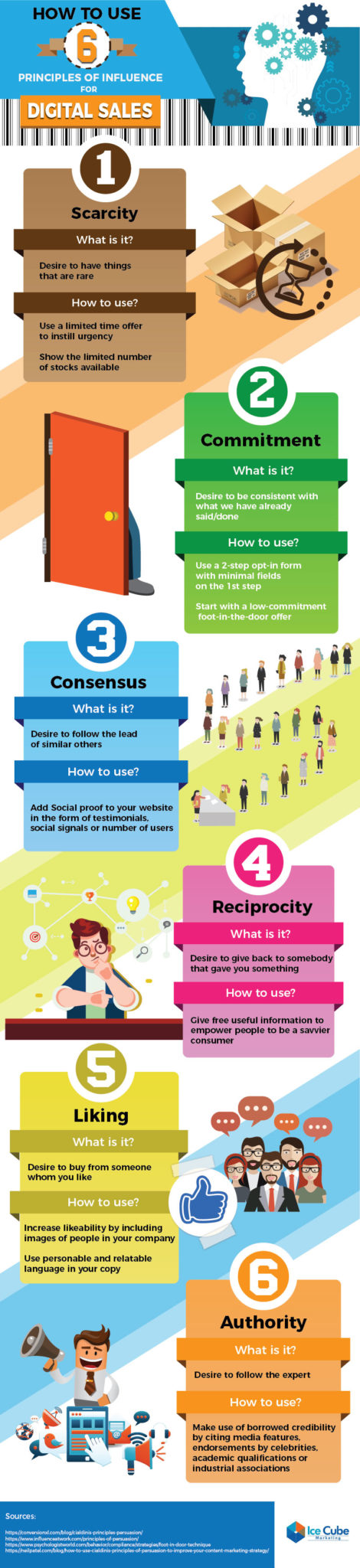
1. Scarcity
People are always driven to take action when things are scarce. If you want your offers to really entice them to make a purchase, you need to give them a strong reason. There are many ways to use scarcity in your online marketing.
This can be anything from offering a time sensitive discount, providing exclusive bonuses for the first buyers, to only selling a limited number of products for acting on your offer.
2. Commitment
People are more inclined to take action once they’ve committed to a previous action. The idea here is to get people to act on small commitments and lead them forward with bigger ones throughout the process. You can think of it as an ascending ladder.
A great way to use this principle in online marketing is to start with lead generation. Give new subscribers a valuable gift for signing up to your email list. You can then follow up with a low cost offer and follow that up later with a higher priced offer.
3. Consensus and social proof
It’s human nature to look to others for proof. People want to follow the crowd because they want to belong and make the right decisions. Social proof is a form of consensus where things like customer testimonials can help convince prospects that your product or service has great value.
A great way to use this in online marketing is to use case studies and personal video testimonials on your sales pages and content. In the eCommerce industry, reviews are one of the most powerful forms of social proof. If you want to go for consensus, you can focus on building a community and create stories involving your customers.
4. Reciprocity
When we are given something of value, it’s normal to return the favor. This principle of reciprocity is a simple buy powerful way to get prospects and customers to take action. A great way to use reciprocity is to offer something that is appealing and relevant to your audience.
This can be anything from free samples, free products, informative content, and free trials. This not only makes people want to return the favor, it gives them a glimpse of the value your business offers.
5. Liking
At the end of the day, people prefer to do business with people they like. This principle is simple but not easy to pull off. How can you get people to like you with online marketing?
You can create a strong personality, tell emotional stories, engage your audience, provide valuable content, and establish clear brand values. The whole process will build a relationship with your audience and also communicate all the ways your business is distinct from the competition.
6. Authority
People want a way to distinguish an average person from an expert. By positioning yourself as an authority, you will be able to do a better job in selling your product or service online.
How do you establish authority? You can mention recommendations from well known figures in your industry, use authority badges (As Seen on TV, Featured on Fox News, Mentioned on the Morning Show, etc.). Other authoritative elements like certifications, degrees, and licenses will also help.
Have you come up with any ideas on how to use these six principles in your online marketing yet? These examples should give you a lot to work off. Make sure you integrate as many of these principles as you can for your next marketing campaign.
— Ted Chong is from Ice Cube Marketing, a digital marketing agency in Singapore that helps local small businesses acquire leads from channels such as Facebook and Google.

- Posted 4.18.20 at 05:07 am by Roy Osing
- Permalink
April 13, 2020
How COVID-19 can actually help a small business do better

Source: Pexels
How COVID-19 can actually help a small business do better.
I know you’re struggling to keep the lights on, pay your employees and just keep your head above water in these insane times.
And I wish you all the very best of luck and that each and everyone of you come out at the end of this deadly tunnel safe and still able to provide the services that we all need in our communities.
So what can you do now that the pause button has been pushed? How can you make the very best of a bad situation and prepare yourself when times get better (and they will)?
Unlike most of a small business leader’s life, you just may have some time available to work ON your business instead of constantly working IN your business 24X7.
You rarely have had the opportunity to look forward to making sure you’re on a path that will increase the likelihood of success because day-in and day-out you’re focusing on what you need to do TODAY to make ends meet.
Here are 5 things you might want to do with your new found bandwidth.
1. Work on the game plan for your business
Whenever I’ve asked a small business owner to work on their business strategy, I get “I don’t have time for that stuff. I’m too busy.”
Well guess what? Now you have the time even though you might not think your business future is great.
Issues to consider in your strategic game plan review:
▪️Reset your growth goals. COVID has destroyed every small business revenue plan so it’s time to reset it. Develop a new 36-month revenue plan with a startup mentality. Think about your challenge as starting over again, because that’s what you’re doing.
▪️Question whether your customer base is still appropriate. After COVID, people will have changed — your previous customers included — and their buying habits have probably changed as well.
You may decide to try and attract different customers than the ones you had prior to the pandemic.
▪️Reassess your competitive approach. Post-COVID, if you choose different customers to attract, you will probably have new competitors to contend with so you’ll probably need a new strategy to beat them.
2. Learn more about new technologies
COVID rules to respect social distancing requires enabling technology, and there are many that have risen in popularity, some old and some new.
FaceTime, Skype have seen a resurgence in use and newer portals such as Houseparty and ZOOM have risen in popularity.
Take the COVID break to learn about communications technology and how it can be used to engage with your customers, suppliers and partners.
The application of technology has the potential to build your competitive strength so use this time to learn as much as you can about the options available.
3. Research new potential suppliers
Again, when you consider going after different customers, you might have to consider modifying your products and services which, in turn, might require new sourcing.
Or even if you decide to stay with your current portfolio of customers and service offerings, you should probably take the time to see if new suppliers might give you a better deal than your present ones.
Better margins should always be in your crosshairs so now you have a window to explore your options.
Take it.
4. Scout out some potential new employees
My view has always been that leaders need to be constantly on the lookout for new talent, and for small business it’s always a challenge to find the right people.
So take the “gift” COVID has given you and get out there and hunt. Hunt for great service people who will carry you reincarnated business to new levels and hunt for others who according to your revitalized game plan are critical to your success.
Get proactive and don’t wait for people to come to you. And poach them from other businesses if you have to.
5. Talk to your customers
Many news video clips these days show customers walking up to a small business establishment, trying to open the door and looking inside with yearning looks on their faces.
Why not take some of your time available and stand outside your closed door and (at the correct social distance away from them of course) talk to people who just might ask you something about your business?
It’s a hell of a way to not only establish a personal connection with people who are already leaning in to you, but it’s also an incredible opportunity to learn something from them that might be of value when you open back up.
Oh, and don’t forget they are very likely to tell their friends and family how AMAZED they were to see you there in these times.
Every business needs referrals; this is a natural and powerful way to get them.
COVID-forced downtime wasn’t in your plan and it’s creating havoc for you, your employees and your customers.
But there might be some benefits if you look for them.
Cheers,
Roy
Check out my BE DiFFERENT or be dead Book Series
- Posted 4.13.20 at 06:22 am by Roy Osing
- Permalink
April 11, 2020
Amazing books every startup entrepreneur and founder should read now
Amazing books every startup entrepreneur and founder should read now.
When asked about the keys to success, Warren Buffett said that he reads 500 pages every day. He claims, “That’s how knowledge works. It builds up, like compound interest.”
Mark Cuban, another iconic entrepreneur says he reads about 3 hours a day. When asked about why he devotes so much time to books, he explained. “I feel like if I put in enough time consuming all the information available, particularly with the net making it so readily available, I can get an advantage in any technology business.”
Other famous startup founders like Bill Gates reads 50 books a year and Elon Musk claims to have taught himself to build rockets by reading.
You get the point. Some of the busiest and most successful people make the time to read. Not only is reading essential for gaining knowledge as an entrepreneur, but it’s an important part of growing your knowledge base, getting exposure to new ideas and changing your modes of thinking.
In a digital world, it’s the norm to default to podcasts, YouTube videos, a quick blog post or the occasional TedTalk to source knowledge. Not that there’s anything wrong with these mediums, but you don’t always get the juicy details that 300 pages will give you. If you’re an entrepreneur who aspires to turn your startup into a successful business, then you’ll want to start cracking open books — or doing so on a more regular basis.
So, where do you start? Not all books offer quality advice and it can be time consuming to sift through reviews to discern quality from fluff. Knowing this, the startup insurance company, Embroker, put together a guide of the best startup books to help point you in the right direction.
They broke these up into three categories for entrepreneurs who are looking to scale their business: growth hacking and scaling, books to read before pitching VCs, and entrepreneurship and startup stories.
● Growth hacking books— These are good reads for the entrepreneur who is specifically interested in what they can do to scale their business — e.g. mastering marketing, product development, sales, and other areas are crucial in growth hacking.
● Books to read before pitching VCs — This section is for founders who are ready to start raising venture capital (beyond what they’ve bootstrapped). If you’re in need of some advice on how to pitch venture capitalists, how to understand VC deal structures and strategies or how to choose the right investors and VC partners, these books are for you.
● Entrepreneurship and startup stories — There’s a lot of value in knowing the stories of other startups: what they’ve been through, what worked and what didn’t. If anything, reading these can be encouraging to let you know you’ve not in the trenches alone. This section speaks to books that cover the ups and downs of entrepreneurship and the startup experience.
More details like an overview of the books, key takeaways and who they’re written for can be found in this full startup book list.
— Keilah Keiser is a freelance writer and content curator with a focus on business development and startups. When she’s not behind a screen, you’ll find her hiking in sunny San Diego with her dog.


- Posted 4.11.20 at 07:12 am by Roy Osing
- Permalink
April 6, 2020
Why do great leaders come out in a crisis like COVID?

Source: Pexels
Why do great leaders come out in a crisis like COVID?
The current COVID-19 pandemic has demonstrated that there are two categories of leaders in the organizational world: those who strut their their academic credentials to the world and who pride themselves on understanding business and leadership theory, and then there are those who have the credentials and theory as a base, but who focus on achieving results by harnessing the purpose and emotion in people.
The ones who think
Intellectual leaders believe that if their solution is based on sound business theory it will be successfully implemented in the field.
And the actions they take to arrive at a solution tend to be analytical in nature: defining potential alternatives, assessing each one of them within a predetermined criteria, and selecting the one that best satisfies the stated objectives and intended outcomes.
Intellectual leaders generally take considerable time in coming up with a solution; the process of pondering, exploration, analysis and decision-making can take copious amounts of time as the leader wants desperately to come up with the “perfect” solution and avoid making a mistake.
Their infatuation with using the tools of analysis chews up so much time that implementation occurs several days/weeks/months after the need for a solution showed itself.
The ones who feel
Emotional leaders salute accepted business principles but place primary importance on how a solution fits the emotional needs of the people who are impacted by it.
Their priority is to find a solution that is “just about right” in terms of applying good business principles, and bear down on the one that appeals to how people feel about it and how the solution will make their job and personal life better today.
Emotional leaders recognize that people are mildly interested in the long term impacts a solution has on the organization but are passionately concerned about how a solution affects the organization and employees TODAY.
The need for immediacy is what enables the emotional leader to rise above their intellectual colleagues and achieve greatness.
Emotional leaders thrive in a moment of crisis.
Crisis circumstances separate the boilerplate leader from the great one for these reasons:
Weekly plans
▪️a crisis forces the leader to think about what action is required over the next 24 hours and upcoming weeks not what’s needed over a longer term planning horizon.
“What needs to be done in the next 14 days?” dominates the conversation, not what should be done to maximize profits over the next three years.
They recognize that if the short term isn’t successfully dealt with, the long term never “shows up”.
24-hour planning forces this leader into action and out of the traditional planning mindset.
Reaction
▪️a crisis forces the leader into a responsive mode; they simply don’t have the luxury of time to carefully plan out what they should do in the face of the unforeseen events.
In a crisis, traditional leadership training is really not helpful except to evaluate the potential actions one could take in the moment.
It’s ironic, really, that more often than not great leadership is defined by the leader’s ability to develop a strategy for their organization as opposed to how well they are able to react to unpredicted body blowssuffered and yet it’s the latter competence that separates the mediocre from the great ones.
People focus
▪️a crisis forces the leader to consider what individuals must have to survive; the needs of the organization are temporarily put on hold.
The leader places each and every individual employee in their organization as the focus of their attention and energy; they under that the broader requirements to grow shareholder value will come once the crisis is successfully dealt with — if the crisis isn’t survived, the longer term is an irrelevant consideration.
Risk taking
▪️a crisis forces the leader to make decisions without having complete information. Making a call that meets the needs of individuals today may in fact have long term negative consequences for shareholders, for example.
Continuing to pay employees while your business is shut down for COVID 19 will reduce profitability for the firm, yet that’s what a great leader does.
Frontline focus
▪️a crisis forces the leader to take care of frontline people; those amazing folks who actually serve the critical needs of others who are threatened by the crisis — hospital workers, first responders, service representatives and delivery drivers.
Getting products and services to the people who need them is the leader’s priority and finding ways to make the frontline job easier in the moment takes all the leader’s energy.
Great leaders do this normally but a crisis brings this action element into focus.
A crisis forces the leader to ACT. NOW. FOR PEOPLE.
Cheers,
Roy
Check out my BE DiFFERENT or be dead Book Series
- Posted 4.6.20 at 04:31 am by Roy Osing
- Permalink