



Roy's Blog: Business Success
July 17, 2017
How to build a great business plan in 3 simple steps

Source: Pexels
Unfortunately, many organizations don’t develop a strategy to guide them into an unpredictable future; they rationalize the current planning process to be too complicated, time consuming and expensive.
And they’re right.
Numerous people gather in a room for a strategic planning session. Subject matter experts descend of the group and try to impress everyone with their detailed knowledge of the many governing factors that need consideration in the strategy building process, and many days are consumed — in my experience wasted — to get the strategy perfect.
Normally the services of a third party firm are used to both facilitate the session and provide expert content to the plan direction and efficacy. This is a clever way of avoiding having the people responsible for the strategy’s success taking ownership of the direction taken by applying their own opinions and good judgement.
The planning team is presented with material, they ask questions about various aspects of it and in the end most of the time they agree with the results of the analysis and direction proposed.
But at the end of the day, the traditional planning process takes so much time and energy, there is insufficient time left to develop how the plan will be executed in the trenches by real people. And the planning team is left with a strategy that may make sense on paper, but can’t be executed effectively because there was insufficient time devoted to implementation.
Get insanely focused on execution
Given that eventually any strategy or plan must result in action, the best planning process is predicated on the premise: keep it simple, get to the gut issues quickly and ACT.
Minimize the strategy direction setting time; maximize the implementation action planning time.
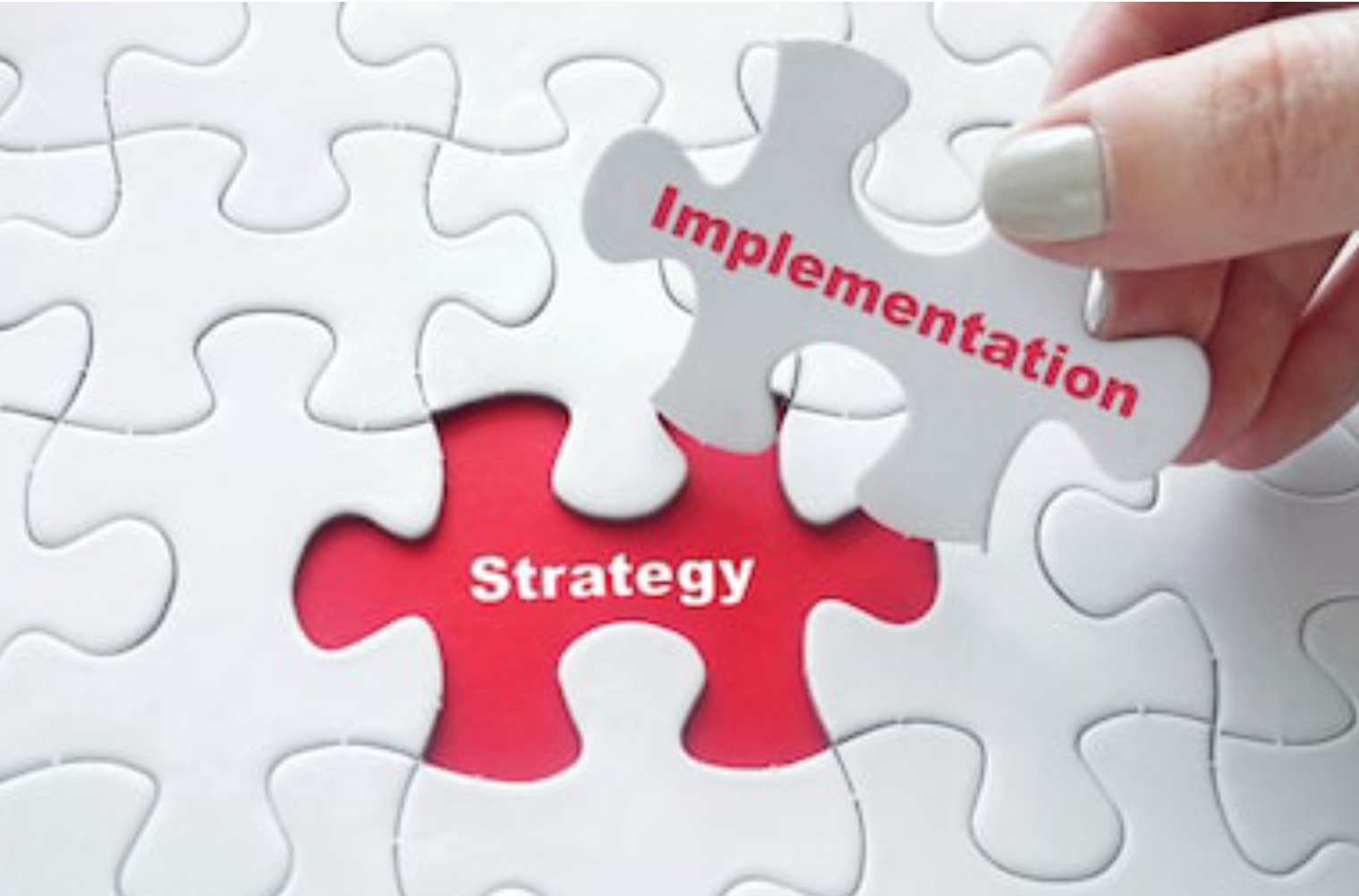
Loosen up on strategy development; tighten up on execution.
The strategy-building process I developed was necessary because although the field of experts who could help me develop a theoretically pristine direction was wide and deep, the number who actually could help in plan execution was close to zero.
The process I developed was simple, fast and time efficient. And unlike its brethren, it used the knowledge and experience of the planning team members rather than going with a third party planning expert — added benefit was the team building that went on during the process.
My process — the strategic game plan — was based on discovering the answers to 3 questions; the answers defined the strategy.
Growth — HOW BIG do you want to be?
Most planning processes end with financial results. They calculate the growth results of executing the strategic direction chosen.
My process starts with your growth intentions, and builds the strategy from HOW BIG you want to be. The reason is simple: more aggressive growth goals require a more aggressive — and risky — strategy, and more moderate growth goals need a more incremental — and less risky — strategy.
The traditional planning approach forgets that there is an extremely tight relationship between revenue growth and strategic intent; my strategic game plan doesn’t and that’s what makes my approach DiFFERENT than others.
Customers — WHO do you want to SERVE?
You have a goal to grow revenue 25% annually over the next 36 months. The next question is where are you going to get it? Where are you going to invest your scarce resources of time and money.
It boils down to selecting a group of customers who collectively have the potential to generate the revenue you have decided to go after.
To get the right answer to this question requires an intimate understanding of the various customers you serve. You can’t choose the customer group to generate the revenue you covet if you don’t understand the propensity of your various customer segments to buy from you — discover their secrets and success will follow.

Competitors — HOW will you compete and WIN?
It would be nice if you were the only provider of products and services to the customer group you’ve chosen, but that’s not likely to be the case. There is likely to be healthy aggressive competitors targeting the same customers you want to target, so the challenge you face is to determine how you will differentiate your organization from all others you will be competing with.
Why should people choose your organization when they have other choices available? What makes your team special in view of the alternatives available?
HOW will you compete is intended to explore the competencies of your organization that you can exploit to gain competitive advantage, with emphasis on how you can be positioned in the customer group you’ve chosen as the ONLY one that does what you do.
By answering these 3 questions using the expertise of those in the room you will have your strategy quickly (less than 3 days) and inexpensively (a personalized experience for your team). And it will be owned by every person who has contributed to it which means execution will follow.
Cheers,
Roy
Check out my BE DiFFERENT or be dead Book Series
- Posted 7.17.17 at 04:10 am by Roy Osing
- Permalink
June 12, 2017
Why progress is made by being effective first and efficient second

Source: Pexels
Why progress is made by being effective first and efficient second.
Progress in any organization can be achieved in two ways: being more efficient and being more strategic.
In the former instance, progress is achieved by reducing the rate of product or service breakdown, eliminating software bugs, reducing outstanding collectibles, reducing cost to increase operating margins, reducing inventory turns, reducing the rate of customer attrition and reducing employee turnover.
These efficiency gains are targeted to improve operations by a process or procedural change that simplifies the way things are done, reduces cost and improves productivity.
The most common method employed to be more efficient is to benchmark a best in class organization and copy their methods.
Followed to its ultimate conclusion, the copycat method results in all participating organizations gravitating to the same internal operational methods and approaches; they don’t bestow any uniqueness whatsoever.
Efficiency driven programs are tactical; they seek to make the organization ‘machine’ work better; progress is measured by assessing the output of a process both in terms of time and quality - delivering the intended outcome right the first time.
Efficiency gains will not move the organization to higher levels of performance in the long run. They may boost operating results in the short term through a period of continuity, but they cannot be relied on to deliver long term success over multiple cycles of economic and competitive change.
Sustainable progress can only come from being strategically efficient; achieving strategic breakthroughs as opposed to applying the efficiency formula to the way business is currently conducted
Efficiency gains should only be considered after strategic objectives based on taking the organization to a knew place’ have been set. Determine the strategic progress needed first and then look for the efficiency gains necessary to make the journey as productive as possible.
There should be a single focus of strategic progress - inching ever closer to being the ONLY organization that does what it does.
Specifically, creating a customer value proposition that answers the question “Why should I do business with you and no one else?”
This is the real measure of whether or not an organization is making progress strategically; the ability to craft and fine tune over time their ONLY Statement that declares what they uniquely do to serve their customers.
More resource time is spent in organizations pursuing efficiency gains rather than starting down the path of uniqueness.
Why?
Because it’s much easier to copy best practices and achieve incremental progress than it is to seek a special place in the market that you and only you own.
The thing is, if there is no pain, there’s likely to be no gain.
Focus your efforts on being unique in a compelling and relevant way and being efficient in that world.
If you’re successful your progress will be measured by product and service innovation, disruptive technology introduced, revenue growth and market dominance, not systems throughput.
Leave blind efficiency to the herd.
Cheers,
Roy
Check out my BE DiFFERENT or be dead Book Series
- Posted 6.12.17 at 02:51 am by Roy Osing
- Permalink
June 5, 2017
Why the downside is really an exciting upside in disguise

Source: Unsplash
Many people I associated with over my career were ‘one-timers’ when they ran into an unforeseen problem.
They would typically shout their displeasure - “Awe sh*t” - and make excuses to their boss for why they were unable to deliver the expected result.
They were victimized by the assault of a random event.
They reached back for the ‘Things happened that were beyond my control’ to explain why they were unable to succeed.
Like it’s ok to fail because things didn’t go as planned.
It’s nonsense of course.
There are ALWAYS unforeseen and unexpected events that reveal themselves to challenge the successful attainment of a goal. It is rare that a plan plays out according to its original script; only the naive and inexperienced believe that the plan is immune to the randomness of the marketplace.
That’s not the way the real world works despite school teachings.
Success-driven people are different than the ‘excuse artists’
They are naturals at looking at a potentially negative situation and finding the pony; they are magnets for an opportunity buried in the excrement.
When confronted with a setback over which they have no control, they deploy these actions to recover.
1. They emphatically declare to one and all their intention to NOT accept they bad hand they have been dealt and that they will find a way to get back on track. They want everyone to know that THEIR brand is all about coming back not giving in.
2. They study the forces that caused their plan to go awry; the detailed characteristics of the intervention at play. They work hard to get the facts that caused the problem rather than succumbing to emotion.
3. They evaluate the specific impacts created on the current course of action. They calculate the new plan vector from the old plan + interruptive force. With no counter initiatives where is the original plan likely to go given the unexpected disruption?
4. They look for nuggets; opportunities disguised as a body blow. Given the new force at play how can its energy be harnessed to create an intervention of your own? And a new direction? “This is how it might work” replaces “Damn it didn’t work”.
5. They don’t stop. They continue to iterate through possible adaptations until they find one that will work. Not a perfect solution (for that could only happen with a return to the original plan) but a good “imperfect” one.
Forces in the environment can’t be predicted but successful people can make the best of a bad lot in remarkable fashion.
Cheers,
Roy
Check out my BE DiFFERENT or be dead Book Series
- Posted 6.5.17 at 04:30 am by Roy Osing
- Permalink
April 19, 2017
4 proven ways to execute your business plan better

Source: Unsplash
4 proven ways to execute your business plan better.
With so many experts around, running a successful business is complicated.
There are finance experts who promulgate principles for having a healthy balance sheet; sales wizards who describe what an effective sales funnel looks like; inventory management specialists who define the level of product turnover required to drive optimum operating margins and leadership pundits who prescribe the fundamentals necessary to maximize employee engagement and loyalty.
Each discipline brings their own specific area of expertise to the table to help organizations enhance their performance, but how does leadership determine which specific tools are key to improving their organization?
It’s too complicated.
There are numerous moving parts involved in how an organization operates, and determining how each component part should be synchronized to optimize overall effectiveness is an extremely difficult challenge.
It’s like a golfer trying to improve their game.
There are lessons in how to address the ball, grip the club; the backswing; the ball impact; shifting body weight; and the follow through. The golfer focuses on the grip and can’t assimilate the rest of the swing fundamentals; their game doesn’t improve to the level they expect. They are frustrated.
It doesn’t have to be that way.
Business can be simplified; it can be boiled down to a single crucial focus that drives sustaining levels of remarkable performance and growth.
Leaders should be building organizations to execute brilliantly; building execution as a core competency and applying it to any strategy they create
And if they do, they will outperform their peers and outpace their competitors.
Pay attention to these four execution fundamentals.
1. Planning — Ease up on planning. The most critical element of performance is how well the strategy is carried out.
The biggest challenge for most businesses is executing well - not devising helium-filled plans for reaching the next level. — Peter Drucker
Yes, a meaningful plan with a sensible direction for the organization is required but if execution falters the plan is worthless.
An average plan brilliantly executed produces far better performance than what people might consider to be a brilliant strategy with mediocre execution.
Invest 80% of your time on planning to execute and 20% on strategic planning
2. Serving — Lead by serving those in the trenches. Serving leadership cultures unleash individual executional effort and lead to unexpected and amazing results. Leadership presence in the workplace engaging with frontline people is an incredible motivator to execute better.
“What can I do to help?” is the question serving leaders pose to reduce the grunge employees face when trying to do their job, and to eliminate internal barriers — rules and policies for example — that prevent things from getting done in a smoothie efficient way.
3. Recruiting — Recruit people ’lovers’. Customers are loyal to an organization when they feel cared for by employees who invest honest emotional energy in taking care of their wants and needs.
Execution prowess demands that millions of mind blowing moments of truth occur seamlessly between an organization and its customers 24X7X365.
This happens only when employees have the innate desire to serve another human, so your hiring plan needs to be driven to discover these folks who serve in their DNA.
And remember you can’t train people to love people; you can train ‘em to grin but that’s about it.
If your employees don’t love one another, they can’t possibly love the customer
4. Selling — Stop selling; start serving. Flogging products and services tries to advance the organization’s agenda, not the customer’s.
This one-sided dynamic may result in a single short term transaction but does nothing to create an annuity stream of revenue over the long haul.
Execution genius looks out to the horizon, so organizations need to be mindless about building and deepening rich customer relationships by serving them; marching to their agenda; subordinating the interests of the business to their interests.
Remarkable execution is vital to grow a business, so build an execution machine first and then fuel it with each strategy you have.
Cheers,
Roy
Check out my BE DiFFERENT or be dead Book Series
- Posted 4.19.17 at 12:06 pm by Roy Osing
- Permalink