




Roy's Blog: Entrepreneurs
June 23, 2023
“Welcome to the Roy Osing Story” Podcast
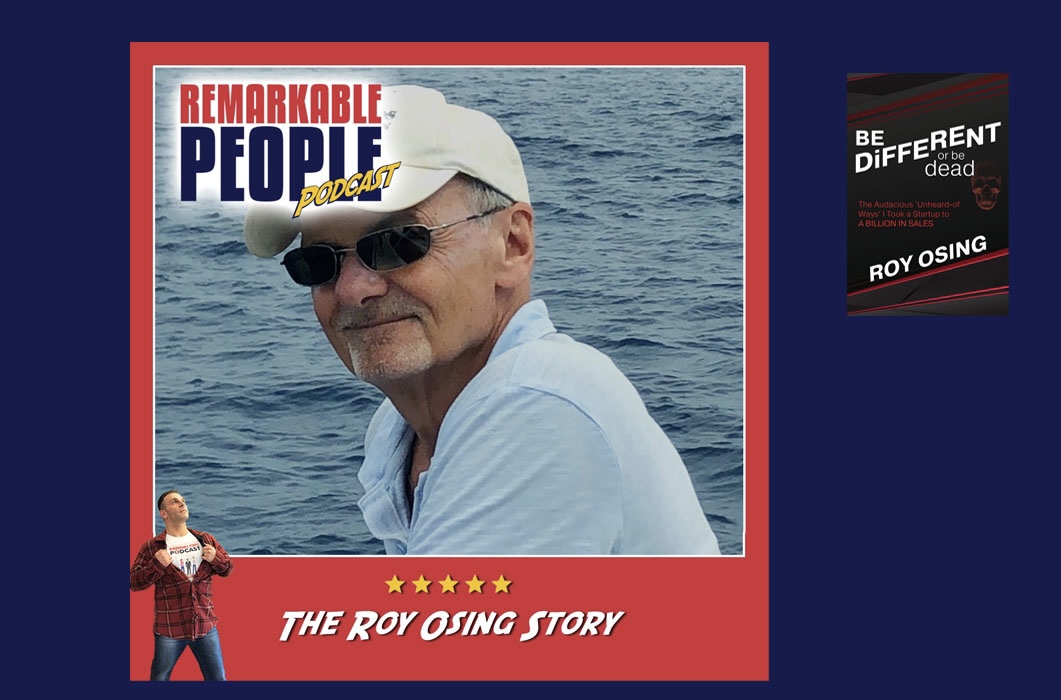
Standing Out, Defining the Fox, & Being “The Only One”
EPISODE OVERVIEW:
“Have you heard the one about that guy who built a billion dollar company? You know, the one that talks about becoming “the only one”.
Watch or listen now to learn how you can differentiate yourself in business personally, and as an organization. And according to this man, that’s how you experience billion dollar success.
He’s going to walk us through his life story, explain the key elements of success that you and I can learn from and apply, and then he’s going to share with us the practical steps of how to take the next step in our own journey.
Today’s guest is a gentleman, an entrepreneur, and an expert at growing organizations. He helps people recognize their worth, and is a catalyst for growth in their lives.
He’s written seven books, led multiple organizations, and even though we don’t mention this in the show, he’s balanced it all and been married now for over 56 years!
Ladies & Gentlemen, welcome to the Roy Osing story!”
— David Pasqualone, Host, The Remarkable People Podcast
- Posted 6.23.23 at 06:54 am by Roy Osing
- Permalink
June 19, 2023
5 really amazing secrets that smell success in your small business

5 really amazing secrets that smell success in your small business.
In my experience working with small business leaders, one thing shouts out loud and clear: you spend most of their time working IN your business not ON your business.
Time is precious to you..
Resources are scarce.
But your goal, nevertheless is to build a thriving business with superlative performance.
How do you do it?
The secret for small business leaders is to FOCUS on the critical FEW things that will make a huge difference to their success.
These 5 things are vital to small business success.
#1. Plan….. simply.
Every small business needs a plan or strategy to follow. No plan = No idea of whether or not you’re making progress.
But the plan doesn’t have to be arduous, complicated or expensive.
My Strategic Game Plan (SGP) process was designed to get the end game ‘just about right’—there’s no such thing as a ‘perfect’ plan in an imperfect world—and execute pristinely—results come from execution and nothing else.
Once the SGP is in place it serves as the small business roadmap without which success is almost impossible.
#2. Be the ONLY one.
Give people a reason to do business with YOU and not your competition.
Promise them something that no other business does.
Create The ONLY Statement—“We are the ONLY ones who…”—that sets you apart and watch what happens!
#3. Hire human lovers.
Your employees are the reason people do business with you. Sure, technology helps but without your employees, you don’t have a business.
Recruit people who genuinely like others; who care for them and satisfy them.
You can train people to grin at people , but you can’t train them to ‘love’ them.
#4. Create a unique customer experience.
Your products and services are important to be sure, but people expect them to live up to the benefits you ascribe to them.
But strong loyalty and high performance come from how people FEEL when they do business with you, and that’s all about the experience they have when engaging with you.
With employees who ‘love’ people you are armed with all you need to make your customers feel special. And when they feel this way, they tell their friends, who then tell their friends.
And magic happens.
#5. Create don’t copy
Be innovative in your business; don’t follow what works for others. All it does is put you in the common herd and moves you away from being the ONLY one who does what you do.
Look for new ways of doing business and SURPRISE your customers.
Let someone else be the copycat.
You be the leader.
Cheers,
Roy
My 50+ Podcast Shows that will change your life.
Check out my BE DiFFERENT or be dead Book Series
‘Audacious’ is my latest…
- Posted 6.19.23 at 05:38 am by Roy Osing
- Permalink
May 8, 2023
4 exciting breakaway moves to leave ‘the herd of sameness’

4 exciting breakaway moves to leave ‘the herd of sameness’.
The herd of sameness.
The undifferentiated mass where everyone’s the same.
Where compliance rules.
Where conformity reigns supreme.
Where risks are avoided.
Where no one stands out.
Where commonness and average describe its constituents.
Where momentum from the past defines its direction.
Where innovation is missing in action.
What I mean by ‘breakaway’.
▪️divergence.
▪️radical change,
▪️sudden attack or movement,
▪️’violent’ exit away from the herd.
For those of you who have followed my work—books, blogs, podcasts—you know that I advocate choosing a journey that others don’t.
Finding a way forward that serves others in ways that others don’t.
Discovering your ‘sweet spot’ in a world where copying runs rampant and originality is a lost art.
Some might say that’s what ‘pivoting’ is all about.
No it’s not.
A pivot is a change of direction from the past. It’s an incremental move away from past momentum. It’s a shift making use of the competencies that have been developed in the past.
A breakaway move is disruptive.
It reinvents the playing field by virtue of the move you make. It dismisses the past in terms of reliance and usefulness; it isn’t used to inform the future.
I took a startup to A BILLION IN SALES by creating these 4 breakaway moves intended to create something NEW that could drive miraculous performance.
Move #1. BE DiFFERENT!
▪️Don’t COPY.
Copying what others do keeps you in The herd of sameness. Look for ways to CREATE, not copy. Purge ‘best in class’ from your vault of business tools.
▪️Avoid CLAPTRAP.
Stop thinking of yourself as faster, better, best, leader or #1.
“We provide the best customer service.” is pure conjecture offered by the company spewing the words.
Start thinking of how you can become The ONLY One that does what you do in satisfying what is compelling and relevant for people.
▪️Shed ASPIRATIONS.
Ground yourself when it comes to defining what makes you special. A helium-filled 10,000-foot aspirational declaration doesn’t help convince people to do business with you.
“We are in business to save our home planet” may make the organization feel good about itself, but it does little to make it perfectly clear why they, and no one else, should have your business.
The ONLY Statement puts precision to your promise. It’s clear, measurable and understandable. It’s your Ground Zero.
Move #2. EXECUTE!
Academics and other so-called ‘experts’ have convinced us that the strategy is the critical element of high performing organizations.
They preach that the Plan must be elegant—by using their quantitative toolset—and it must be ‘perfect’—by accurately predicting the outcome of the Plan.
As a result, we spend 80% of our time trying to get the Plan absolutely ‘right’ in an imperfect world with stochastic events relentlessly bombarding us.
Stop! My experience in marching to A BILLION is that EXECUTION is the planning element that needs more attention than the Plan itself.
Get the Plan ‘just about right’ and execute it flawlessly is the real prescription for unbelievable performance.
My Strategic Game Plan is based on the view that a perfectly workable Plan is to ‘head west’.
Start executing. Learn from how well you’re executing. Learn from any unpredictable events—‘body blows’—that have rocked you. Adjust the Plan. Keep executing.
Move #3. SERVE!
Actually, the leadership herd of sameness is large and growing.
Most leaders are rote practitioners. They follow the leadership pedagogy promulgated by theorist academics and HR pundits who all espouse the same fundamentals.
Tactics of leadership are encouraged as the things leaders should do in order to transform themselves into ‘great’ leaders.
And so, tactics dealing with communications, delegation, team building, planning and others rain down on the leadership crowd with everyone getting washed with the same soap.
This is a BIG problem in my view.
Tactics should always be informed by strategy; tactics without strategic context serve no productive purpose other than satisfying the ‘expert’ pushing the tactics under their definition of ‘the right thing to do’.
My leadership guide was always to enhance the ability of the organization to EXECUTE! our Strategic Game Plan pristinely and hence improve performance and results ever higher.
My prime focus was to embed myself in the workplace—I call it ‘Leadership by SERVING Around (LBSA)—asking one simple question: “How can I help?”
The ‘gold’ I discovered from my breakaway move for the most part was what had to be done to remove the mud and grunge in the organization that was preventing effective execution: ‘dumb’ rules, policies, processes, systems and procedures that didn’t enable strategy execution, they prevented it.
Drawing a direct Line of Sight for people between their specific job responsibilities and the strategy was another SERVING Leadership role I played. Simple reason why it was important: if people understood exactly what they had to do to effectively execute the strategy, chances are their actions would deliver the strategic outcomes expected.
LBSA didn’t make me a ‘better’ leader, it made me a DiFFerENT leader from everyone else in ways which were required to drive performance through the roof as we marched to A BILLION IN SALES.
Move #4. DO-IT-YOURSELF!
There are certain tasks that should be delegated, but there are also some things the leader should do themselves regardless of what the books say.
’Strategic Micromanagement’ is my way of describing the fact that certain tasks associated with the execution of the organization’s strategic imperatives should be owned by the leader. No delegation. Period!
Audacious breakaway leaders NEVER delegate the stuff relating to the execution of their strategy.
These are some of the actions I took personally.
▪️ I ‘put my fingerprints’ on architecting ‘The Customer Moment’, the customer engagement process required to deliver amazing service experiences. Defining the behaviors required to ‘dazzle’ a customer were led by me. I took on the job of ensuring the organization knew what ‘Moments’ looked like, and trained everyone to deliver them.
▪️ Selling the organization’s Strategic Game Plan to employees was MY responsibility. I didn’t delegate it to anyone. It was my way of hearing first hand what people thought of the journey we decided to take and what they needed to fulfill it.
I had to answer the tough questions about why we chose the path we were on and how we were going to be successful.
▪️ I took on the role of ‘Strategy Hawk’ for my organization. It was my personal responsibility to monitor how effectively our strategy was being implemented and what remedial actions had to be taken to get us back on track when our results strayed from objectives.
▪️ I personally participated in the recruitment process for frontline managers and, on occasion, frontline employees as well. Panel interviews were held with potential candidates and I played an active role asking questions and selecting who got the job.
My objectives were twofold: first, to ensure that people in positions ‘close to customers’—I consider the frontline manager to be one of the most important positions in any organization—had the right Leadership By Serving Around skills and attributes and, second, to model the interview dynamics—questions and probing—for the other managers in the room.
Frontline people are key to executing a strategy; I wanted my fingerprints on the frontline recruitment and selection process.
Conclusion
Inertia plagues the ability of organizations and individuals to achieve superlative levels of performance which can only be achieved by a desire to breakaway from the momentum of the past.
My breakaway roadmap worked for me, and I guarantee it will work for you if you trust it.
✔️ BE DiFFERENT!
✔️ EXECUTE!
✔️ SERVE!
✔️ DO-IT-YOURSELF!
Cheers,
Roy
My 50+ Podcast Shows that will change your life.
Check out my BE DiFFERENT or be dead Book Series
‘Audacious’ is my latest…
- Posted 5.8.23 at 07:00 am by Roy Osing
- Permalink
May 1, 2023
Why being imperfect FAST! is the secret to amazing business growth

Why being imperfect FAST! is the secret to amazing business growth.
Imperfection is the engine of innovation—trying different things. And in my experience perfection—however defined—is not needed to win.
We didn’t get to a BILLION in annual sales by being perfect in the classical sense. Check out the audacious ways we got there.
While you’re intellectually seeking perfection, you’re not DOING anything!
Pondering perfection is an excellent way to do nothing and fail.
You need to create your own version of perfection, that will be the solution—inelegant and messy probably—that works for you.
— What do you mean when you say a business needs to imperfect ‘FAST’?
Rarely does anyone achieve unbelievable success after one attempt; they will seldomly ‘get it right the first time’.
You will have to make many ‘tries’ before landing on something new that will work.
Failure is an essential ingredient of innovation. So ‘fail a lot’ is a strategic imperative.
Success depends on the number of tries you make (so many variables at play in a highly complicated and unpredictable world), which means that making many tries FAST is essential.
— How does being imperfect FAST make an organization different?
Because it leads to more innovation. A constant stream of tries will eventually create something truly special that raises performance to astonishing heights.
An ‘imperfect FAST’ culture sets the organization apart from others who are stuck in the ‘perfection seeking mode’ and making little progress.
It inspires employees so an adaptive organization culture is nurtured.
— What are the benefits of being imperfect FAST?
▪️It aids in the execution of your strategy.
▪️It ‘keeps your feet moving’, on your toes to take a turn when your plan isn’t working out the way you want.
▪️It avoids the impossible task of taking copious amounts of time seeking a solution that doesn’t exist—perfection.
▪️It effectively prepares you to deal with uncertainty and unpredictable change.
▪️It feeds the innovation organizational value. You can’t be innovative with the belief you can find a silver bullet that will miraculously do the job for you.
It doesn’t exist.
Speed is a competitive advantage.
▪️First mover advantage with imperfection makes you standout and puts you ahead of the herd.
— What actions can an organization take to be imperfect FAST?
✔️ Leaders must declare that it’s ok to be imperfect. That the number of ‘tries’ is the innovation journey that will define ultimate success.
✔️ Embed ‘tries’ in performance plans. Everyone should be expected to try new things. Trying must define the culture of the organization.
✔️ Celebrate ’triers’ constantly. What a great way to make trying matter. Have fun with it. Recognize trying heroes.
✔️ Create an ‘Imperfectionist Club’. I’m thinking the ‘Cult of Triers’ would be an excellent way to kick this journey off. Start small and build the cult to include the entire organization.
In a world of imperfections, why do we constantly try to be perfect?
Doesn’t make sense to me.
Want to stand out from the crowd and win?
Be imperfect FAST!
Cheers,
Roy
My 50+ Podcast Shows that will change your life.
Check out my BE DiFFERENT or be dead Book Series
‘Audacious’ is my latest…
- Posted 5.1.23 at 06:56 am by Roy Osing
- Permalink

