



Roy's Blog: Business Success
May 18, 2020
How marketer’s can easily create amazing value packages for people

Source: Pexels
How marketer’s can easily create amazing value packages for people.
In my experience as a CMO for a number of years, a marketing organization that has a strategy with these three elements is miles ahead of other organizations, and becomes the best practice for the herd to follow.
The strategy they follow involves a unique approach to:
▪️ The process used to understand what people want and desire.
▪️ The information selected on people that makes a difference on whether or not someone chooses you as their provider.
▪️ How to transform the information into something that people will pay for over and over again.
The process to follow…
The old adage that knowledge is power has a specific application in an environment where competition is fierce, economic shifts are dramatic and unpredictable and where customer wants and desires are changing almost every hour on the hour.
Most organizations employ market research as the tool for discovering the mood and needs of customer groups; the studies are typically performed by an external firm and are done periodically.
Market research has limitations.
— First and foremost, as the name suggests, it deals with ‘markets’; aggregations of people who express similar needs. The problem is that no two people are identical in any way, so when you look at market data you are looking at a blend of individuals where no one specifically is like the data gathered.
— Second, the fact that it is done periodically means that the rapid pace of changing needs could put organizations out of touch with what the current priorities are for the customer.
What people desire in this moment are likely different from what they yearned for a moment ago.
— Third, being outsourced to 3rd party contractors puts the management of customer knowledge outside the organization, and the understanding and application of it in the hands of a few employees.
Marketing receives the customer data and decides what it means to their marketing programs.
A new research model is needed; one that leverages the gathering of customer insights on the run to be a core competency of an organization that is unmatched by others.

Source: Unsplash
A core competency that applies the continuous stream of changing customer needs discovered to create opportunities and solutions for the customer that others simply are unable to do.
Customer learning is the answer.
Customer learning is the continuous process of capturing customer needs, wants and desires real time in the moment they touch the organization.
The idea is that every time a customer ‘touches’ the organization, it represents an opportunity to learn something about them.
My approach was to define all touch points in the organization and focus on the ones that represented 80% of the action.
Any customer touch point can yield productive learning if you consider it as a strategic learning opportunity rather than just a customer contact.
The challenge is to engineer the contact to produce the maximum amount of learning. Structure the engagement to allow you to easily gather their information you seek; ask the right questions, be unobtrusive and let the magic begin.
Obviously one of the engineering issues organizations need to get over is the amount of time an employee is allowed to spend with a customer. If they are managed by how long the engagement takes, the amount of quality information on the customer will be reduced.
And, for online applications, the engagement process must be structured to encourage people to provide information on the website. This has limitations, of course, because it’s not a conversation where the dialogue opens up opportunities to obtain more information from a person.

Source: Unsplash
A touch point that paid off handsomely for me was the customer complaint; when a customer called in with a complaint about something.
Dealing with complaining customers may not rank #1 on the rewarding experience scale for employees, but the complaint can, if listened to closely, produce useful information on how you can better serve your customers.
As an aside, I’m not a fan of being pointed to a FAQ web page as the organization’s way of handling my complaint. The questions are rarely relevant — because they’ve been prepared by employees from encounters with other people — and the moment leaves me frustrated and annoyed. On the other hand, I’ve had some terrific experiences with the Chat function; more resources should be deployed here.
What to do with all the information gathered from customer moments? Store them in a repository that is used by marketers to develop meaningful solutions to the problems and opportunities buried in the data.
The scope of customer learning is to look at the customer holistically; what their needs and wants are at the highest and broadest level.
The idea is to look laterally across their persona to discover their integrated needs rather than to look vertically to define a narrow — slice — need.
A holistic need for a consumer could be to travel every 6 months with their family; a slice need could be to have faster internet speed.
For a business a holistic need could be to leverage technology into a competitive advantage; a slice need could be to increase inventory turns by twofold.
To be able to use your marketing machine to standout from your competitors, it starts with institutionalizing a process to continually learn about your customers.
The information to gather…
The challenge in a world where virtually everyone has their basic needs satisfied is determining how an organization can stand out and be noticed. How does it get tagged with being remarkable and indispensable by their customers?
Today people are looking beyond their basic needs to feed their cravings, wants and desires. They are driven to a higher level to seek happiness; basic needs satisfaction may give people a lift for a period of time but the lustre soon fades — a new SUV soon becomes a used car.
As marketers, if we continue to focus on what people need we will miss the opportunities that lead to market leadership and enhanced profitability. The source of this huge untapped potential are the untapped secrets hidden in the deepest nooks and crannies of every individual that define who they are and how they want to express themselves.
A customer secret is what someone craves, aches and hungers for.
A customer secret has little to do with what someone needs. They need food, shelter, water and dependable communications — they expect to get them and pay as little as possible when they do; they might crave to see a Liverpool game played at Anfield in England and are willing to pay more for the opportunity to have their dream come true.
In a business setting, they might need power to run their manufacturing facility, but would be delighted to have a consultant recommend how alternative technologies could be employed to drive costs down and efficiency up.

Source: Unsplash
Exactly how does one gather secrets? People divulge their secrets only to others they trust, have confidence in, and have a strong relationship with.
If you are an outsider, they won’t tell you anything (other than perhaps what they need) and you won’t discover the gold that will enable you to have a profitable long-term relationship with them.
So, focus on relationship building with people you choose to serve. And don’t expect results overnight. It’s a long term investment; you can’t earn someone’s trust in a 60-minute interaction with them.
Secret gathering is a personal affair. Commit to informally meeting face-to-face with customers every week as a personal priority; you can’t discover secrets from your office. And have a casual conversation with the person you’re meeting; it’s not a formal market research interview — and don’t try and sell them on anything.
Avoid prying into personal matters unless it is a natural lead-in based on the conversation you are having. After the ice-breaker question, be guided by what they say.
And take lots of notes if it’s ok with them. It shows you’re interested in what they have to say.
How to use the information you gather…
Marketing with the focus on products and services is the way most companies engage with the market and compete today.
Nothing wrong with this, but it’s hard to find a unique niche where your competitors won’t find you.
Product competition is always challenged with how to provide features others don’t.
Rather than the traditional product-centric approach, unforgettable marketing is moving to offering packages of value that reflect the broad holistic view of the target customer in terms of their needs, wants and desires.
The key question is, of course, how do you move to the package creation mode when you have been stuck in the product-only gear for so long?
Here are the 5 steps to follow to create packages around your products and services.
Define the core product — start with your core product. It will be the anchor for your package and generally represents the key product or service that you want to offer.
Add elements to your core product — Identify additional components that can be ‘wrapped around’, or added to, your core product.
The choice of what value to add is based on what you have learned — through the customer learning process — about your target customers. The more you know about the customer the easier it is to choose what added elements are appropriate.
Your end game is to create a package that addresses a relevant want or desire in the most compelling way possible.
Resist the temptation to add too many value elements; don’t complicate the package.
Try to add just three additional value components that present a consistent and seamless value proposition to the customer and a natural add-on to your core product.
You can always add more elements later if you discover there are unsatisfied wants evident or if your competition does something creative and you need to respond.

Source: Unsplash
Choose synergistic value components to create your package in order to present a cohesive theme to the customer.
If the value components don’t work well together, your target customer group won’t understand the overall benefits your package provides.
If you are in the financial business, for example, with an anchor product of financial advice, you might consider additional value elements such as on-line self management investment tracking tools and quarterly financial management seminars which all play well together.
Or you might consider wrapping these elements around a four seasons resort hotel room:
— spa services
— yoga classes
— resort activities such as zip lining and water rafting
— a bottle of the customer’s favourite wine with a meal
— day care services
Create the value proposition — Define the value proposition for your package — what is the collective benefit the package provides to the customer?
This is not a statement that simply adds together the benefits of each package component rather it’s a declaration of the overall benefits of all package elements working seamlessly together.
In my example above, how might you define the collective benefits of financial advice, on-line tracking tools and regular seminars? You need to express the theme they collectively express. How about something like “investment self-management”?
Brand the package — Brand your package reflecting the value proposition you’ve created.There is no sense creating something new and not taking credit for your innovation. Too many organizations are into the bundling where product elements are simply added together and a discounted price is applied.
That’s not what I advocate.
Packaging is all about creating something new; bundling is merely slapping currents products together with reduced prices being offered with the volume increase.
Your new brand should reflect the collection of benefits provided. In the example that we have been using how about branding the package ‘The self-management Investment Plan?
Price your package — Price your package in terms of the market value provided.
Think premium pricing. Avoid the bundling mentality — and commodity thinking — of discounting the package based on the number of components in it.
If you have hit the mark with relevant, compelling value you should be able to command a premium price and realize healthy margins.
If you learn that you can’t price your package at a premium level, you have not defined it well enough — your package doesn’t contain the right combination of elements that result in a value proposition people are willing to pay more for.
Go back to the drawing board. Start over.
If you love your marketing craft and want to excel in it, do it the right way. Do it in a way no one else does.
Practise the process I’ve given you here and I guarantee success will be waiting.
Cheers,
Roy
Check out my BE DiFFERENT or be dead Book Series
- Posted 5.18.20 at 02:18 am by Roy Osing
- Permalink
April 13, 2020
How COVID-19 can actually help a small business do better

Source: Pexels
How COVID-19 can actually help a small business do better.
I know you’re struggling to keep the lights on, pay your employees and just keep your head above water in these insane times.
And I wish you all the very best of luck and that each and everyone of you come out at the end of this deadly tunnel safe and still able to provide the services that we all need in our communities.
So what can you do now that the pause button has been pushed? How can you make the very best of a bad situation and prepare yourself when times get better (and they will)?
Unlike most of a small business leader’s life, you just may have some time available to work ON your business instead of constantly working IN your business 24X7.
You rarely have had the opportunity to look forward to making sure you’re on a path that will increase the likelihood of success because day-in and day-out you’re focusing on what you need to do TODAY to make ends meet.
Here are 5 things you might want to do with your new found bandwidth.
1. Work on the game plan for your business
Whenever I’ve asked a small business owner to work on their business strategy, I get “I don’t have time for that stuff. I’m too busy.”
Well guess what? Now you have the time even though you might not think your business future is great.
Issues to consider in your strategic game plan review:
▪️Reset your growth goals. COVID has destroyed every small business revenue plan so it’s time to reset it. Develop a new 36-month revenue plan with a startup mentality. Think about your challenge as starting over again, because that’s what you’re doing.
▪️Question whether your customer base is still appropriate. After COVID, people will have changed — your previous customers included — and their buying habits have probably changed as well.
You may decide to try and attract different customers than the ones you had prior to the pandemic.
▪️Reassess your competitive approach. Post-COVID, if you choose different customers to attract, you will probably have new competitors to contend with so you’ll probably need a new strategy to beat them.
2. Learn more about new technologies
COVID rules to respect social distancing requires enabling technology, and there are many that have risen in popularity, some old and some new.
FaceTime, Skype have seen a resurgence in use and newer portals such as Houseparty and ZOOM have risen in popularity.
Take the COVID break to learn about communications technology and how it can be used to engage with your customers, suppliers and partners.
The application of technology has the potential to build your competitive strength so use this time to learn as much as you can about the options available.
3. Research new potential suppliers
Again, when you consider going after different customers, you might have to consider modifying your products and services which, in turn, might require new sourcing.
Or even if you decide to stay with your current portfolio of customers and service offerings, you should probably take the time to see if new suppliers might give you a better deal than your present ones.
Better margins should always be in your crosshairs so now you have a window to explore your options.
Take it.
4. Scout out some potential new employees
My view has always been that leaders need to be constantly on the lookout for new talent, and for small business it’s always a challenge to find the right people.
So take the “gift” COVID has given you and get out there and hunt. Hunt for great service people who will carry you reincarnated business to new levels and hunt for others who according to your revitalized game plan are critical to your success.
Get proactive and don’t wait for people to come to you. And poach them from other businesses if you have to.
5. Talk to your customers
Many news video clips these days show customers walking up to a small business establishment, trying to open the door and looking inside with yearning looks on their faces.
Why not take some of your time available and stand outside your closed door and (at the correct social distance away from them of course) talk to people who just might ask you something about your business?
It’s a hell of a way to not only establish a personal connection with people who are already leaning in to you, but it’s also an incredible opportunity to learn something from them that might be of value when you open back up.
Oh, and don’t forget they are very likely to tell their friends and family how AMAZED they were to see you there in these times.
Every business needs referrals; this is a natural and powerful way to get them.
COVID-forced downtime wasn’t in your plan and it’s creating havoc for you, your employees and your customers.
But there might be some benefits if you look for them.
Cheers,
Roy
Check out my BE DiFFERENT or be dead Book Series
- Posted 4.13.20 at 06:22 am by Roy Osing
- Permalink
March 30, 2020
Be a good copycat by making these 2 practical moves

Source: Unsplash
Be a good copycat by making these 2 practical moves.
Benchmarking others can be a good thing when you’re trying to be more productive.
For my regular reader, you’re undoubtedly sick over my relentless chant about the folly of copying others; following in someone else’s footsteps with the hopes that you will reap untold benefits.
Copying to gain a strategic advantage is NOT ok
I’ve said repeatedly that copying best in class is for the weak and lazy; that it’s an easy disguise for innovation and that as long as you’re in the hunt to benchmark someone else you give yourself permission not to be creative and innovate.
Copying is the antithesis of strategic innovation. Period.
I guess it’s due to my current state of chronological impairment, that I now offer somewhat of a contrarian view to my previous thesis. It doesn’t supplant my anti-copying rants, however, it merely defines an exception to the rule.
Copying to improve operations efficiency IS ok
The exception is: copying for operations improvements is ok as long as you realize they are not contributing to a strategic advantage in any way whatsoever
This is a critical piece of thinking. If you are looking for efficiency gains than go ahead and find a best practices organization that has top notch returns from their processes and copy them.
But don’t for a moment think you’re going to improve your competitive position because that’s not on.
How can you gain any advantage strategically by doing what someone else does? You can’t, regardless of what anyone says.
But you can improve your operating margins within the strategy you have, and that’s a good thing. A ho-hum strategy with improved margins is better than one with skinny ones (but don’t kid yourself, you’re only putting off the inevitable if you’re not the ONLY ones that do what you do).
These 2 practical moves will allow you to use the copycat strategy the RIGHT way:
1. Create a business plan that sets you apart — First, develop a strategic game plan that will separate you from the herd of competitors you face and make you unmatchable in the markets you serve;
2. Efficiently execute the plan — Second, adopt as many best practices you can that will enable you to execute your business plan with maximum efficiency.
Success is a healthy blend of strategic wisdom + operating efficiency that yields a higher level of performance than your peers.
If you are a copycat to try and dominate your competition, DON’T.
But if you apply copycat methods to HOW you get the strategic job done, DO.
Cheers,
Roy
Check out my BE DiFFERENT or be dead Book Series
- Posted 3.30.20 at 07:02 am by Roy Osing
- Permalink
March 28, 2020
High employee turnover causes serious problems; here’s how to solve them

Source: Pexels
High employee turnover causes serious problems; here’s how to solve them.
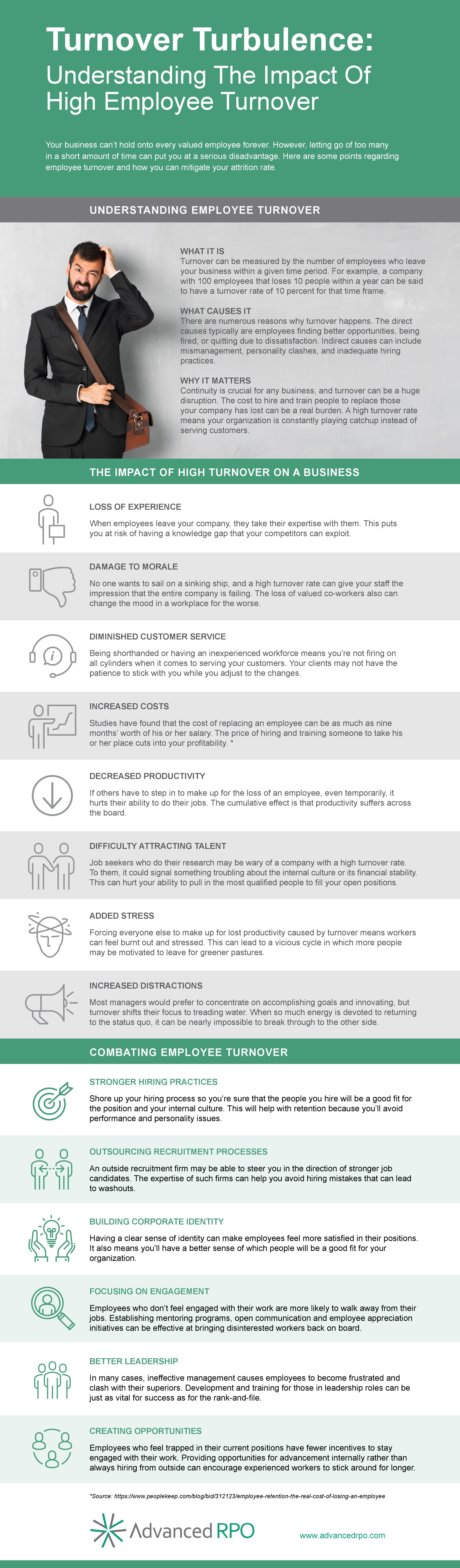
Retaining top talent is a priority for every organization. As a business leader or entrepreneur, high turnover can have a significant effect on your company’s everyday operations and profitability.
Turnover can stem from many reasons, including poor leadership skills, weak corporate culture, inadequate hiring practices and lack of career advancement. If you want to retain a valued workforce, read on to learn about the impacts of high turnover on a company and how you can combat it with the proper business strategies.
When employees are constantly coming and going, remaining workers can get distracted from your company’s mission and may not work productively to meet important goals. This can affect team dynamics in the office and the effectiveness of work.
Production could be delayed or even come to a standstill, especially if key employees quit without notice. The quality of your products and services can suffer as a result, which can lead to customer satisfaction issues.
It can be costly when you have to replace employees frequently, especially those who have the most experience. Your company can take a serious hit from the costs of recruiting, interviewing, onboarding, and training possible replacements. On average, it costs about $17,000 to replace an employee who is making median wage in the U.S.
Leadership
One way to counteract turnover rates in your workplace is with better leadership. Providing managers with training for setting effective goals, giving feedback, and recognizing and rewarding employees can help retain valuable staff.
When leaders are personable, communicative and qualified to lead, they provide positive work environments, which can lead to a more motivated and productive workforce. Effective leadership also can help employees feel valued and that their job matters to the company.
For more information on how turnover can impact your business and how you can rectify it, take a look at the accompanying infographic.
— Pam Verhoff is President of Advanced RPO, a talent acquisition company in Chicago, IL. Verhoff has extensive experience in building RPO businesses and solutions, as well as developing growth strategy.

- Posted 3.28.20 at 04:33 am by Roy Osing
- Permalink