



Roy's Blog: Business Success
March 21, 2020
6 tips for making your cafe business successful

Photo by Petr Sevcovic on Unsplash
Being successful in the café business requires a lot of investment, effort, and the right decisions. Without investing, you can’t have the appropriate products and equipment. And also, without excellent decision-making and effort, your customers won’t visit your place more than once.
Therefore, doing the right things from the early days of your business is mandatory for reaching the top. In this article, we will show you six vital tips for making your café business more successful.
Find a good business lawyer and accountant
Having an excellent business lawyer by your side to check your contracts and business agreements is mandatory. If you didn’t hire the right person in the early days of your café business, do it now – it is never too late to start doing things in the right way when it comes to legal stuff.
After that, once your business grows, it would be smart to hire an experienced accountant or bookkeeper. There will always be a lot of annoying work with paperwork, and it is always better to save your time and hire a professional to do it for you. Having a lawyer and accountant will make your business more secure.
Location is everything

Finding the right place is one of the most important tasks before starting your café business. Location is the first precondition for success. Among all the factors that you should consider when choosing the place, visibility is the most crucial. Your location has to be visible, preferably on a busy street. Anyone who struggles to find your shop will just sit in another one.
Also, it should be close to either college, business complex, or some city institution. You want to create loyal customers that come every day (even multiple times), and it is only possible if they spend a lot of time close to your location. But, keep in mind your budget limitations – a better place usually means more money at the start. However, you will still profit in the long run.
Everything is easy with the proper equipment
Delivering quality coffee, cookies, and other products is impossible without the best equipment. First of all, you need an adequate POS system for a cafe that contains every feature and option that your business requires. Also, you need basic stuff, such as espresso machines, freezers, blenders, drip coffeemakers, and much more.
Once you grow your business, start buying other tools and equipment that might make a difference. Storage and shelving systems should be on your priority list as well since you can’t operate your business well in a mess. And finally, think about your security and consider implementing an advanced security system.
A variety of products

Photo by Toa Heftiba on Unsplash
To create a successful café business, you need a fantastic atmosphere and a wide range of products. Serving only a few espresso and tea variations won’t attract too many people nowadays, even if you possess the best location.
Many customers will have some special requests, which you should fulfill in order to keep them in your café. Besides coffee and tea, it is vital to have a few excellent snacks and pastries on your menu. If it is possible, bake some cookies in-house since customers love to taste authentic food.
Expanding your food menu as much as possible can differentiate your cafe from the competition. It is a battle you have to win if you want to stay on the top in your business. However, don’t offer too much because you can end up with a substantial waste. Focus on products that your most loyal customers enjoy regularly.
A pleasant customer service
Developing a successful café with an excellent reputation is impossible without a great team of employees with a strong work ethic. They are the ones who speak to your customers and create a positive atmosphere. In other words, they are the mirror of your café business. On top of that, many people decide to come back to your place only because of a few pleasant employees.
That fact alone is enough to understand how crucial it is to have a great team. Besides that, you should opt for either counter or table service. Counter service minimizes labor costs, and it is better for busy periods, while table service is slower but much more beneficial if customers spend more time in your place.
Implement a loyalty program
Who doesn’t like a free coffee or a cookie? Implementing a loyalty program is a common strategy, especially for cafés, snack bars, etc. To put it simply – it encourages customers to come to your place more often (every day, preferably). For instance, you can offer a free coffee after five, eight, or ten orders. However, your competitors might apply the same strategy, so be aware. Become a spy, and see if they are doing the same thing as you, or even something better.
In that case, try to change your loyalty program to look more appealing to your customers. In the end, keep in mind that loyalty cards are great for promotion. Hence, print your logo and brand message on it, and make it suitable for wallets.
In the end, it is worth mentioning that love towards coffee is almost equally important as all other business aspects that we mentioned. It is practically impossible to be successful in this business without loving the pleasant taste of this drink. Coffee is love!
— Luke Douglas is a fitness and health blogger at Ripped.me and a great fan of the gym and a healthy diet. He follows the trends in fitness, gym and healthy life and loves to share his knowledge through useful and informative articles.

- Posted 3.21.20 at 05:29 am by Roy Osing
- Permalink
March 9, 2020
4 great ways to be different and easily beat your ruthless competitors

Source: Pexels
4 great ways to be different and easily beat your ruthless competitors.
If you’re looking to be unmatched in the marketplace, follow these simple proven tactics…
1. Be relevant and unique — in the business plan for your organization.
Dumb your strategic game plan down and answer the three fundamental questions to capture the essence of what you have to do to WIN. Create your ONLY statement around requirements that both matter to your target customers and which you and only you provide.
And, focus on execution recognizing that a plan that can’t be implemented is worthless.
2. Be holistic in your approach to customer opportunities — to create value in your marketing function.
Provide value-based packages for your chosen customer groups based on a customer learning competency your organization adopts.
Look at the total customer in terms of their broad attributes and requirements and not a thin slice of their product needs. Discover the secrets of your customers and use them as the driver of your marketing strategy.
3. Be dazzling — in how you serve your customers.
Treat creating memorable customer experiences as a critical priority. Vary how you treat your customers to enhance their loyalty.
Adopt the elements of a dazzling service experience plan:
▪️hire human being lovers
▪️empower frontliners to say yes
▪️kill dumb rules that make no sense to your customers
▪️ recover from your service blunders — fix the problem and do the unexpected by leveraging the customer secrets you have discovered.
4. Be intimate — in your sales strategy building strong relationships with your customers.
Avoid product flogging that does nothing to generate loyalty and makes you the same as everyone else. Strong deep relationships encourage your customers to buy stuff over the long term; product flogging is short term thinking at best.
There you have it, the essential elements of establishing a winning strategy and healthy culture in your organization.
Cheers,
Roy
Check out my BE DiFFERENT or be dead Book Series
- Posted 3.9.20 at 07:46 am by Roy Osing
- Permalink
February 24, 2020
6 simple ways ‘CRAP’ can be cut from your organization

Source: Pexels
6 simple ways ‘CRAP’ can be cut from your organization.
The world is a noisy and cluttered place to live; so many choices and so many people exercising them.
Resources available are scarce and limited but demand continues to grow.
How can organizations — and governments for that matter — achieve their growth objectives with limits on the available time and money necessary to achieve them? And in some cases, not just holding the line on resources but reducing their availability?
Obviously productivity gains will offset the need to add some resources.
If the organization can realize a 10% increase in productivity, and growth requires a 5% increase in operations expenses, growth goals can be more than achieved assuming the targeted productivity savings are realized and are allocated to growth projects — spending productivity gains elsewhere is a waste and results in added costs being necessary.
But there are limits on how much should be mined out of expenses from productivity to fund growth.
Doing things more efficiently has its limits and it’s trade offs
Changing operational processes to drive cost out can impact customer service.
Costs of a re-engineered process might decrease but customers could be dissatisfied with the resulting way they have to engage with the organization — it’s less customer friendly.
And they express their dissatisfaction by buying less or by moving to another supplier.
Outsourcing call centers to remote regions of the world, for example, may reduce costs but could also reduce customer loyalty due to the new experience that customers have to endure.
And of course when productivity benefits are calculated, the opportunity costs associated with impaired service and lost revenue are rarely part of the analysis.
In my experience, the bigger play is not to focus on how to do things right — seek more efficiency — but rather to do the right things — be more effective.
Effectiveness is achieved when the right set of new programs is selected and is flawlessly executed to achieve the long term strategic intent of the organization.
Effectiveness is not just deciding on the new things you need to do
A huge part of effectiveness is not what additional to take on, but what you decide to give up — the current activities in motion you decide to stop.
It’s forced obsolescence — productivity applied on a macro scale (large projects or blocks of activity) as opposed to eliminating smaller pieces of the operations (a call center or product fulfillment process).
Forced obsolescence — cut the CRAP — is consciously eliminating yesterday’s relevance for tomorrow’s necessity.
Examples of forced obsolescence initiatives could include marketing programs established in the past to enhance a product line that are no longer in the crosshairs of the strategy. Or a planned HR system built to support acquiring skills and competencies that are no longer considered essential.
This is my step-by-step process to force obsolescence out.
1. Assign a senior champion
Appoint a respected and trusted senior person with a high tolerance for ‘pain’ and whose compensation is based on how much savings is actually realized by the cut the crap activity.
Avoid the mistake that most organizations make by assigning a mid level manager to the task. This communicates that forcing obsolescence out isn’t really all that important and like many other corporate programs, “it too shall pass”.
2. Take inventory
Inventory all current initiatives in the organization. It’s important that the list be complete in order to capture all of the activity consuming resources. I suggest that you set an annual expense threshold — say, $100K — and identify only activity that exceeds this amount.
The point is to isolate activity that consumes a material amount of resources and a threshold criteria is a meaningful way of doing it.
>3. Create a ‘keep’ list
Create a list of those initiatives that should remain because they all directly support the organization’s strategy.
Make keep list short, as there is a tendency to try and justify everything that is currently going on as vital to the future of the company.
This, of course, is hogwash and is merely an attempt for people to protect their position in the organization. If you end up with 100 major initiatives on the list, walk away. You are wasting your time.
4. Create a ‘cut’ list
Create a list of yesterday’s work that is no longer needed because it is not relevant to the strategy the organization has chosen.
Make the cut list long; make it tough to keep doing activities of yesterday.
As a guideline, you should have at least 3 cut activities for every keep activity; on a threshold of $100K that means you are cutting $300K in expenses for every $100K you keep — a 3:1 payback; not a bad place to start.
5. Finalize keep and cut lists
With both lists in hand, the senior leader must present and get input on both lists throughout the organization to get as much buy-in as possible.
Forced obsolescence will never get 100% support so don’t bother fretting over it. This is a challenging step as no one wants to give up what they’re doing. They have too much emotional equity in what they’re busy with.
So debate and listen then make the call on what needs to stay and what needs to go.
6. Prepare the CRAP execution plan
Develop a 6 month action plan to execute the cut list initiatives. Include firming up the annual savings and the organizational units that will realize them.
THE key step — close the loop by reducing their operating expense budgets and place savings in a special account that can be used to fund new initiatives.
This fund should be available to anyone responsible for introducing a new strategic program that is a priority.
And beware of those who possess the CRAP.
These ‘custodians of the past’ are people who are comfortable handling past activities; they enjoy them and they don’t want to change.
They are managers of irrelevance and are critical to the CRAP elimination process. If they are permitted to continue to do their thing they will infect others in your organization and prevent them from taking on the new direction.
Identify these folks and manage them: either reassign them or, if they are unwilling to move to the future, exit them with dignity from your organization.
Cut the CRAP will save the world. If we don’t expunge today’s unproductive and wasteful activity, we won’t have the resources to take on the new initiatives necessary to advance organizations and societies.
Taken to its ultimate conclusion, the obsolete will rob the world of growth and limit our possibilities.
Cheers,
Roy
Check out my BE DiFFERENT or be dead Book Series
- Posted 2.24.20 at 06:33 am by Roy Osing
- Permalink
February 22, 2020
10 simple business lessons from women leaders in beauty
10 simple business lessons from women leaders in beauty.
The beauty industry isn’t the same anymore.
Marketing in beauty and cosmetics is constantly changing. It went from advertisements typically appearing on traditional media like billboards and newspapers, to now, influencer marketing.
The multi-billion-dollar beauty industry that has been created into what it is today, due to several revolutionary women.
From Elizabeth Arden to Kylie Jenner, the principles established in the past still remain consistent in new beauty companies.
The team at FragranceX has created a list of impactful women in the beauty industry, and from that, here are a few women that changed the game:
Elizabeth Arden
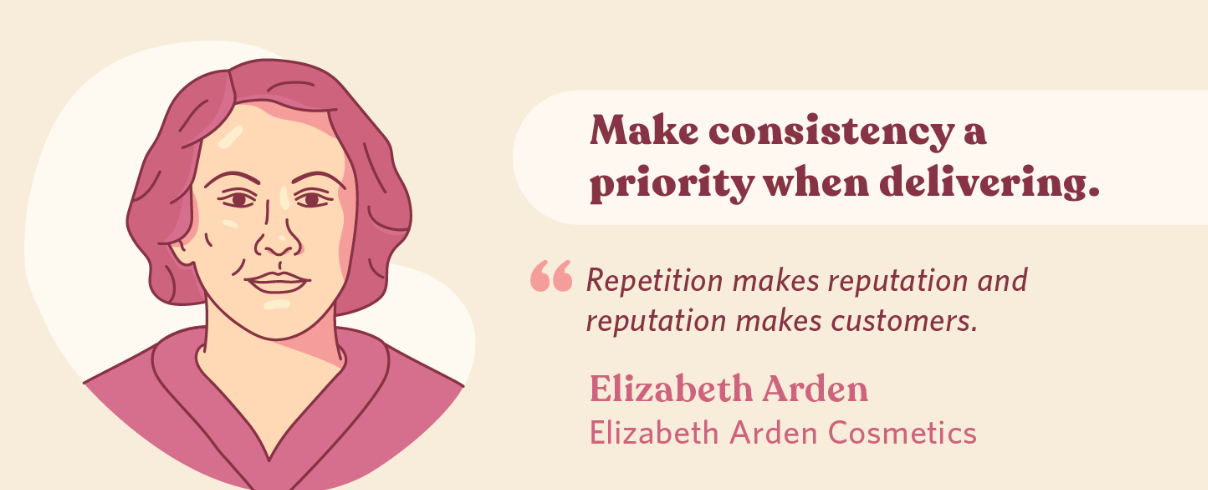
Elizabeth Arden started her business in the early 1900s and believed in the idea that familiarity is key. Her line hosts a wide range of products from anti-aging cream, moisturizing lipstick, and her famous red door perfume.
Her success comes from the idea that repetition and frequency allow people to be familiar with your brand, leading to trustworthiness. It’s the “oh, I’ve heard of that brand!” concept. The more you engrave something into the consumer’s mind, the better.
Kylie Jenner

Kylie Jenner is not only a business owner but a celebrity as well. With the rise of social media and more ways to be vocal, she discusses the scrutiny she has faced. As long as you push through the negative and focus on the people who are supportive, you and your brand will flourish.
The beauty industry is constantly evolving, as well as the marketing tactics that come along with it. It would be impossible to list out every powerful woman in the field, but the image below highlights some revolutionary women that should be noted.
— Leanna Serras is the in-house writer and perfume expert at FragranceX. She has extensive experience writing for a variety of subjects including fragrance, beauty, skincare and wellness. In her free time she enjoys taking on DIY projects and spending time with her pets.

- Posted 2.22.20 at 06:33 am by Roy Osing
- Permalink