



Roy's Blog: Guest Posts
August 8, 2020
6 brand-building strategies startups can use to compete with big brands
Source: Pexels
6 brand-building strategies startups can use to compete with big brands.
For every successful startup, there are at least a dozen that don’t see the light of the day. Many startups fail, not because of their intentions or the quality of their product, but because they couldn’t build a brand and set themselves apart from the competition.
Brand building is an integral part of business development and growth. Establishing a brand is challenging, even when you have ample resources at your disposal. It is more challenging for startups since they are new players in the market and often face budget and time constraints.
Being at a growing phase, startups struggle to compete with the business giants that have already established themselves as a brand. In such scenarios, you should be familiar with the right branding tactics to maximize your popularity among customers as a startup.
In this blog, we’ll explore essential brand-building strategies that will not only help you get started but also compete with the big brands in your niche. But before we dive into the nitty-gritty of branding, let’s define what we mean by brand building.
What is brand building?
Brand building is the process of promoting products or services of a business to consumers. The goal is to create a positive, unique, and lasting image of your business in the marketplace.
Creating a memorable impression and maintaining it over time can be a demanding task. However, a positive image is something that startups can’t afford to overlook because it provides a basis for all your communications, marketing, and promotional campaigns.
To help you start on the right foot, here are a few brand-building strategies that you can adopt to grow your startup in a saturated marketplace.
Brand building begins with a good name
Brand name plays a key role in what customers will think of the business. Unfortunately, many people rush to give their business a title and end up with terrible brand names. Take your time and choose a name that is easy to pronounce and makes sense.
It is said that you have 7 seconds to make a good first impression. If the consumers spend that seven-second window only to pronounce and understand your name correctly, then you are not on the right track. Therefore, choose an easy name that is relevant to your brand and clearly conveys the brand’s message.
Differentiate yourself
You may have a brilliant business idea and product concept; there is a good chance that someone else already has a similar product in the market. You need to research the marketplace and identify how your brand will stand out from your competitors.
Offer a unique value proposition and position yourself in a way that the users can see the advantage that your brands have over your competitors.
For startups, it can be the only way to survive and compete with established brands. Look for ways to be different no matter small or insignificant the difference might seem.
Create a visual identity
A startup’s visual identity goes a long way in the branding process. There are many factors that go into a visual identity, including the brand’s logo, the images posted on the web pages, fonts, textures, and the color scheme used across the media. Come up with a professional logo design and create photos that clearly and accurately represent your brand.
Since you will be working on a range of different platforms to build a visual identity, make sure that the communication remains consistent across all the touchpoints where potential customers will encounter the brand. This will ensure that you convey the right values and be perceived the way you want and not the other way around. A good way to achieve consistency in branding is by creating a written document that will govern your branding and style guidelines.
Build your social media presence
The importance of social media presence cannot be emphasized enough for brand building. Social media can be a powerful tool to gain exposure and reach your relevant audience. Think of LinkedIn, Facebook, Twitter, and Instagram to create a voice for your brand.
Research your target market and identify the platforms that your target audience actively uses. Once you identify the best platforms, it is time to create a company profile and utilize the power of the platform. Make sure that the pictures and cover photos you use match the brand’s visual identity.
To keep things simple, use the same logo and images you use on your website. Additionally, be consistent in communication and use language that accurately conveys the brand’s message in every post.
Utilize the power personalization
Tailoring your brand to your customers’ individual needs can have a massive impact on your brand building campaign. Personalization will, however, require extensive research of the market so that you can identify user’s interests and what makes them more likely to purchase a product.
Encourage users to interact with your brand and tailor the experience based on their interaction with the brand. Top brands always try to improve personalization and build products that meet customers’ needs and preferences.
Tell a story
When you look at the successful brands today, they all have a cult following based on their stories. For years, parents, teachers, and politicians have understood the power of stories, and you can utilize the same power in your brand-building efforts.
Share where your company comes from, and what inspired you to create the product that you currently offer. The deeper you dig into your brand’s background, the more you will understand your motivation, values, and purpose.
Wrapping up
Brand-building plays a vital role in a startup’s success. It will stand you apart from the competitors and help you build a lasting image in the marketplace. The above strategies will not only help startups with the process of brand building but also pave their way for long-term success. You only need to be clear about them and the way you will implement them.
— Alma Causey is a mother, wife, logophile and a professional blogger by choice. She has completed her masters in English literature from the University of Groningen. With her unique approach towards content marketing, she brings worth a second read blogs to life. Oh, Alma is incomplete without cats. Find her on Twitter: @Almacausey. And you can check out some of her past work at Muckrack.

- Posted 8.8.20 at 06:00 am by Roy Osing
- Permalink
August 1, 2020
Advertising during COVID-19: what you should and shouldn’t do
Source: Pexels
Advertising during COVID-19: what you should and shouldn’t do.
Half of 2020 has gone by, and for many parts of the world, there’s still no sign of COVID-19 going away. It has left people no choice but to adapt to the “new normal.”
Today, businesses have three choices - to pause and wait until this all passes, shut down for good, or take the challenge in stride. Some brands have had no choice but to go for either of the first two. Of course, there are still those who are fighting to keep their businesses afloat.
If you belong to the latter, whether you’re the owner of a small or big business or a marketing professional, you know that one of the areas that you need to focus on is your advertising.
Advertising or marketing a brand during the COVID-19 pandemic is tricky. It is unprecedented, so there’s no rule book that you can refer to that can tell you exactly what to do and how things will turn out. That said, here are some helpful advertising “dos and don’ts” that you can apply during the pandemic to get you started on the right track.
Advertising DOs you should follow
◾️ Stay true to your brand values — If you want to create and maintain a real connection with your customers, you have to be authentic. And this has to be reflected in your messaging. If you want your brand to stay relevant during the present crisis, you have to let your audience see what you stand for and how you respond to the challenges.
For instance, BEHR, a paint company that stands for the importance of making people feel great in their homes has acknowledged the sudden shift of a lot of workers to a work from home setting. And they also understood that many people have homes that aren’t as camera-ready.
Their move of coming up with BEHR Your Background, which is a library of styled home backgrounds available for free, says a lot about what their brand values are and what they really are all about.
◾️ Revisit your creative juices regularly — Circumstances change rapidly even amidst the pandemic, this includes market trends and consumer behavior. For this reason, it’s wise to consistently reassess your creatives as well as your messaging to make sure that you stay relevant.
Ford has received positive attention when they swapped their existing ads for ones that feature the brand’s revised car payment relief program during the COVID-19 pandemic, along with subtle reminders of how the car company has stood by their customers in past disasters.
According to Kantar’s research, people are beginning to get tired of adverts with generic messaging that look and sound the same as many others. While there’s nothing wrong about doing your part in reminding people of the importance of staying home and observing safety precautions, you have to think of ways to be memorable, too.
Heinz’s “12 million breakfasts” campaign is an example of an outstanding creative and messaging that is effective in showing people that their brand is actually doing something and looking out for others during difficult times.

◾️ Examine your web analytics and segmentation and adapt your strategy — When the landscape is as unstable as it is currently, it is imperative that you don’t just listen to your audience but that you be attuned to them. You may have to segment your audience to make sure that people get the message that would resonate with them.
One way to do this is by monitoring your web analytics to see how customer behavior is changing and then segmenting your audience based on those shifts. Some of the things that you should pay attention to are changes in streaming behaviors, psychographics, and significant lifestyle changes, among others.
◾️ Find out what media channels your audience spends time on — As mentioned above, customer behavior has changed since the pandemic. It’s evident in a number of ways, including how people consume media. Aside from the increase in mobile video and gaming category, there has also been an increase in consumption of CTV during daytime on weekends that resulted in an auction volume rise for slots between 12 noon to 4 pm and 6 pm to 9 pm. Desktop video auction volume has also risen during the pandemic.
◾️ Go for the premium options — Given the uncertainty of the world’s situation right now, consumers are more careful and are very particular with credibility. According to Adobe and YouGov’s recent survey, consumers are more likely to support services and buy products with ads that are found on premium or paid content channels.
While there is nothing wrong with using user-generated content, the survey found that adverts found on premium channels were deemed 20% to 50% more credible compared to the former. This is something that you really want to think about, especially if you are considering using only user-generated content during this crisis.
Advertising DON’Ts you should remember
◾️ DON’T assume people’s content consumption hasn’t changed — You can’t and shouldn’t assume that there haven’t been any shifts in the way your audience is consuming content, especially because so many things have changed in their lives. For one, the movie and television industry has taken an indefinite pause. Most live sports have either been canceled or postponed. And the “new normal” set up of working from home has changed the way people spend their time with their screens at home, too.
Track these changes and refocus your advertising efforts based on the results you get. If you continue to assume that your audience’s content consumption is unchanging, you are at risk of losing a substantial portion of your audience.
◾️ DON’T hastily restrict placement of your ads on COVID content — As this crisis of epic proportions continues, there are brands that have been quick to pull out their regular pre-pandemic conceptualized ads. Perhaps it’s all about sensitivity and they’re thinking about what people would say if they have ads placed within pandemic-related content. You might want to think it through before following suit, though.
Know that with the incredible amount of coverage the pandemic has been getting, blocking your ads means you’ll lose the opportunity to connect with potential customers. If you are worried about what advertising on such content would do to your brand image, you’ll be relieved to know that Integral Ad Science’s recent report shows that 78 percent of people stated that their perception and sentiment towards general ads appearing near COVID-related content would likely stay unchanged.
◾️ DON’T carelessly share insensitive or panic-inducing ads — It’s a very sensitive time and people’s emotions are triggered easily by the littlest things. Make sure that your ads are evoking positive feelings and that they don’t come across as insensitive or fear-mongering.
This is especially important if your products or services are considered non-essentials. For instance, an ad for a fast food restaurant that features people eating-out together won’t be appropriate at a time when everybody is encouraged to stay home.
When revisiting your creatives, ask yourself if there’s an element in your ad that could possibly induce panic, misinform your audience, or appear insensitive? It’s a good idea to get the opinion of your customers and your team before you launch an ad campaign to know for sure that you’re not missing anything.
Coors Light, for example, made a good decision of pulling the plug on their March Madness ad that was supposed to feature their brew as “the Official Beer of Working Remotely.” While the message is not malicious at all, it could still appear to some as if the brand was making light of the situation that many of the workers and companies are facing now.
Hershey’s has made the same decision, too, regarding their ads that focused on human interaction that would seem inappropriate during the COVID-19 pandemic.
Final words
Everybody is in a state of worry today, wondering how they can improve conversion rates and keep their brands relevant in the time of COVID-19.
Hopefully, the “DOs and DON’Ts” can give you some insight on how your advertising strategy should look like during the pandemic and help you come up with campaigns that would resonate with your audience.
— Vincent Sevilla is a professional web designer and inbound strategist for HostingFacts. His goal? To innovate ideas, create good art, and to travel to all the best places in the Philippines. You can follow him on Twitter @easyvince

- Posted 8.1.20 at 06:47 am by Roy Osing
- Permalink
July 25, 2020
How an ‘Anti-Resume‘ can help you make an amazingly successful career

How an ‘Anti-Resume‘ can help you make an amazingly successful career.
How many times have we been told to focus on our successes whenever we hit an obstacle? There are probably millions of articles and quotes that tell us to keep our chin high, and to keep our eyes on the goal as we pick ourselves up to march forward.
But what if there is another way to work our way up; one that requires us to embrace and list down all our failures and rejections in life?
That’s exactly what playwright and award-winning author Monica Byrne did.
On the anti-resume that she published on her website in 2013, she mentioned that from all the submissions and applications that she made in her professional life, her success rate was only 3%. This means that she failed 97% of the time and if we look at the rejection rate at face value, the number can be disheartening. But for Monica, she used her failures to help propel her to success and even bag an award from The North Carolina Arts Council later on.
But how exactly does highlighting our failures help us in our careers and open our eyes to view success differently the way it did for Monica and the others who have followed suit?
What is an Anti-Resume?
An anti-resume is basically just a document where you list down and highlight all the failures and rejections you’ve encountered while trying to achieve your goals. This is not for the purpose of putting the companies who rejected you in a bad light, but rather for you to retrospect on, and gain strength and wisdom from.
How can an Anti-Resume help you become better?
While it may be uncomfortable to face our past failures head-on, changing how we look at them can ultimately help shift our perception of success and how we better react to situations in the future.
It is human nature to want to get better and succeed at what we do because we have this inherent need for acceptance or recognition. Gaining an achievement is like getting a dopamine shot which then drives us to work harder and get better because we need to be able to continue filling this need.
However, in job hunting and in our career life in general, not everything goes our way and it is normal that we encounter rejections as we work our way up the corporate ladder. As a matter of fact, we most likely will receive more rejections than acceptance in our entire lives.
These hiccups may set us back and cause us to feel frustrated simply because a need was unmet. However, it is important to learn how to process these failures from a more constructive perspective because doing so can have a big and positive impact in your career growth.
But it is possible to shift our mindset from automatically sweeping failures under a rug, to consciously seeking understanding of why and how they happened. This enables us to reflect on our skills, competencies, the approach that we use, and our career objectives as we move forward.
Transformative Learning
According to sociologist Jack Mezirow, adults can open themselves up to higher and deeper learning by changing their viewpoint or by developing a different way of understanding a certain ‘disorienting dilemma’ or a situation. Known as transformative learning theory, it uses obstacles or failures as opportunities to make way for more meaningful choices and better actions in the future.
Application of this theory in our career not only helps us understand our personal capabilities better, it also helps us identify our learning process as adults which is a very critical item when it comes to skills development.
Although this learning theory was developed and used to educate people in the past, it is now being adapted and used in workplaces today and is acknowledged as an effective way to develop employees.
Application of Transformative Learning in your career development
In a career setting, this ‘dilemma’ can either be a job loss, a rejection of application, or declined promotion requests, among many others. How many applications have you sent in that never got positive results? How many times have we hoped for a promotion only to watch it be given to someone else? And how many times have we shifted our career paths simply because the last one did not work out?
While it is tempting for us to brush these off as things of the past, they have the potential to become positive learning experiences for us if we take the time to identify the critical items. You can start by asking yourself meaningful questions like, “Why am I applying for this job?” Or “What is the purpose behind this work or action?” This way, you are reminded of your motivations and the reasons why you followed this career path in the first place, then use that as one of your guiding references when mapping out your future plans.
Another thing that you can do is to request feedback for the purpose of self-improvement. Why did you not get the job? Reach out to the recruiter and ask for feedback. While not everyone might respond, some companies do provide interview feedback when requested. Why did you not get the promotion you were hoping for? Find the right time and avenue to request a feedback session from your manager.

Look at situations like these as opportunities for you to identify your strengths, as well as your areas of improvement with the help of another pair of eyes. Reflect on the strategies you used to get to this stage and come up with better action plans that you can apply in the future for better results. Failure can be a great catalyst of learning and has the potential to be a great teacher when perceived and processed constructively.
Foster self development using the Anti-Resume
Transformational learning happens when you are able to internalize and reflect on the “dilemma” and then use this new understanding to guide your next steps. Here is how you can utilize an anti-resume to foster self-development and career growth.
▪️ Identify the disorienting ‘dilemma’ — You do this by listing down all past failures in your anti-resume. It does not matter how long or how short it is, the goal is to put everything you consider as ‘career fail’ into writing. You can either write them on paper, in a journal, or online, as long as you see them in print.
Keep in mind that in order to turn a failure around, it requires mental strength, positive perspective, and perseverance because you need to be able to talk about these challenging experiences without shame or guilt. You should be able to talk about them openly with pride knowing that those uncomfortable situations can push you into innovating yourself to become better at the things that you do.
▪️ Conduct a self-examination — Look at each item and acknowledge your feelings towards these so-called setbacks. Look for that cathartic release by taking full responsibility for your actions and their outcomes. This helps remove the stigma that you may feel about each one of them and this can help slowly change your perception towards these items as failures and to start seeing them as opportunities or new challenges that you can undertake.
▪️ Assess the situation — Once you have listed all of them down, try to identify the things that you did that led to that result and what you could have done differently, as well as different approaches that could have yielded a different result. Now this is not for self-blaming, but for you to have a clear view of the changes that need to be made in the future.
From there, you then identify your new course of actions based on this now clearer view of the situation. New action items can include application for new roles, different career path, or different approach towards job hunting such as adding your resume to LinkedIn or any career development.
▪️ Acquiring skills and method adjustments — Now that you have identified your new goals, take the time to acquire skills necessary and apply additional preparations which you think may help you achieve your new goals. This can be making effective changes to your resume, or brushing up on your interview skills. This can even be acquiring new knowledge by signing up for training and certifications related to your field. The goal is to become more equipped and better prepared for what’s ahead.
▪️ Testing out new action plans — You do this by moving forward with your job applications, new career path or whichever it is that you wish to pursue. With a better understanding of previous ‘fails’ and having done the necessary changes, you now put what you have learned into action by applying them in the new tasks at hand. Remember that there is no real learning until a skill has been put into practice.
▪️ Gaining confidence and mastery — You will soon realize that you are slowly becoming more competent in your new set of skills and with your new perspective in life as you move along your career path. This becomes your reality now. You become more open to changes and reflective as a person because by doing so, you know that your actions are guided by continuous conscious learning and adjustment.
▪️ Continue to grow — Learning does not end; continue to look at things as opportunities for you to learn and grow as a person and career-wise. Continue to be an advocate of learning and change because the more we learn, the better we get at adapting and in delivering what is expected of us and even more. This type of thinking permanently alters the way we conduct things for the better.
This process requires a lot of patience, critical thinking, and most of all, immediate meaningful actions for it to succeed. It can even mean that you will have to experience mental and emotional conflict within yourself as you come to terms with your authentic self-realizations, some of which may be a little hard to swallow and accept in the beginning.
This means that it must come from a place of sincere desire to improve, but once you allow these perspective transformations to happen, you will soon realize that it creates a positive environment; one that allows exponential growth when it comes to self-actualization and adaptability to the world around you.
Applying this can seem tasking and even out of the ordinary, but it can be an extremely powerful tool to incorporate in your career life.
How an Anti-Resume can help you redefine success
Because you now have a clearer view of the things that you had to overcome and you are aware of the changes that you had to make in order to get to where you are, even the smallest of success becomes a reason to celebrate and to continue pushing forward.
Highlighting failure can help you redefine success. Even the failures from the past are no longer seen negative, but instead viewed as building blocks to help you become a better version of yourself.
It also helps you value even the smallest progress. You will be able to see right through even when the results are not ideal because you are more focused on the fact that this allows you to have a better understanding on how to make it better in the future.
We need to see that the world is one big classroom, and that when building our careers, the sometimes uncertain steps on the career ladder can be the best place to learn and understand our limitations, our determination, and our ability to adapt and change for the better.
— Ann Hayes is a writer and a contributor to contentcampfire.com. She likes writing about job-searching and career-related topics in hopes to give a clear meaning to the journey of looking for work or changing careers.

- Posted 7.25.20 at 05:47 am by Roy Osing
- Permalink
July 18, 2020
How leadership expectations in the workplace are being redefined by Gen Z

How leadership expectations in the workplace are being redefined by Gen Z.
The distinction between and among generations is very evident in the workplace.
Generally speaking, the older the generation, the more traditional the work style is. For example, it may take a while for employees from the Boomer or Gen X demographic to adapt to new systems or tools due to either technical understanding or the reluctance to try something unfamiliar.
Gen Z-ers, on the other hand, are considered digital natives. Since they have been exposed to computers and the internet from the outset, they are naturally adept in using technology at work.
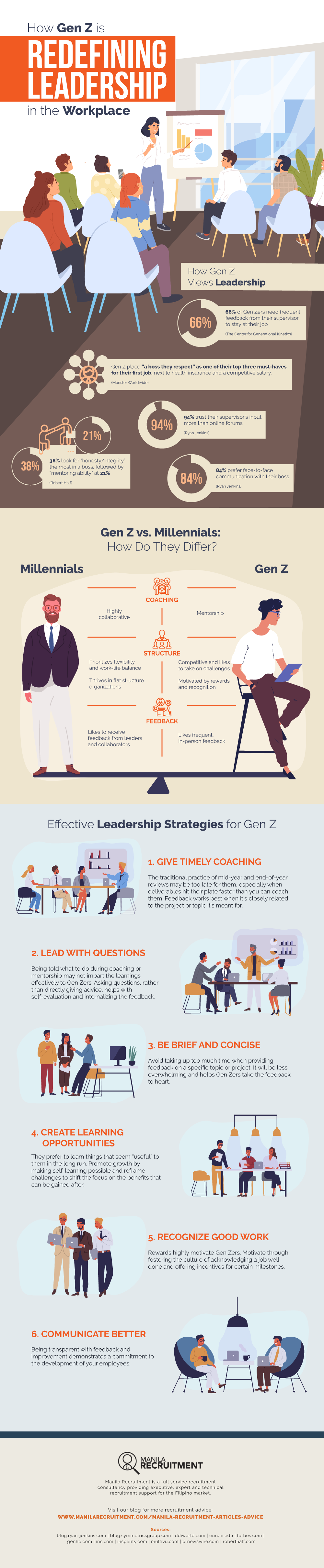
How Gen Z views leadership is also different from their older counterparts. Interestingly, Gen Z employees prefer to communicate with their managers face-to-face, even though there are many digital platforms designed for collaborative work.
Despite their technical abilities, they still value making personal and meaningful connections with people they work with.
Typical Gen Z-ers are also highly competitive individuals. They’re willing to get out of their comfort zone to learn something new or something completely different from their area of specialization. This can be beneficial not only for themselves but can also help you maximize their role in the team.
Many Gen Z employees also like sharing ideas that they think will help improve the workflow or processes within the organization. That said, Gen Z-ers want a leader who values their contributions to the company through a proper recognition and reward system.
Gen Z-ers are redefining the concept and values behind leadership in the workplace. Knowing their expectations and preferences in a leader can help as you try to engage your Gen Z employees.
For more insights and tips check out the infographic below.
— Valerie Chua is a Content Specialist at Manila Recruitment, a company providing headhunting solutions for the recruitment of executive, expert, technical and specialist positions in the Philippines.

- Posted 7.18.20 at 05:57 am by Roy Osing
- Permalink